

 Home
HomeDate: 2026-04-08
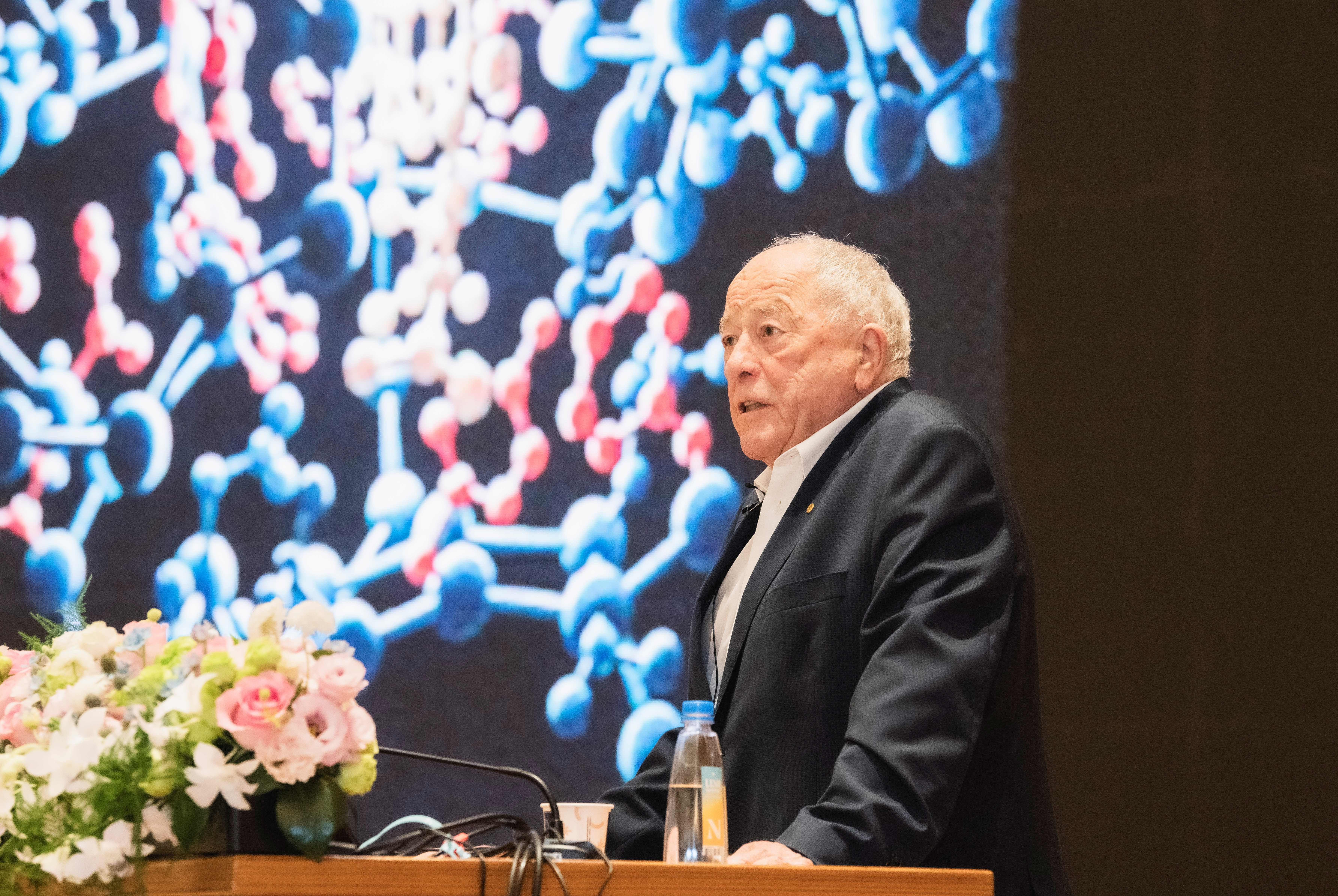
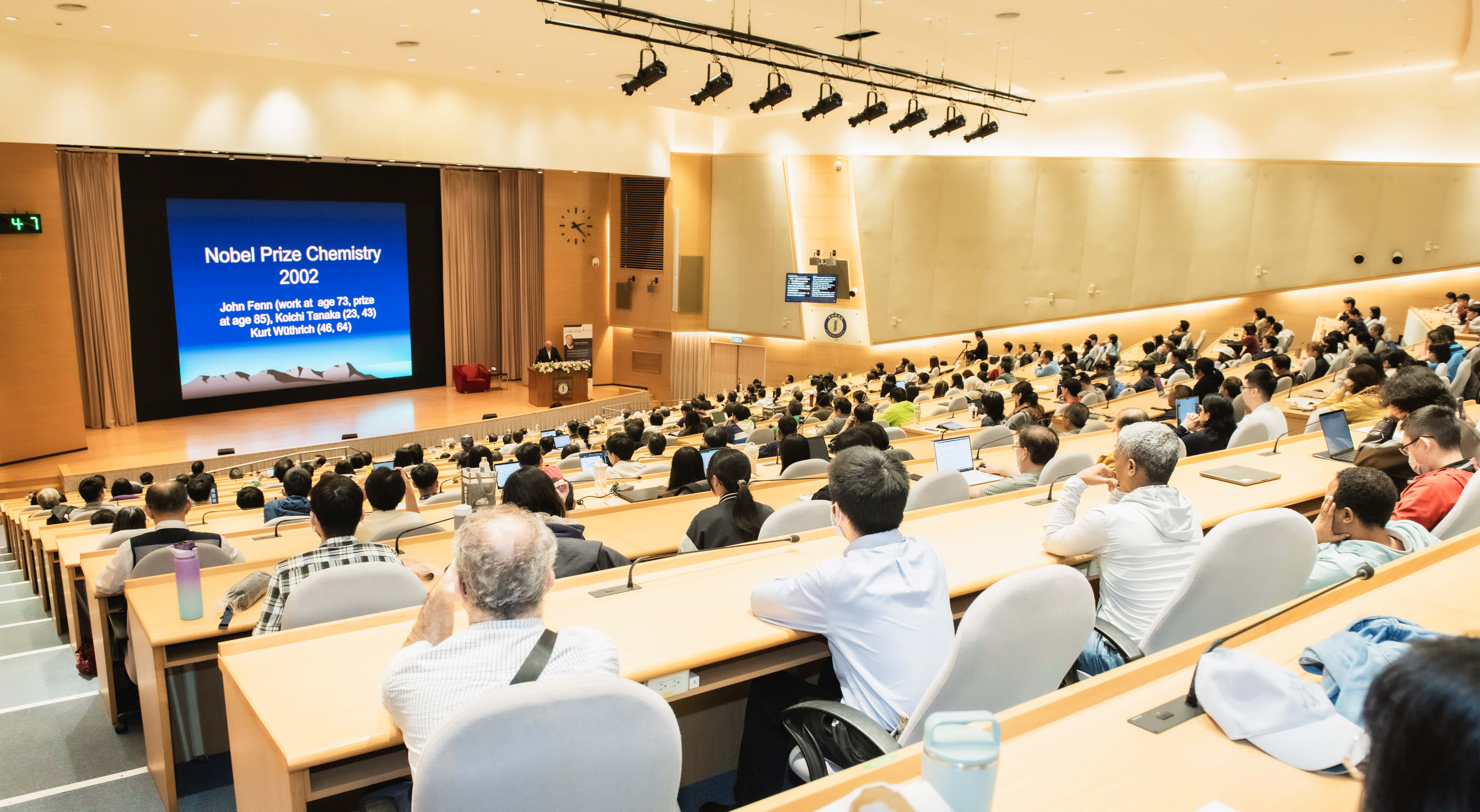
The ninth lecture in Academia Sinica’s TAIWAN BRIDGES program was held yesterday (April 7), featuring Professor Kurt Wüthrich, recipient of the 2002 Nobel Prize in Chemistry. In his lecture, titled “The Molecules of Life, AI and Human Health,” Professor Wüthrich shared the technological breakthroughs that enabled the use of nuclear magnetic resonance (NMR) to determine the structures of biological molecules, as well as the application of these advances in precision medicine. He also noted that amid the rapid rise of artificial intelligence (AI) and accelerating technological change, the ability to keep learning and adapting has become an essential quality. The event drew a full house, with more than 400 researchers and students in attendance.
In his opening remarks, President James C. Liao encouraged young students to boldly explore interdisciplinary possibilities by reflecting on Professor Wüthrich’s academic journey. Professor Wüthrich did not originally set out to become a scientist. During his university years, he studied both chemistry and sports science, while also devoting himself to competitive athletics, training intensely for more than 25 hours a week. Drawing on his athletic expertise, he once helped train researchers in swimming and physical conditioning, which gave him the opportunity to enter the laboratory and take part in research, gradually setting him on the path toward science. His background as an athlete also sparked his interest in how hemoglobin affects oxygen transport and athletic performance. At the time, comprehensive biological sample banks did not yet exist, so he used the hemoglobin in his own blood as research material—an experience that marked the beginning of his work on protein structure. After four decades of sustained dedication, Professor Wüthrich developed techniques for using NMR to determine the three-dimensional structures of proteins, allowing scientists to observe protein folding and conformational changes more precisely in liquid physiological environments that simulate human blood, gastric fluid, and other bodily conditions. For this groundbreaking work, he was awarded the 2002 Nobel Prize in Chemistry.
President Liao emphasized that our level of understanding of protein structure directly shapes our understanding of physiological processes and disease mechanisms. In view of the importance of protein structure, Academia Sinica’s core facilities include a High-Field NMR Center and cryo-electron microscopy (cryo-EM) platforms, which make key technologies and advanced equipment available to the wider research community, supported by dedicated technical teams that provide consultation and assistance. By integrating advanced instruments with specialized technical expertise, Academia Sinica not only strengthens the sharing of research resources, but also helps enhance Taiwan’s overall scientific development and fosters more comprehensive and in-depth research outcomes.
In his lecture, Professor Wüthrich systematically explained the functions and structures of biological macromolecules such as DNA, RNA, and proteins, emphasizing that in the microscopic biological world, structure determines function. Using a vivid analogy, he noted that if we cannot see the three-dimensional structure of a molecule, it is like trying to understand a complex machine in the dark—we cannot truly grasp how it works, nor can we make effective use of it. He also introduced the major methods currently used to resolve the three-dimensional structures of macromolecules, including X-ray crystallography, NMR, and cryo-EM, and explained how these approaches complement one another and have evolved over time. He noted that traditional X-ray crystallography requires proteins to be crystallized first, which makes it more difficult to capture their true state in physiological environments. By contrast, NMR can determine protein structures in solution and can also be applied to the structural and dynamic study of biochemical macromolecules such as DNA and RNA. NMR also plays an important role in drug development, helping scientists identify promising candidate molecules more efficiently and accelerating the early stages of drug screening.
Speaking on the wave of AI, Professor Wüthrich pointed out that artificial intelligence is transforming structural biology at an astonishing pace. Through AI-based protein structure prediction, results that once required years of experimentation can now be achieved far more quickly. While affirming the significance of technological advances, he stressed that human development and cultivation remain even more important. He encouraged young students not to limit themselves too early, but instead to think independently and adapt to changing environments. Only by continuously adjusting oneself, he said, can one avoid being left behind by the times. In a thoughtful concluding message, Professor Wüthrich remarked that the core mission of university education is to lay a foundation that can sustain students over the course of a 40- to 50-year career. It is not merely about teaching tools that will inevitably continue to evolve, but more importantly about cultivating the ability to keep learning and to reinvent oneself—qualities essential for thriving in the uncertainties of the 21st century.
The TAIWAN BRIDGES Program is a joint initiative led by Academia Sinica in collaboration with 11 domestic academic and research institutions and the International Peace Foundation. It is dedicated to fostering in-depth intellectual exchanges between Taiwan and top global scholars. Starting from November 2025, Academia Sinica will host more than ten Nobel Laureates over the course of one year, spanning the fields of peace, physics, chemistry, biomedicine, and literature. This program underscores Academia Sinica's continued commitment to strengthen international academic collaboration and advancing frontier research.
On April 23, Academia Sinica will also host Dr. Takaaki Kajita, recipient of the 2015 Nobel Prize in Physics, for a lecture titled “International Collaboration in Basic Science - From My Experience”. The public is warmly invited to register and attend.
Registration link: https://forms.gle/j8pXekBBhysdHSbG9
-
Ellen Lu, Section Chief,Department of International Affairs, Academia Sinica
(02) 2787-2688,phlu@as.edu.tw
-
Ms. Yi-ling Lee, Media & Public Affairs, Secretariat, Academia Sinica
(02) 2789-8820,cvcc54@as.edu.tw
-
Ms. Steffi Tung Lin, Media & Public Affairs, Secretariat, Academia Sinica
(02) 2789-8820,tunglin@as.edu.tw