

 Home
HomeDate: 2026-01-19
On January 16, Academia Sinica launched the third lecture of its TAIWAN BRIDGES series, welcoming 2012 Nobel Laureate in Physics, Dr. Serge Haroche, for a talk entitled “The Laser and Quantum Physics.” Drawing an audience of hundreds of faculty members and students, the lecture offered a compelling journey through a century of quantum physics, blending scientific rigor with intellectual elegance and inspiring lively exchange throughout the event.
In her remarks, Vice President Mei-Yin Chou noted that Dr. Serge Haroche’s pioneering contributions to quantum optics and cavity quantum electrodynamics (Cavity QED) resolved a century-old challenge in quantum mechanics—the difficulty of isolating and observing single quantum systems—and laid a foundational cornerstone for the advancement of modern quantum science and precision measurement.
Dr. Serge Haroche’s Nobel Prize–winning achievement lies in his development of groundbreaking experimental methods that enable the measurement and control of individual quantum systems. By overcoming the long-held limitation in quantum mechanics that measurement necessarily perturbs and destroys the system under observation, he devised a “photon trap” composed of ultra-high-reflectivity superconducting mirrors. This innovation made it possible to observe photons over extended periods without destroying them, ushering in a new era in which humanity can directly probe and interact with single quantum entities.
In this lucid and engaging lecture, Dr. Haroche unveiled the mysteries of the “photon box” through a series of rare and insightful experimental slides. He explained how the technique allows a single photon to bounce back and forth inside a superconducting cavity, surviving for up to 0.1 seconds. He further shared how scientists employ Rydberg atoms as probing “scouts,” passing through the cavity to perform non-destructive measurements without absorbing the photon. This achievement not only transformed Schrödinger’s cat from a thought experiment into an observable reality, but also laid a solid experimental foundation for the precision of modern atomic clocks and the development of quantum memory technologies.
The lecture was co-hosted by the Institute of Atomic and Molecular Sciences and the Institute of Physics at Academia Sinica. The moderator, Associate Research Fellow Yu-Ju Lin of the Institute of Atomic and Molecular Sciences, noted that Dr. Haroche traced the inseparable co-evolution of quantum physics and lasers. Beginning with the foundations of quantum theory laid by pioneers such as Planck, Einstein, and Schrödinger, Dr. Haroche explained how concepts including stimulated emission and two-level systems were realized in the invention of the laser, profoundly reshaping the landscape of modern physics. Dr. Lin emphasized that understanding the fundamental properties of light and matter is the driving engine of scientific breakthroughs. Dr. Haroche’s work demonstrates how lasers enable unprecedented precision in atomic clocks and allow the direct manipulation of individual quantum systems. Against the backdrop of today’s rapid advances in quantum technologies, lasers will remain an indispensable tool for exploring the frontiers of physics.
Beyond his outstanding academic achievements, Dr. Serge Haroche also displayed the optimism and wisdom of a seasoned scientist when responding to questions about the impact of artificial intelligence. He incisively remarked that AI, for humanity, is much like the laser for physics—a powerful tool that cannot replace the uniquely human capacities for creativity and understanding. He emphasized that fundamental science and applied technology are mutually reinforcing. Addressing young scholars, he reflected, “When I first embarked on research, I simply wanted to challenge what Schrödinger had called ‘impossible.’ The true charm of science lies in those unforeseen surprises.” This lecture was not only an intellectual feast, but also, at the dawn of a new quantum era, a profound infusion of scientific humanism.
The TAIWAN BRIDGES program is jointly organized by Academia Sinica, National Taiwan University, and ten other academic institutions in Taiwan, in collaboration with the International Peace Foundation. The initiative aims to foster deep exchanges between Taiwan and leading global scholars. From November 2025 through 2026, ten Nobel Laureates across the fields of peace, chemistry, physics, biomedicine, and literature will visit Academia Sinica. Through interdisciplinary and international dialogue, the program seeks to cultivate a broad and dynamic global platform for intellectual exchange.
The next TAIWAN BRIDGES lecture will be held on January 22, featuring Dr. Michel Mayor, laureate of the 2019 Nobel Prize in Physics, who will speak on “Is there a Planet B – Will humanity emigrate to an exoplanet?”
Registration link: https://forms.gle/zmjxTqWy8GwPsM3a8
-
Ellen Lu, Section Chief,Department of International Affairs, Academia Sinica
(02) 2787-2688,phlu@as.edu.tw
-
Stanley Lin,Acting Senior Executive Officer, Department of International Affairs, Central Administrative Office, Academia Sinica
(02) 2789-9446,lsd@gate.sinica.edu.tw
-
Ms. Savid Paljilji, Media & Public Affairs, Secretariat, Academia Sinica
(02) 2789-9727,savid@as.edu.tw
-
Ms. Steffi Tung Lin, Media & Public Affairs, Secretariat, Academia Sinica
(02) 2789-8820,tunglin@as.edu.tw
-
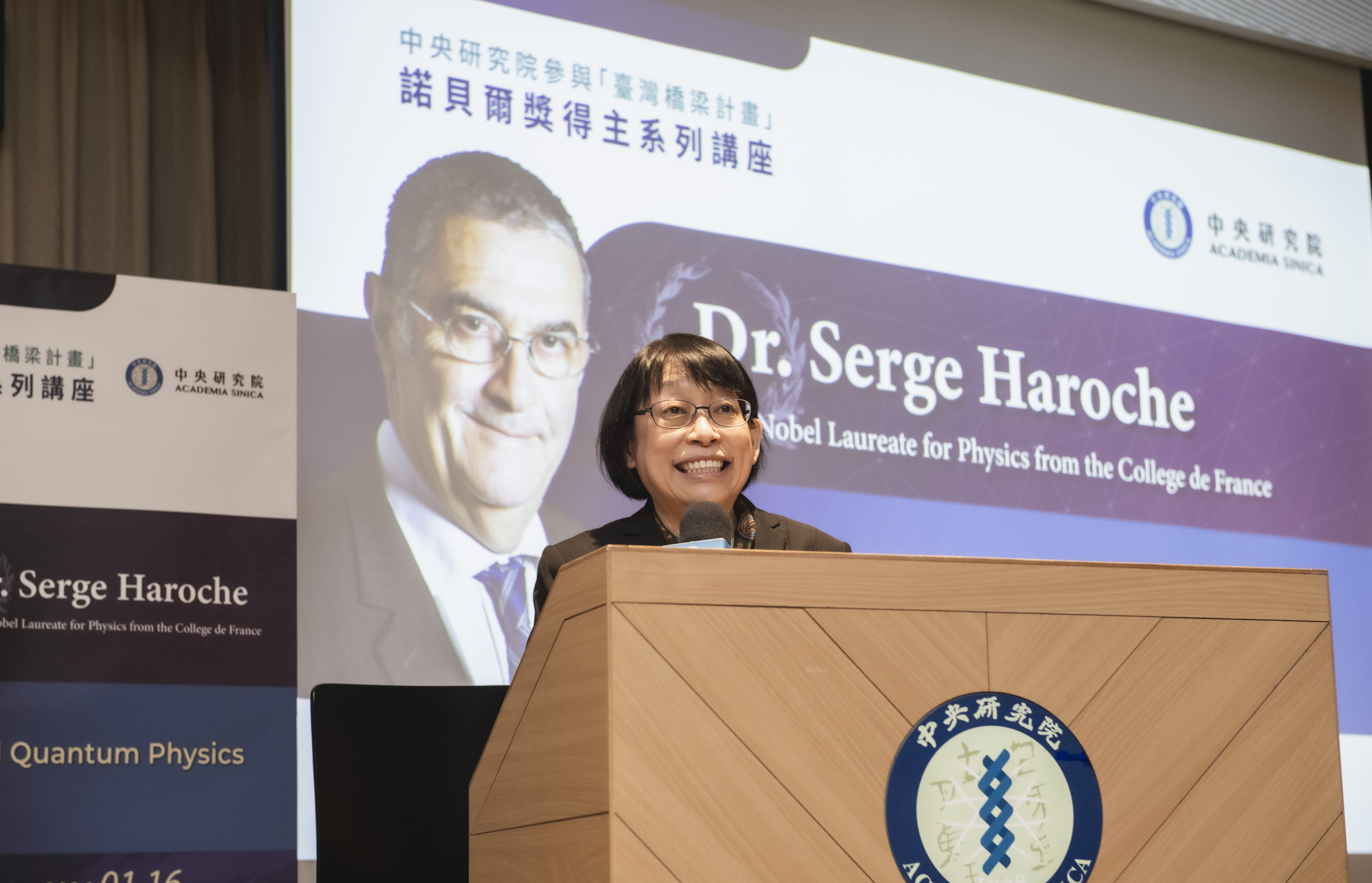 Academician Mei-Yin Chou, Vice President of Academia Sinica, delivered the opening remarks. Photo credit: Academia Sinica.

-
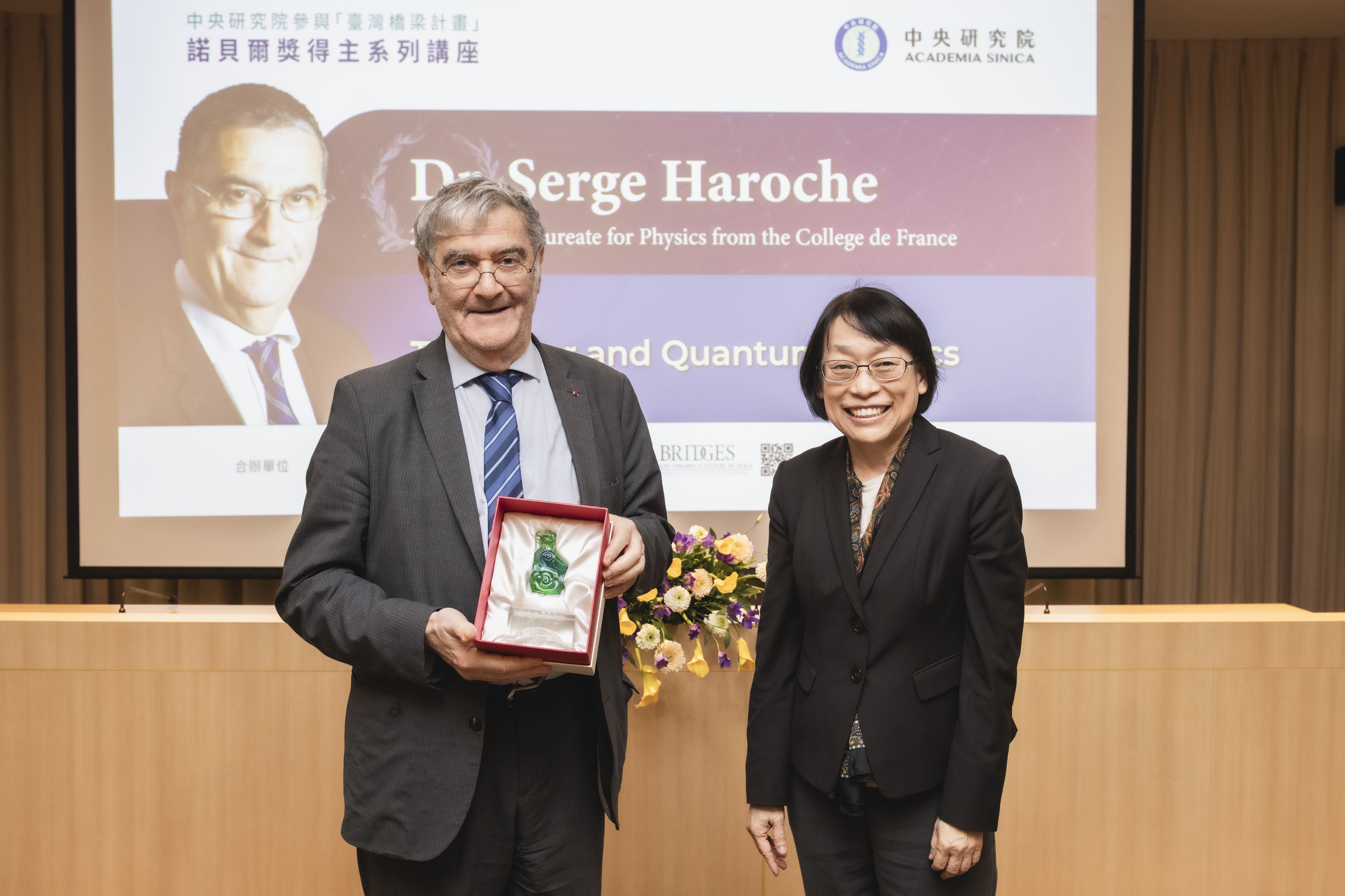 Vice President Mei-Yin Chou of Academia Sinica and Professor Serge Haroche. Photo credit: Academia Sinica.
-
 Professor Serge Haroche gives a lecture. Photo credit: Academia Sinica.
-
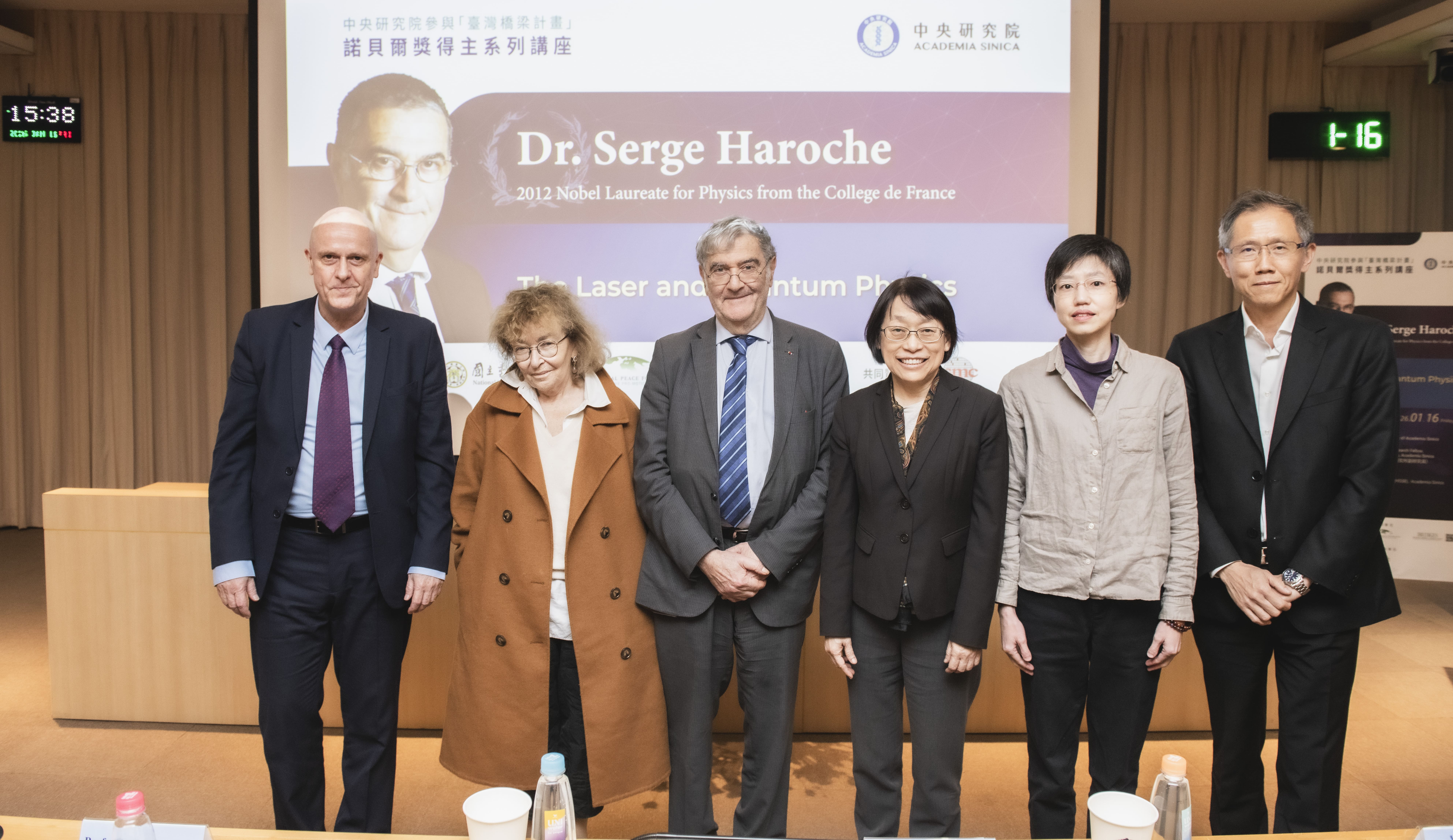 From left to right: Uwe Morawetz, Chairman of the International Peace Foundation; the wife of Professor Serge Haroche; Professor Serge Haroche; Mei-Yin Chou, Vice President of Academia Sinica; Yu-Ju Lin, Associate Research Fellow at the Institute of Atomic and Molecular Sciences, Academia Sinica; and Tzu-Ching Meng, Director of the Department of International Affairs, Academia Sinica. Photo credit: Academia Sinica.
-
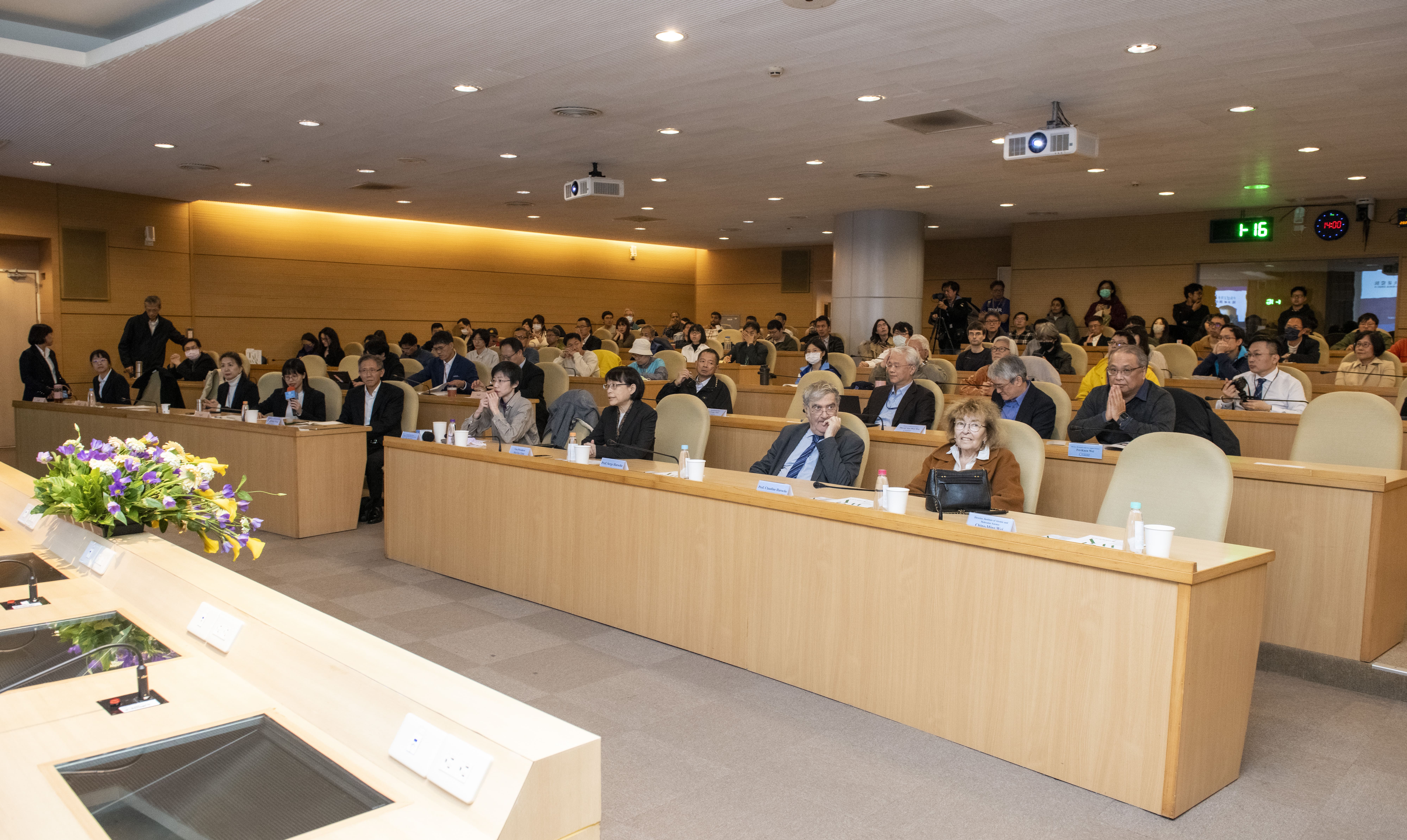 The lecture drew a full house. Photo credit: Academia Sinica.