



 Home
HomeDate: 2026-01-23
The fourth lecture of Academia Sinica’s TAIWAN BRIDGES series was held yesterday (the 22nd), featuring Dr. Michel Mayor, Nobel Laureate in Physics (2019) and Emeritus Professor at the University of Geneva. Dr. Mayor delivered a lecture entitled “Is There a Planet B – Will Humanity Emigrate to an Exoplanet?” The lecture attracted more than 500 participants and explored major questions that may seem imaginative yet are grounded in scientific evidence, including “Does life exist elsewhere in the universe?” and “Can humans migrate to a second Earth?”
In her opening remarks, Academia Sinica Vice President Mei-Yin Chou stated that humanity has harbored a strong curiosity about outer space since ancient times and has long sought ultimate answers to the question of “where humans come from.” In the past, such inquiries largely belonged to the realm of philosophy; however, the efforts of astronomers have pointed humanity toward scientific approaches. In 1995,
Dr. Mayor made the first discovery of an exoplanet orbiting a Sun-like star, which not only demonstrated that the solar system is not unique in the universe, but also suggested that the existence of other life forms in the universe is highly possible. This achievement earned him the Nobel Prize. Vice President Chou emphasized that Dr. Mayor’s perseverance and relentless pursuit of fundamental questions exemplify the finest spirit of contemporary academic research.
Dr. Ue-Li Pen, Distinguished Research Fellow and Director of the Institute of Astronomy and Astrophysics at Academia Sinica, also noted that observing exoplanets was once considered an impossible task—likened to “searching for a firefly next to a spotlight several kilometers away.” Dr. Mayor’s team overcame observational bottlenecks by employing high-precision radial velocity spectroscopy to detect extremely subtle changes in stellar motion, thereby confirming the existence of planets and fundamentally overturning previous views of the universe. This astronomical revolution has led scientists worldwide to devote substantial resources and innovative methods to searching for potentially life-bearing “Planet B” candidates amid the vast sea of stars.
During his lecture, Dr. Mayor reviewed developments over more than 30 years since the discovery of the first exoplanet, noting that more than 6,000 exoplanets have now been detected. Recent studies further indicate that the Milky Way may contain millions of rocky planets located within “habitable zones,” possessing physical environments capable of supporting liquid water and complex chemical reactions, thereby opening up possibilities for the emergence of life. Addressing the audience’s interest in human migration, Dr. Mayor stated frankly that although astronomical observations have shown that Earth-like planets are not rare, the extremely vast distances involved and current technological limitations mean that actual human migration remains unlikely in the foreseeable future. He emphasized that the most urgent task at present is to cherish and protect Earth—the only planet currently known to harbor life—while continuing to use scientific research to understand the nature of the universe and life itself.
Regarding the question “Does life exist elsewhere in the universe?”, Dr. Mayor noted that extraterrestrial life forms may not resemble humans and are more likely to exist in primitive forms such as bacteria or single-celled organisms. He emphasized that even the discovery of the simplest form of life would be sufficient to fundamentally alter humanity’s understanding of the origin of life and our place in the universe. As observational technologies continue to advance rapidly, scientists are now able to further analyze the atmospheric composition of exoplanets and detect water vapor, carbon dioxide, and specific biosignature signals, taking a critical step toward unraveling the mystery of life in the universe.
The TAIWAN BRIDGES program is jointly organized by Academia Sinica, multiple domestic academic and research institutions, and the International Peace Foundation, with the aim of fostering in-depth exchanges between Taiwan and leading scholars worldwide. From November 2025 to May 2026, Academia Sinica will host more than ten Nobel Laureates in Taiwan, spanning fields including peace, physics, chemistry, biomedicine, and literature, demonstrating Academia Sinica’s continued efforts to strengthen international academic collaboration and advance frontier research.
The next TAIWAN BRIDGES lecture will take place on February 5, 2026, featuring Dr. Sir Richard J. Roberts, Nobel Laureate in Physiology or Medicine (1993), who will deliver a lecture entitled “Why You Should Love GMOs?”
Registration link: https://forms.gle/BjD3R4tN5SYZe12K6
-
Ellen Lu, Section Chief,Department of International Affairs, Academia Sinica
(02) 2787-2688,phlu@as.edu.tw
-
Ms. Yi-ling Lee, Media & Public Affairs, Secretariat, Academia Sinica
(02) 2787-2717,cvcc54@as.edu.tw
-
Ms. Steffi Tung Lin, Media & Public Affairs, Secretariat, Academia Sinica
(02) 2789-8820,tunglin@as.edu.tw
-
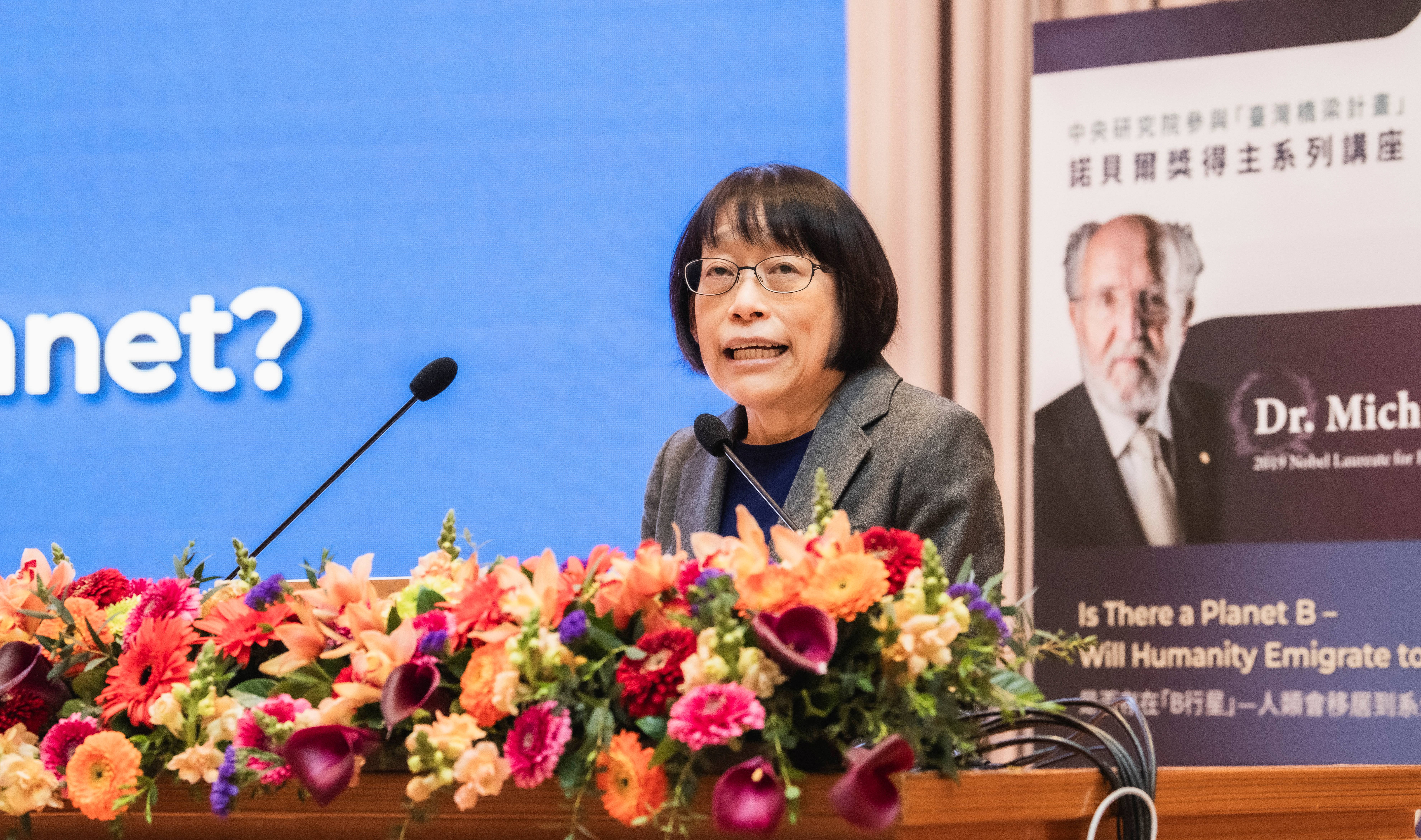 Academician Mei-Yin Chou, Vice President of Academia Sinica, delivered the opening remarks. Photo credit: Academia Sinica.

-
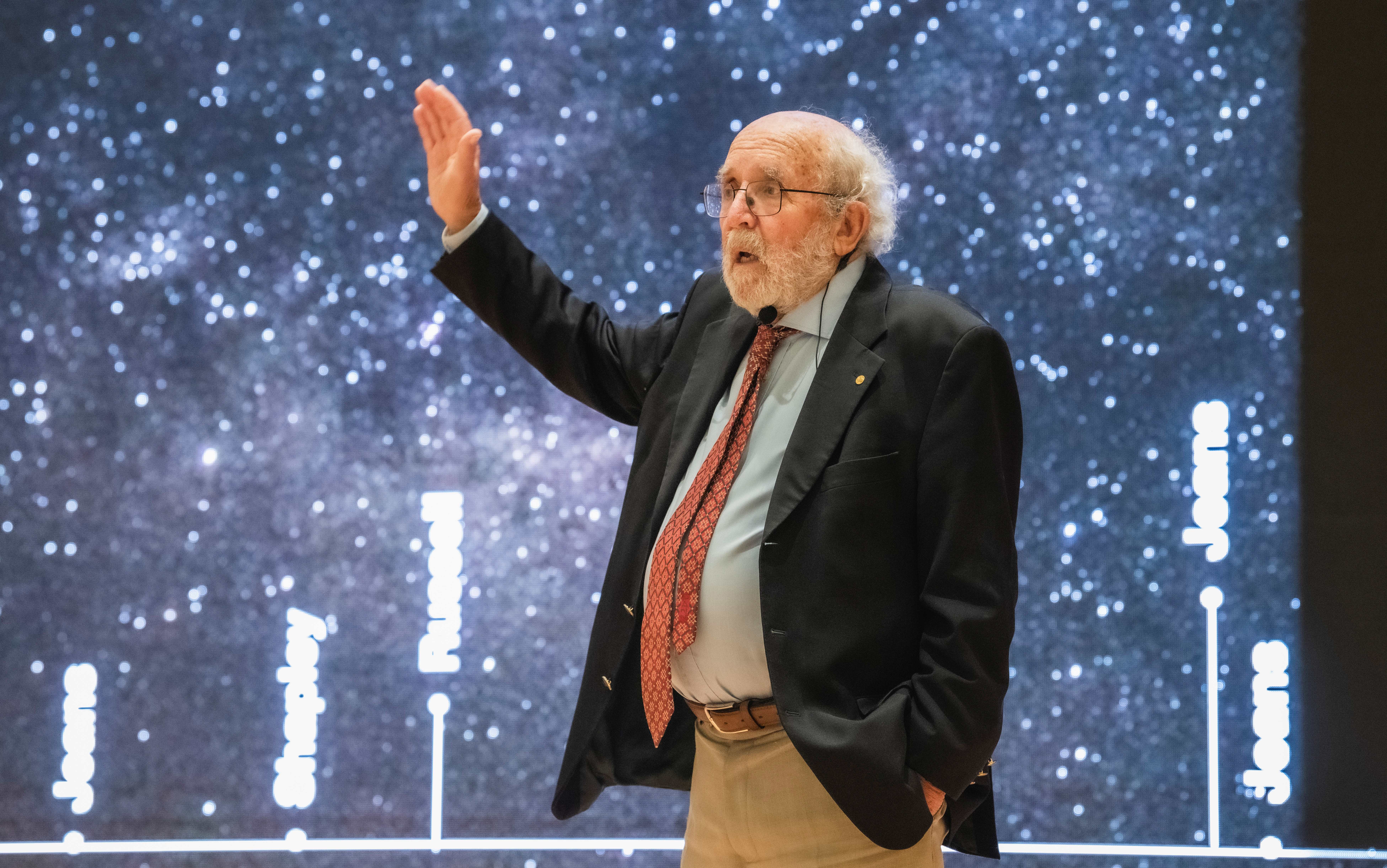 Dr. Michel Mayor gives a lecture. Photo credit: Academia Sinica.
-
 Dr. Michel Mayor gives a lecture. Photo credit: Academia Sinica.
-
 Vice President Mei-Yin Chou of Academia Sinica and Dr. Michel Mayor. Photo credit: Academia Sinica.
-
 From left to right: Academician Chien-Jen Chen ; Shin-Kun Peng, Vice President of Academia Sinica ; Uwe Morawetz, Chairman of the International Peace Foundation; Dr. Michel Mayor; Mei-Yin Chou, Vice President of Academia Sinica; Ue-Li Pen, Distinguished Research Fellow, the Institute of Astronomy and Astrophysics, Academia Sinica; and Tzu-Ching Meng, Director of the Department of International Affairs, Academia Sinica. Photo credit: Academia Sinica.
-
 The lecture drew a full house. Photo credit: Academia Sinica.