

 Home
HomeDate: 2026-02-12
Academia Sinica’s TAIWAN BRIDGES lecture series yesterday (Feb. 11) welcomed the 2001 Nobel Laureate in Physiology or Medicine, Dr. Sir Paul Nurse, who joined more than 400 researchers and students to explore a question that has guided his life’s work: What is Life? Beginning with the fundamental principles of biology, Sir Paul led the audience from the microscopic workings of cells to a broader understanding of how life functions, evolves, and interconnects, while encouraging reflection on humanity’s role and responsibility within Earth’s ecosystems.
In his opening remarks, Academia Sinica President James C. Liao described Sir Paul as one of the foremost figures in modern genetics and cell biology. Beyond his landmark scientific achievements, Sir Paul has played a sustained and influential role in international academic leadership and science policy. Over the past three decades, he has held pivotal positions in major global scientific organizations and currently serves as President of the United Kingdom’s premier academy, the Royal Society. Widely respected for his academic distinction, visionary leadership, and ability to bridge science, policy, and society, Sir Paul is the first individual in the Royal Society’s history to be elected President twice. President Liao noted that in recent years, Academia Sinica and the Royal Society have continued to foster exchanges and dialogue among researchers through reciprocal visits and bilateral meetings, and expressed his hope that substantive and close Taiwan–UK scientific collaboration will be further expanded during Sir Paul’s tenure.
Dr. Chih-Hao Lee, Director of the Genomics Research Center at Academia Sinica and moderator of the lecture, explained that Sir Paul was awarded the Nobel Prize discovering the key regulatory mechanisms governing the eukaryotic cell cycle. His pioneering identification of cyclin-dependent kinases (CDKs) not only fundamentally transformed our understanding of how cells proliferate and established the central framework of modern cell biology, but also provided critical theoretical foundations for elucidating the molecular mechanisms underlying tumor formation and for developing strategies in cancer therapy.
During the lecture, Sir Paul opened with a childhood memory of encountering a yellow butterfly in his garden. He recalled how that fleeting moment led him to realize that the butterfly, like himself, was a living being—capable of sensing its surroundings, responding in real time, and making instantaneous choices. What appeared to be an ordinary observation became the starting point of his lifelong inquiry into the question, “What is Life?” In clear and accessible terms, Sir Paul then outlined five fundamental concepts through which biology seeks to understand life: the Cell, the Gene, Life as Chemistry, Information Management, and Natural Selection. Together, these principles form the foundation of how living systems operate. He emphasized that the cell constitutes the basic structural unit of life, and that life is not merely a collection of chemical reactions, but a complex system sustained by the storage, processing, and regulation of information. All life on Earth, he noted, traces back to a common ancestor and continues to evolve and adapt through natural selection.
Sir Paul further observed that all life on Earth exists in forms that are profoundly interdependent, and that human beings are, to our current knowledge, the only species capable of consciously reflecting on the meaning of this shared existence. No organism exists in isolation; all are embedded within a vast ecological and evolutionary continuum. The more deeply we understand the principles that govern life, the more clearly we recognize the responsibility to protect it. At a time when climate change, global pandemics, biodiversity loss, and food insecurity present mounting challenges, understanding how life functions is no longer solely an academic pursuit—it is a critical foundation for addressing global crises. The lecture therefore extended beyond science, inviting the audience to reconsider the interconnectedness of living systems and to view life, and our place in the world, from a broader perspective.
The TAIWAN BRIDGES Program, jointly promoted by Academia Sinica, multiple leading domestic academic and research institutions, and the International Peace Foundation, aims to foster in-depth intellectual exchange between Taiwan and distinguished scholars from around the world. From November 2025 through July 2026, Academia Sinica will host more than ten Nobel laureates across the fields of peace, physics, chemistry, biomedicine, and literature. The initiative underscores Academia Sinica’s continued commitment to strengthening international academic collaboration and advancing frontier research.
On March 2, Academia Sinica will also host Dr. Sir Gregory Winter, recipient of the 2018 Nobel Prize in Chemistry, for a lecture titled “The antibody revolution.
Registration link: https://forms.gle/NsUpyfiodnVvC92A7
-
Ellen Lu, Section Chief,Department of International Affairs, Academia Sinica
(02) 2787-2688,phlu@as.edu.tw
-
Ms. Yi-ling Lee, Media & Public Affairs, Secretariat, Academia Sinica
(02) 2789-8820,cvcc54@as.edu.tw
-
Ms. Steffi Tung Lin, Media & Public Affairs, Secretariat, Academia Sinica
(02) 2789-8820,tunglin@as.edu.tw
-
 Sir Paul Nurse delivers a lecture titled “What Is Life?”. Photo credit: Academia Sinica.

-
 Academia Sinica President James C. Liao delivers remarks. Photo credit: Academia Sinica.
-
 Academia Sinica President James C. Liao and Sir Paul Nurse. Photo credit: Academia Sinica.
-
 Sir Paul Nurse. Photo credit: Academia Sinica.
-
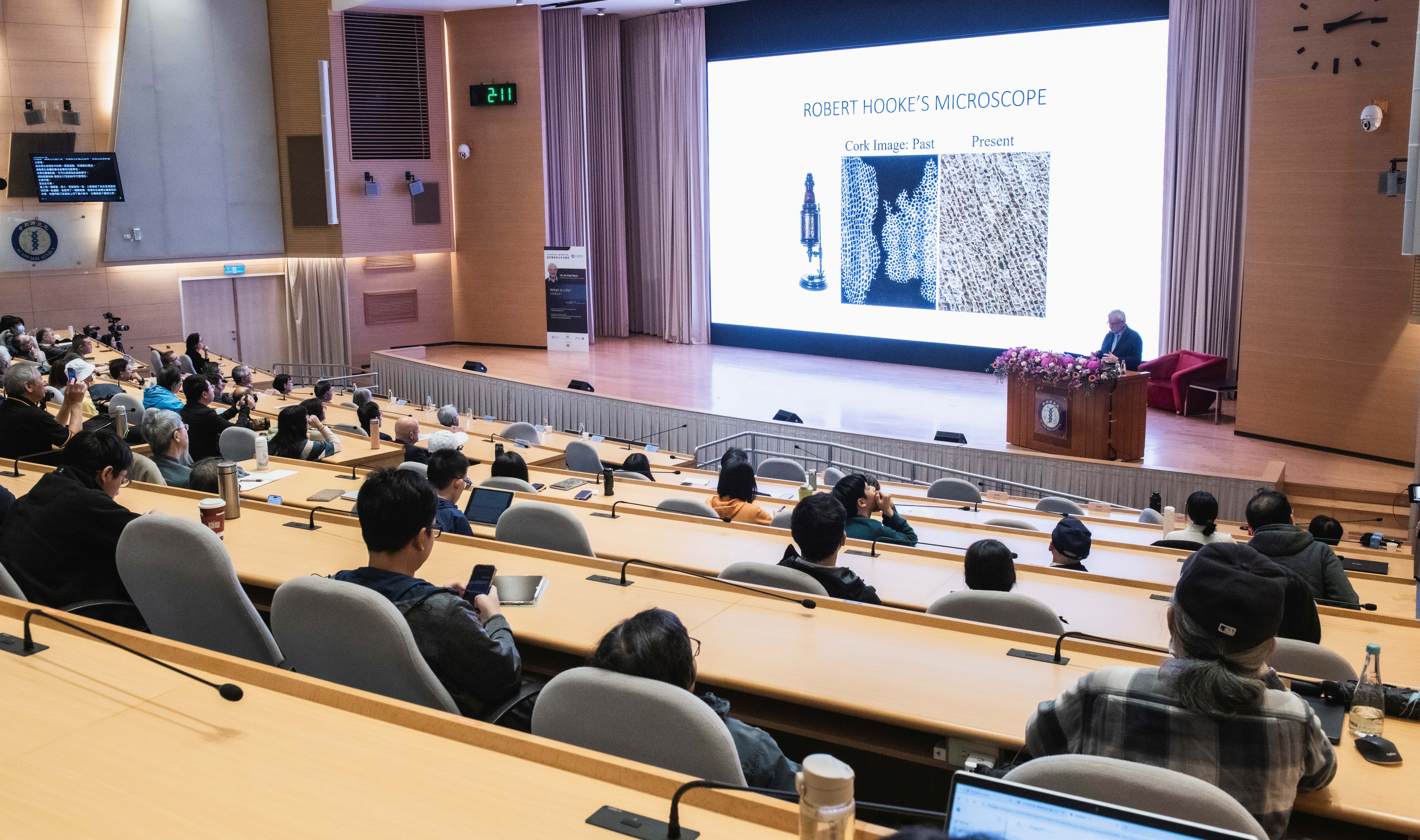 Scene from the lecture. Photo credit: Academia Sinica.