








 Home
HomeDate: 2026-03-17
Breast cancer has long been the most common cancer among women in Taiwan and in many developed countries, with a recent trend toward younger onset. A research team led by Academician Chien-Jen Chen, Distinguished Research Fellow at the Genomics Research Center of Academia Sinica, in collaboration with the National Health Research Institutes (NHRI) and several universities in Taiwan, has completed a large-scale, 20-year study on breast cancer risk assessment. The findings were published in the Proceedings of the National Academy of Sciences (PNAS) in March 2026.
The study establishes a clear temporal link between exposure to di(2-ethylhexyl) phthalate (DEHP)—one of the most widely used plasticizers—and increased breast cancer risk in women, providing evidence supporting a causal relationship. The researchers also identified metabolic susceptibility (MEHP%) as a biomarker for assessing breast cancer risk. The study further found that women with high phthalate exposure, higher metabolic susceptibility, and early menarche (before age 14) face up to a sevenfold increase in breast cancer risk.
Academia Sinica President James C. Liao noted that health is a universal concern. By applying rigorous scientific methods to identify risk factors for disease, researchers advance disease prediction and prevention. He added that this study provides important scientific evidence linking DEHP exposure to breast cancer risk and offers valuable insights for future risk assessment and prevention strategies.
Academician Chien-Jen Chen explained that the study goes beyond examining environmental risk factors by incorporating metabolomic biomarkers used in precision medicine to better understand individual differences in breast cancer susceptibility. The findings provide a new approach to personalized breast cancer risk assessment, helping to identify high-risk women at earlier stages and support more effective prevention and early detection strategies.
Because DEHP is an endocrine-disrupting chemical widely found in everyday plastic products, the research team also advises high-risk individuals to reduce phthalate exposure and maintain regular breast cancer screening.
A 20-year follow-up study provides causal temporal evidence linking DEHP exposure to breast cancer
While previous studies on phthalates and breast cancer have often been inconclusive due to a lack of causal temporality, this 20-year follow-up study followed-up nearly 12,000 Taiwanese women from 1991 to 2010. By analyzing baseline urine samples, the research team demonstrated that DEHP exposure directly precedes the development of invasive breast cancer, providing evidence of causality.
Academician Chien-Jen Chen noted that establishing causality in epidemiological research is inherently challenging because observational studies rely on real-world data on environmental exposures and health outcomes, unlike laboratory experiments where conditions can be tightly controlled.
This study adopted a prospective design, collecting urine samples at baseline while also documenting participants’ lifestyle factors and environmental exposures, followed by 20 years of longitudinal tracking. By linking the cohort to the Taiwan Cancer Registry Center, the researchers identified participants who later developed breast cancer and combined them with cancer-free controls. Urine samples from 119 invasive breast cancer cases and 245 matched controls were retrieved from the frozen specimen repository for analysis of DEHP metabolites. The results showed that participants with higher urinary concentrations of DEHP metabolites had a significantly increased risk of developing breast cancer during the follow-up period.
From environmental exposure to individual metabolic differences in breast cancer risk assessment
First author Dr. Hui-Chi Chen, former postdoctoral researcher at the Academia Sinica Genomics Research Center, noted that one of the study’s key advances is the identification of metabolic susceptibility (MEHP%) as a biomarker reflecting individual differences in DEHP metabolism.
MEHP, the primary metabolite of DEHP, plays a critical role in DEHP metabolism and may be more toxic than its secondary or tertiary metabolites. MEHP% represents the proportion of MEHP in total measured DEHP metabolites; a higher MEHP% potentially indicates limited metabolic conversion of MEHP into downstream phase II or III metabolites. Women with elevated MEHP% were found to be at higher risk of developing breast cancer.
The study further showed that, when both phthalate exposure and MEHP% were high, breast cancer risk increased to 2.68 times that of the control group. When combined with early menarche (before age 14), the three factors demonstrated a strong synergistic effect, with breast cancer risk rising to 7.52 times that of women without these risk factors. These findings highlight the interaction between environmental DEHP exposure and individual metabolic susceptibility.
MEHP% reflects individual differences in the body’s ability to metabolize phthalates. This pattern suggests higher metabolic susceptibility, where intrinsic factors (such as genetic variations, hormone levels, or ethnic differences) and individual environmental exposures (such as endocrine-disrupting chemicals, pollutants, dietary habits, or lifestyle factors) may impair further metabolism. Such metabolic variation may potentially make some women more susceptible to breast cancer even at similar exposure levels. These individual differences in DEHP metabolism highlight the need to consider metabolic variations in environmental health studies. Including MEHP% in risk assessments can facilitate the development of personalized prevention strategies and targeted monitoring.
The study was led by Academician Chien-Jen Chen, Distinguished Research Fellow at the Genomics Research Center of Academia Sinica. Co-corresponding authors include Dr. Shu-Li Wang, Research Fellow at the National Health Research Institutes, and Dr. Chao Agnes Hsiung, Honorary Research Fellow. First authors are Dr. Hui-Chi Chen, former postdoctoral researcher at Academia Sinica, Dr. San-Lin You, Assistant Professor at the School of Medicine, Fu Jen Catholic University, and Dr. Ching-Hung Lin, Professor at the NTU Cancer Center.
Funding for this research was provided by Academia Sinica, the National Health Research Institutes, and the National Science and Technology Council.
-
Mr. Je-Chau Wang, Senior Specialist Genomics Research Center, Academia Sinica
(02) 2787-1301,wjcmsn1301@as.edu.tw
-
Ms. Yi-ling Lee, Media & Public Affairs, Secretariat, Academia Sinica
(02) 2787-2717,cvcc54@as.edu.tw
-
Ms. Steffi Tung Lin, Media & Public Affairs, Secretariat, Academia Sinica
(02) 2789-8820,tunglin@as.edu.tw
-
Link
-
 MEHP% reflects metabolic susceptibility modulating DEHP-associated breast cancer risk. These findings highlight the importance of accounting for individual differences in DEHP metabolism in environmental health research. Photo credit: Academia Sinica.

-
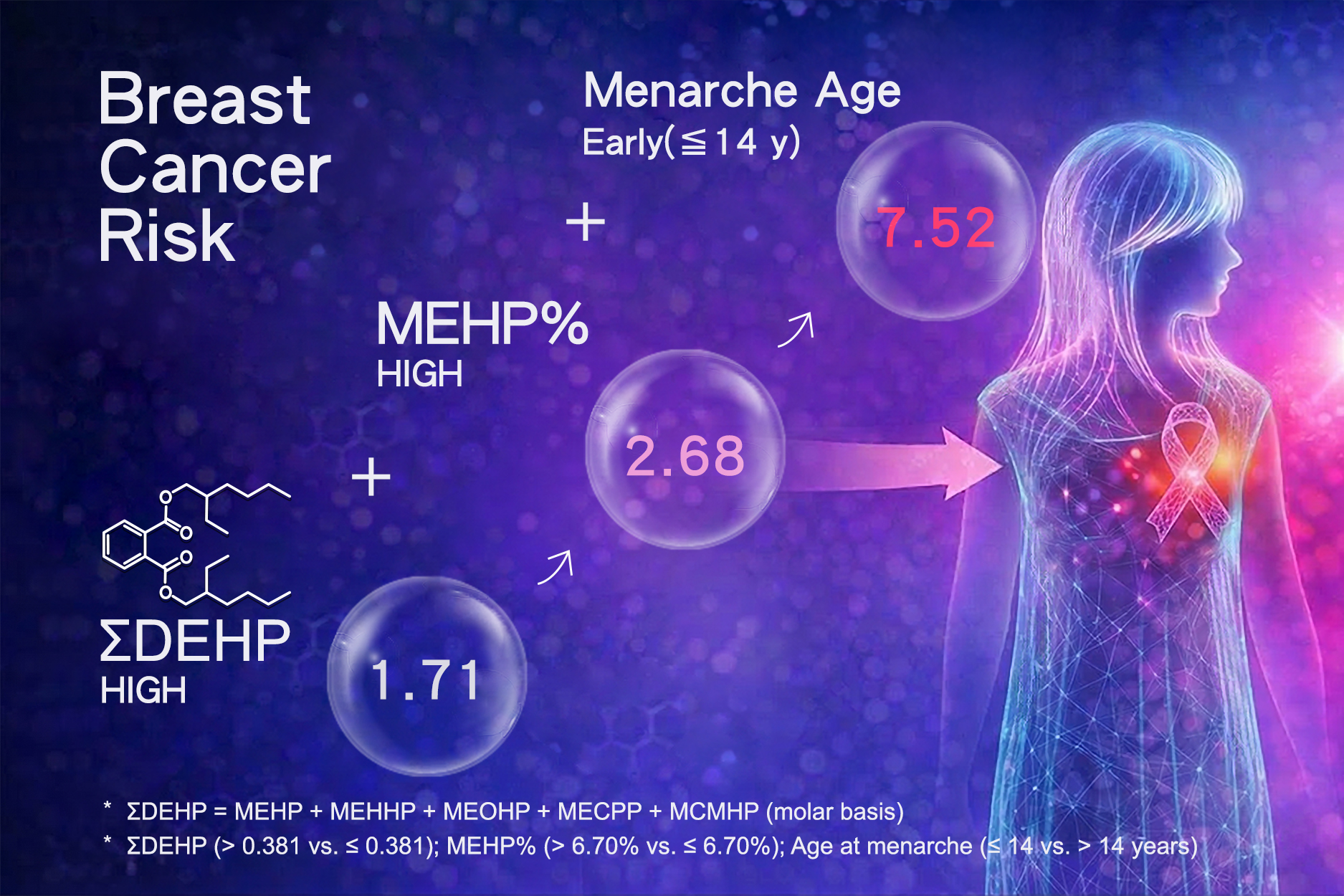 High DEHP exposure increases breast cancer risk by 1.71x. Combined with high metabolic susceptibility, the risk rises to 2.68x. When paired with early menarche (≤14), these synergistic effects skyrocket the risk to 7.52x, highlighting the profound impact of environmental hormones and individual metabolic variations. Photo credit: Academia Sinica.