
 Home
HomeDate: 2026-09-17
As the ocean absorbs an increasing amount of the carbon dioxide released by anthropogenic activity, seawater is becoming increasingly acidic. An international team, led by Associate Research Fellow Yung-Che Tseng of the Institute of Cellular and Organismic Biology at Academia Sinica, has discovered that bigfin reef squid (Sepioteuthis lessoniana) that are maintained in acidified seawater for extended periods have normal basic vision. However, their optic-lobe neurometabolic networks are reorganized, several key brain structures shrink significantly, and their hunting performance suffers a significant decline. This finding contradicts the previous hypothesis that acidification disrupts behavior by impairing vision. It instead suggests that the animal is unable to process and integrate what it sees due to interference with the brain's higher-order neural integration and even a premature structural remodeling of the brain. This is the first instance in which a clear, brain-level change has been documented in an aquatic animal under acidification.
The underlying study appeared this year in Communications Biology. The team collaborated with Associate Research Fellow Hwang, Dennis W. of the Institute of Biomedical Sciences, and the MRI group at the Animal Imaging Facility of the Biomedical Translation Research Center to continue this research. They discovered that acidification reduced the squid's total brain volume by nearly 50%. After the preliminary results were presented at the Society for Experimental Biology (SEB) annual meeting in Italy this July, they drew international press coverage, including reports in “TIME magazine” in the United States and “The Times” in the United Kingdom. These squid are high-level predators and occupy a critical position in the marine food web. The consequences of their loss of the capacity to assess their environment and hunt could have a far-reaching impact on the entire ocean ecosystem.
Seeing the world but no longer reading it: the answer may lie in the brain
Ocean acidification research has long centered on the physiology of marine animals, and much about its effects on the central nervous system and on behavior remains limited. Cephalopods have the most highly evolved nervous systems and the sharpest senses among marine invertebrates. Squid in particular depend on keen vision and fast neural responses to hunt, which makes them a valuable subject for asking how environmental change reaches the higher functions of the brain.
During husbandry at the Marine Research Station, the team noticed that squid held under high carbon dioxide were more prone to defensive inking, to hiding in corners, and to sluggish feeding. The first guess was impaired vision, but the experiments showed no clear change in the squid’s basic visual responses. "The squid can still see, but it may no longer read the world it sees the way it once did," said Dr. Tseng. Careful step-by-step analysis convinced the team that the behavioral changes brought on by acidification do not stem from damaged sensory input. They arise instead from disruption at the level of the brain’s higher-order integration, which offers a new line of insight into how acidification alters animal behavior.
MRI shows brain volume nearly halved, with acidification reaching into brain structure
In order to determine whether acidification impacts brain structure, the team employed magnetic resonance imaging (MRI) to compare squid brains in a simulated present-day seawater environment and a 2100 acidification scenario. After 90 days the two groups showed no clear difference in body size, but overall brain volume in the acidified group had fallen by an average of 49 percent. The optic lobes lost about 52% of their volume, and the optic tract, which carries visual signals, was reduced by about 62%.
In the face of climate change, the team argues, survival is not the only thing worth watching. It’s equally important to ask whether the brain and behavior still function properly. The team manually reconstructed each brain region in a layer-by-layer fashion and translated the image data into machine learning to intelligently construct the world's first cephalopod brain atlas, because the ability to analyze MRI of a cephalopod brain is limited. It is meant for later study of the structure of the brain and neural connectivity.
The research team also includes Assistant Professor Garett Allen of the Department of Biology at Acadia University in Canada, the Faculty of Fisheries at Kagoshima University in Japan, the Imaging Core of the College of Medicine at National Taiwan University, and the Department of Aquaculture at National Taiwan Ocean University. Funding was provided jointly by Academia Sinica and the National Science and Technology Council.
-
Dr. Yung-Che Tseng, Institute of Cellular and Organismic Biology, Academia Sinica
(03)9880-544#14,yctseng@gate.sinica.edu.tw
-
Ms. Tsuey-Yin Piong, Media & Public Affairs, Secretariat, Academia Sinica
(02) 2789-8821,fangzi@as.edu.tw
-
Ms. Yi-ling Lee, Media & Public Affairs, Secretariat, Academia Sinica
(02) 2787-2717,cvcc54@as.edu.tw
-
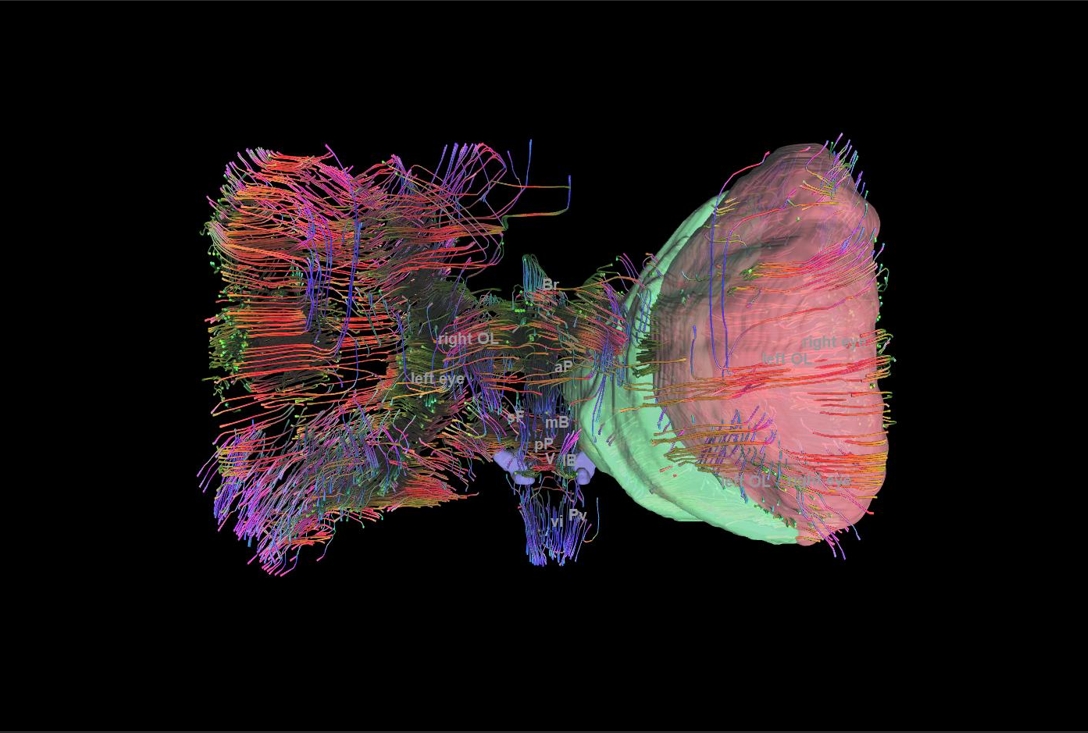 Diffusion tensor imaging (DTI) reconstruction of neural fiber tracts in the bigfin reef squid brain, illustrating the connections between the left and right optic lobes and central brain regions. Photo credit: Academia Sinica.

-
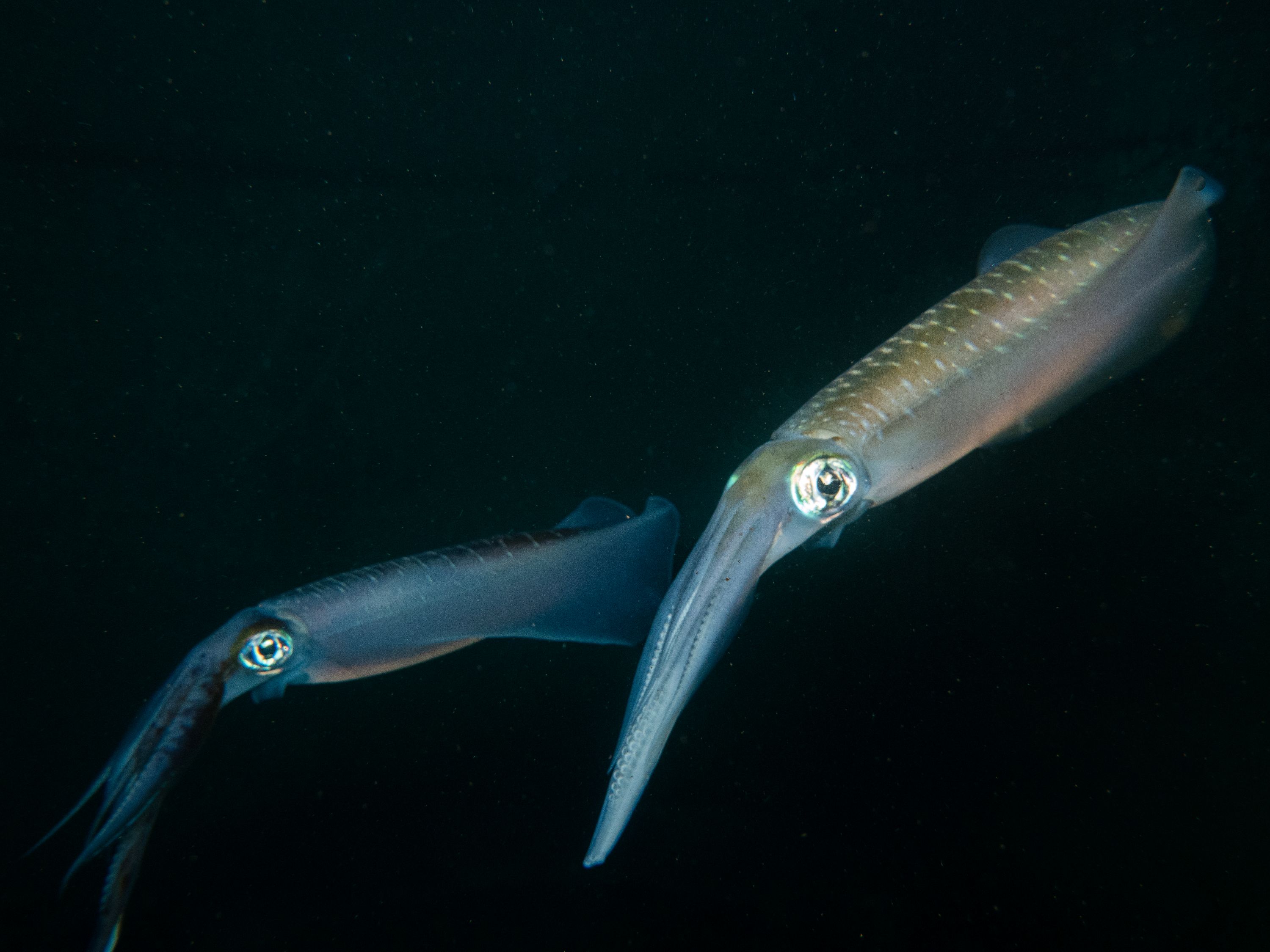 Bigfin reef squid (Sepioteuthis lessoniana) swimming in the aquarium at Academia Sinica’s Marine Research Station. Photo credit: Academia Sinica; photo by Huai Su.
-
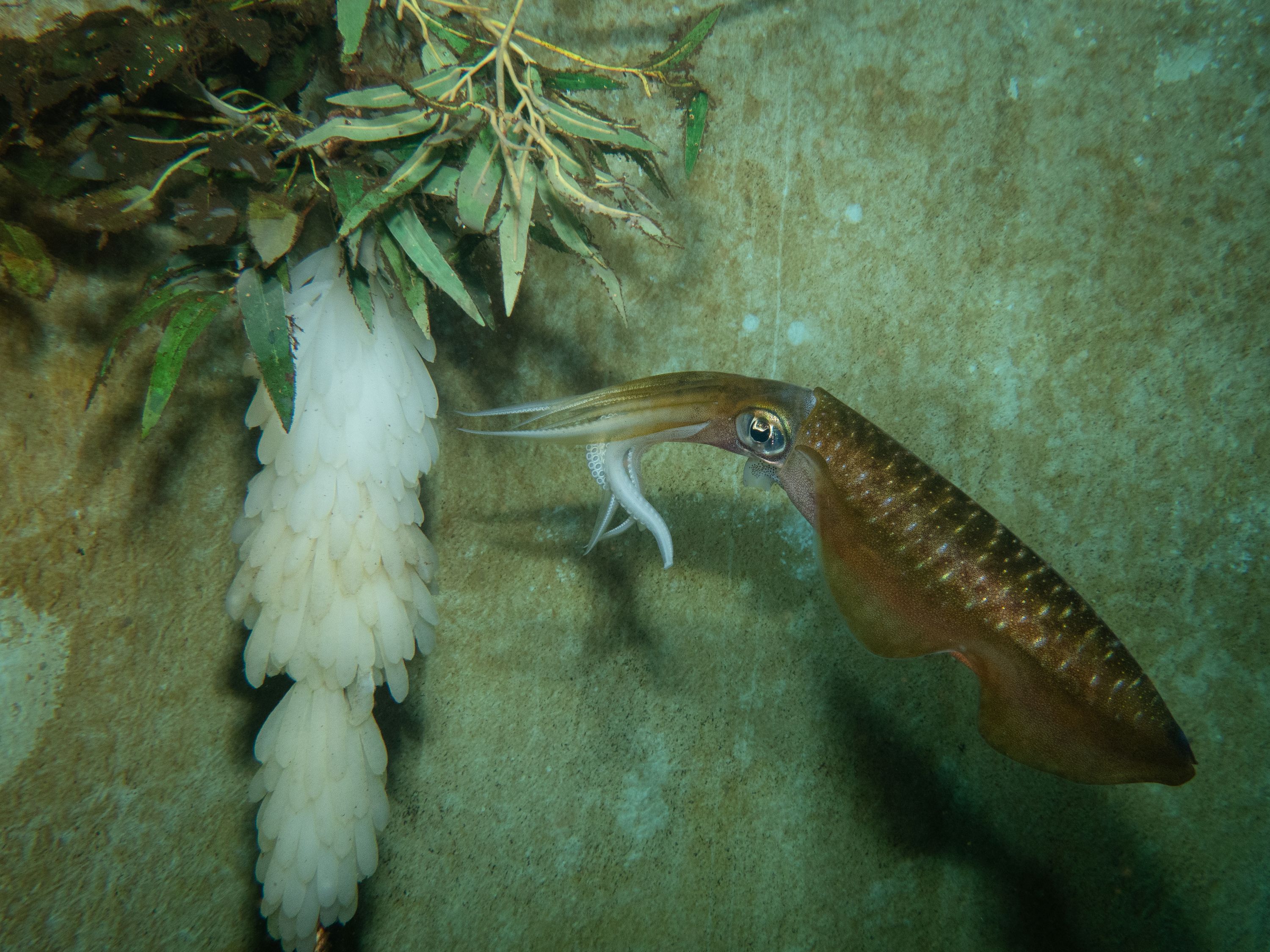 Long-established trans-generational husbandry expertise at the Marine Research Station enabled the team to rear squid under controlled acidification conditions. Photo credit: Academia Sinica; photo by Huai Su.