






 Home
HomeDate: 2026-09-23
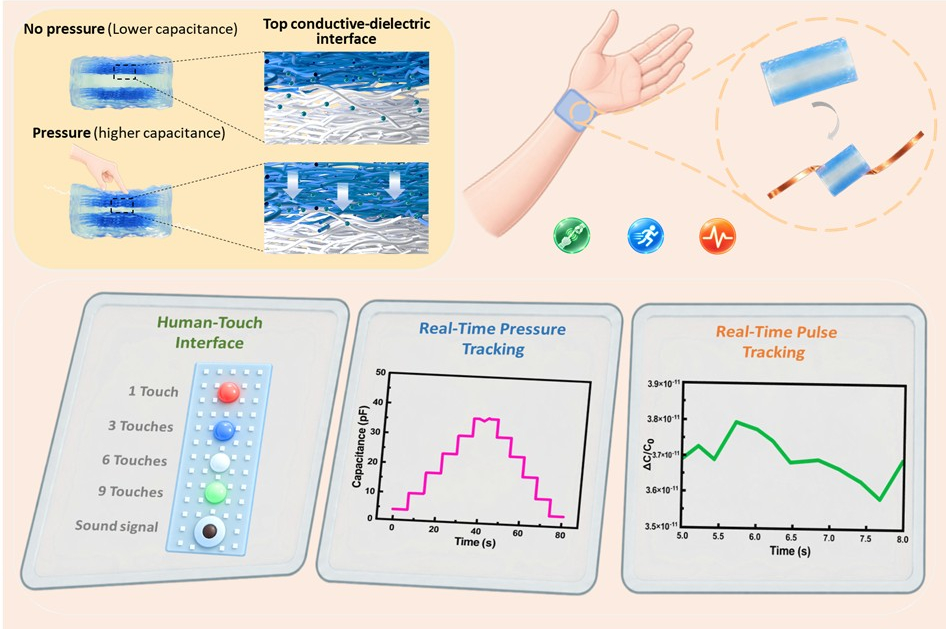
Sensitive pressure sensors with easy fabrication and stable performance are essential for next-generation wearable electronics. Incorporating hydrogels into pressure sensors offers enhanced wearability owing to their soft, flexible, and skin-conformable nature. A research team led by Dr. Hsiung-Lin Tu (Institute of Chemistry) developed a monolithic Janus hydrogel-based capacitive pressure sensor composed of two conductive layers and an intervening dielectric layer, forming an all-hydrogel sensing architecture. The conductive layers were fabricated from poly(3,4-ethylenedioxythiophene)-doped poly(ethylene glycol) diacrylate (PEGDA) hydrogels, while the dielectric layer consists of a pristine PEGDA matrix, enabling intimate interfacial bonding without the need for additional adhesives. The designed sensor demonstrates reliable detection from small physiological signals to human motions. These findings highlight the Janus hydrogel could be a promising platform for wearable health monitoring.
This study was supported by the National Science and Technology Council and Academia Sinica. Collaborators of the study include Dr. Hsiao-hua Yu (Institute of Chemistry), Dr. Chih-Wei Chu (Research Center of Applied Sciences), and Prof. Yu-Sheng Hsiao (National Taiwan University of Science and Technology). The study was published in Advanced Science on July 30, 2026.
-
Link