



 Home
HomeDate: 2026-06-16
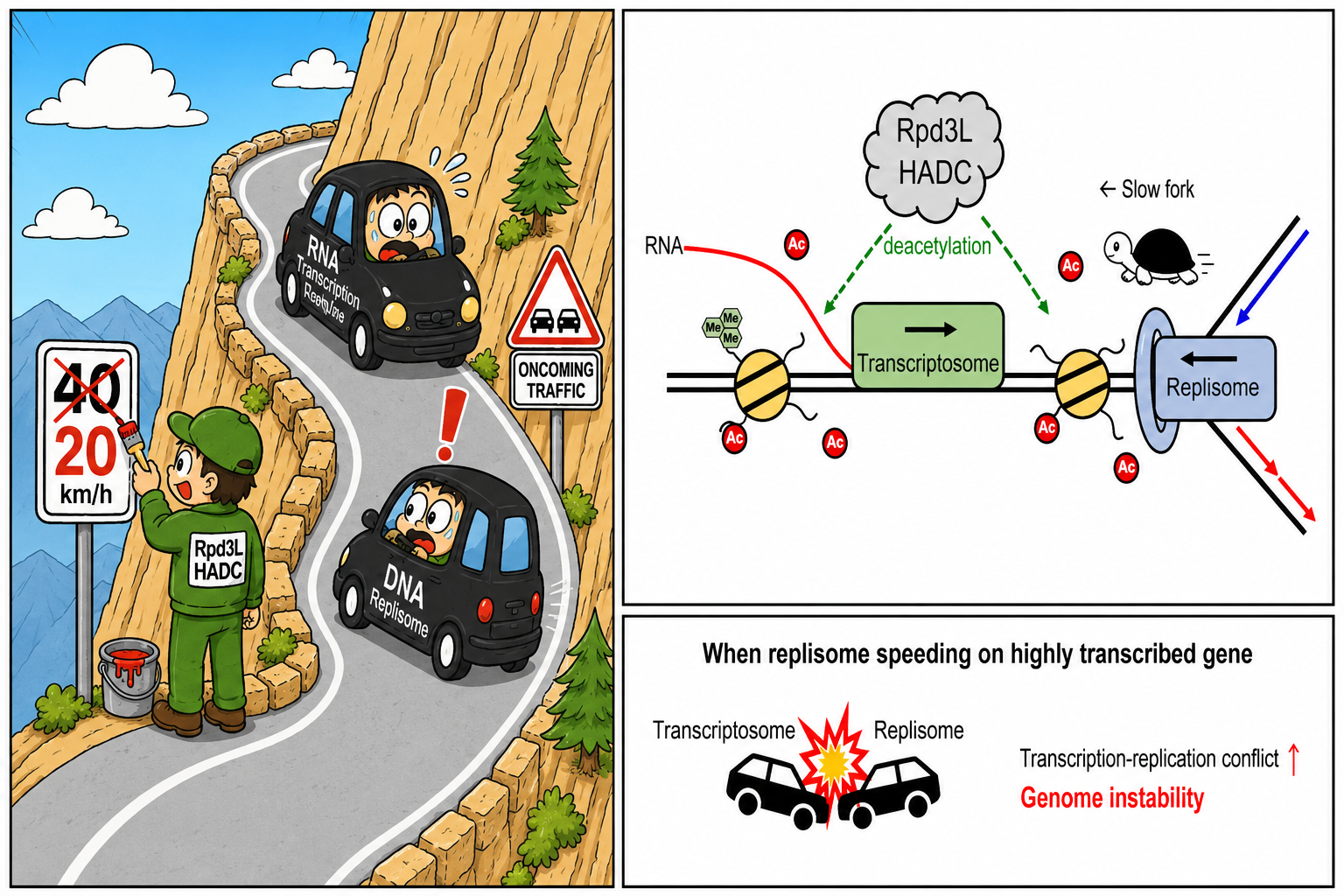
Before cell division, DNA must be accurately replicated. At the same time, many genes continue to be actively transcribed. When the DNA replication machinery encounters the transcription machinery on the same genomic region, transcription–replication conflicts (TRCs) can arise, leading to replication fork stalling, DNA damage, and genome instability. How cells ensure efficient DNA replication through highly transcribed regions therefore represents a fundamental question in genome stability research.
A research team led by Research Fellow Cheng-Fu Kao at the Institute of Cellular and Organismic Biology, Academia Sinica, has uncovered a critical role for the Rpd3L chromatin deacetylase complex in coordinating cellular responses to transcription–replication conflicts. The study demonstrates that Rpd3L can be recruited through both H3K4 methylation-dependent and H3K4 methylation-independent pathways to regulate histone acetylation and replication fork progression. By establishing an appropriate chromatin environment, Rpd3L promotes the stable passage of replication forks through actively transcribed regions and reduces transcription-associated genome instability.
This study was supported by the Investigator Awards of Academia Sinica and research grants from the National Science and Technology Council (NSTC). Co-authors of the study include Dr. Shin Yen Chong, Assistant Professor in the Department of Food Science at National Ilan University, Prof. Yi-Chen Lo of the Institute of Food Science and Technology at National Taiwan University, and Dr. Tsai-Ming Lu, Assistant Research Scientist of the Institute of Cellular and Organismic Biology, Academia Sinica. The findings were published in Science Advances on June 10, 2026.
-
Link