







 Home
HomeDate: 2026-06-16
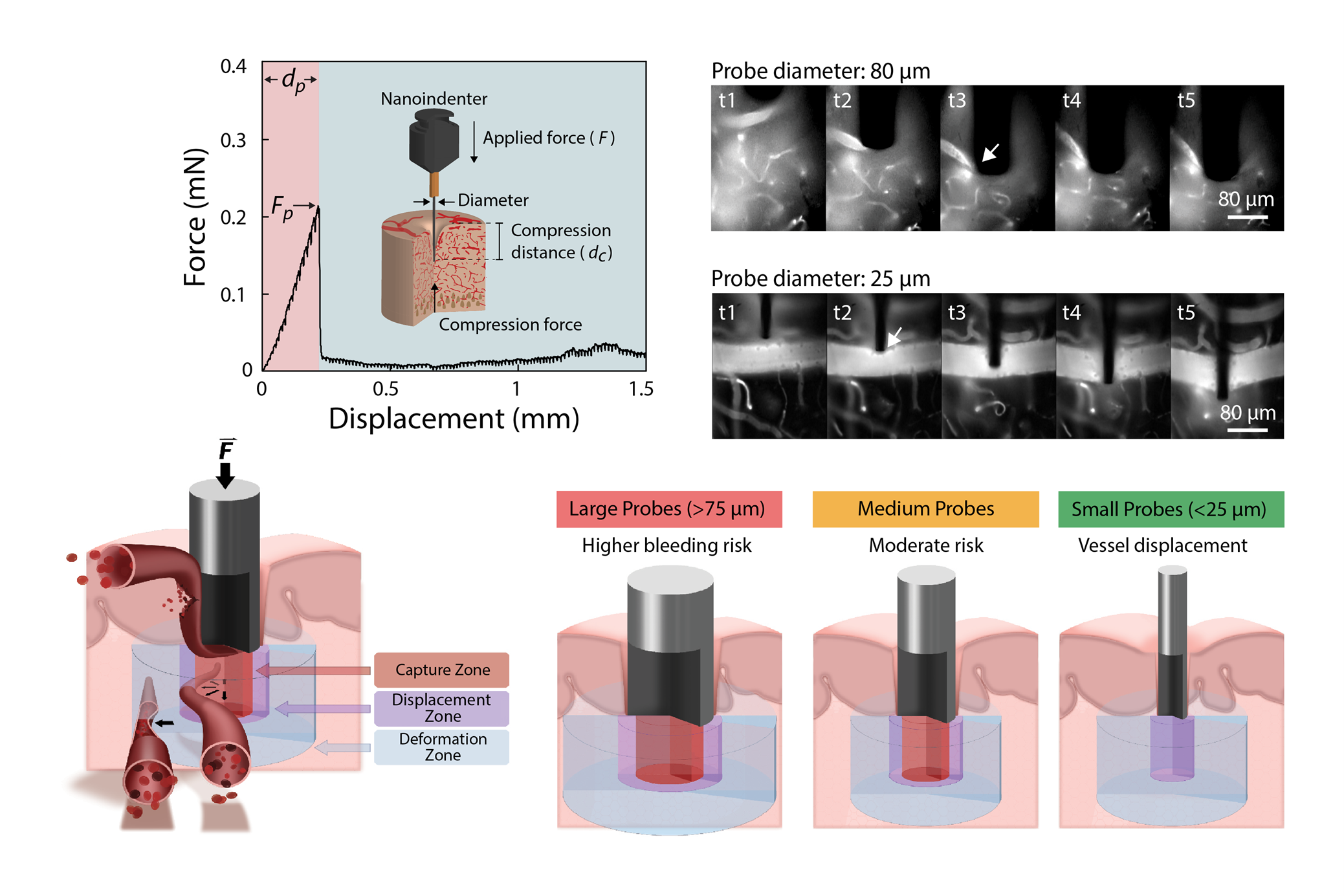
Microscale neural probes are essential tools for next-generation brain-computer interfaces, but inserting them into the brain can injure tissue and blood vessels. In this study, Dr. Yu-Wei Wu’s team at the Institute of Molecular Biology, Academia Sinica, together with collaborators at Stanford University, combined ultrasensitive force measurement with real-time live imaging to observe how probes of different diameters enter and impact the mouse brain.
The team found that the pia, the protective membrane covering the brain surface, is the main mechanical barrier during insertion. Smaller probes required less force and compressed less tissue to puncture the pia, and after the probes crossed this membrane, the insertion force remained nearly constant rather than increasing with depth. Most importantly, probes thinner than about 25 micrometers could push nearby blood vessels aside instead of catching and tearing them, enabling insertion without visible bleeding. Overall, the study offers a quantitative framework for designing safer, lower-trauma neural implants and high-density recording devices, with implications for both experimental neural recording tools and future clinical brain-computer interfaces.
The study was published in the PNAS on March 26 and was supported by the U.S. NIH, Stanford University, Academia Sinica, and NSTC.
-
Link