






 Home
HomeDate: 2025-08-20
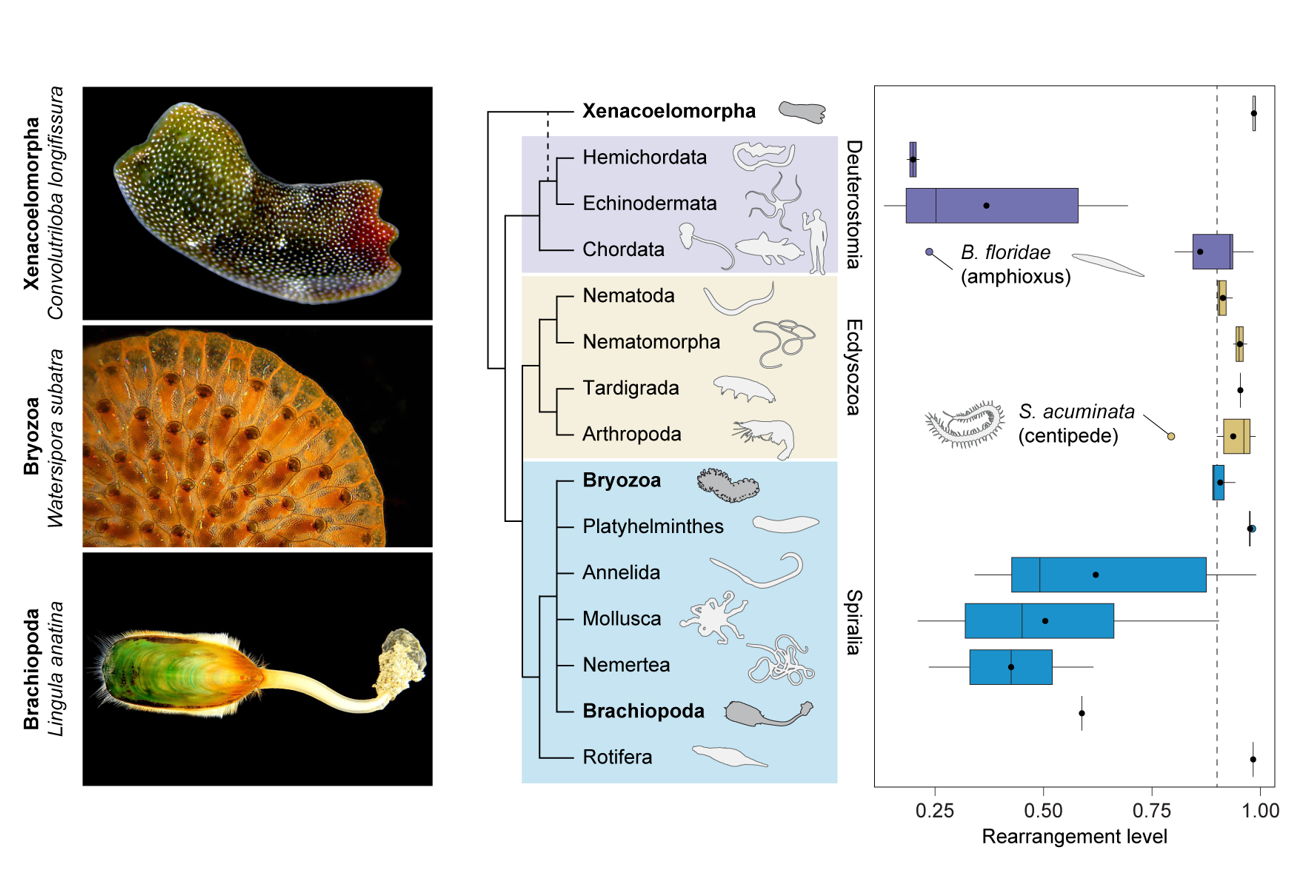
Bilaterally symmetrical animals are those with body structures exhibiting left–right symmetry, including species such as fruit flies, nematodes, and zebrafish. Despite this symmetry, their body plans vary significantly, with around 30 different animal phyla identified. A team led by Assistant Research Fellow Yi-Jyun Luo at the Biodiversity Research Center has analyzed chromosome-level genomes from 15 animal phyla, covering 54 classes. The study used a "rearrangement index" to quantify genome structural changes, finding that most bilaterian genomes have undergone extensive chromosomal rearrangements resulting from events such as fusion, fission, and translocation. In contrast, marine invertebrates such as sea urchins, amphioxus, and scallops exhibit relatively conserved genome structures, with little change over the past 500 million years.
Further analysis revealed that the degree of genomic rearrangement is not significantly correlated with genome size, transposable element content, or GC content, but is strongly associated with rapid protein sequence evolution, indicating a synchronized evolution between genome structure and gene evolution. This research helps to understand the relationship between genome rearrangements and evolutionary adaptations in animals, and sheds light on the molecular mechanisms underlying the stability of chromosomal structures. The study was published in Genome Biology in August 2025 and supported by the Academia Sinica Career Development Award and the National Science and Technology Council Research Project Grant.
Lewin, T.D., Liao, I.JY. & Luo, YJ. Conservation of bilaterian genome structure is the exception, not the rule. Genome Biol 26, 247 (2025).
-
Link