







 Home
HomeDate: 2026-05-26
Writer: Dr. Frédéric Deschamps (Research fellow of the Institute of Earth Sciences (IES) , Academia Sinica)
Dr. Frédéric Deschamps is a research fellow at the Institute of Earth Sciences (IES) of Academia Sinica. He joined the IES in 2011. His research activities address the structure, dynamics, and composition of planetary interiors, and more specifically of the mantles of rocky planets, including our planet Earth, and of the ice layers of icy moons and dwarf planets, such as Europa, Titan, and Pluto.
Dr. Frédéric Deschamps is a research fellow at the Institute of Earth Sciences (IES) of Academia Sinica. He joined the IES in 2011. His research activities address the structure, dynamics, and composition of planetary interiors, and more specifically of the mantles of rocky planets, including our planet Earth, and of the ice layers of icy moons and dwarf planets, such as Europa, Titan, and Pluto.
Our planet Earth possesses a strong magnetic field that cannot be felt by the basic human senses, but that can be easily detected with tools like a compass. While we do not feel it, the Earth’s magnetic field still has a strong impact on us, as it acts as a shield that protects all living species against high-energy particles coming from space, such as the solar wind and the cosmic rays. Without a magnetic field, our planet would probably not be habitable. Luckily, it appears (from the analysis of very old rocks) that the Earth’s magnetic field was already present about 4.0 billion years (Gyr) ago, soon after our planet was formed. Analysis of younger rocks further shows that it persisted since then, but that its strength and orientation varied a lot, both at long- and short-time scales. Today, the origin of the Earth’s magnetic field, in the outer core, is relatively well understood. What is less clear is which processes and properties are controlling its variations over time. However, growing evidence, including research performed at the Institute of Earth Sciences of Academia Sinica, suggest that temporal and spatial changes in the heat that can be extracted from the outer core by the overlying rocky mantle, plays a key role in the evolution of the Earth’s magnetic field.
The Earth’s magnetic field
A key property of the Earth’s magnetic field is that it is prominently dipolar. This means that, similarly to a common bar magnet, the force associated with the magnetic field is aligned with invisible lines (the magnetic field lines) that flow between an emanation and a termination point, referred to as north and south magnetic poles. On Earth, the north and south magnetic poles are respectively located close to the South and North geographic poles . This is why the needle of a compass (which is itself a small bar magnet) points to the North: it feels the magnetic field and its magnetic north pole rotates to align with the Earth’s magnetic field lines that end up close to the North geographic pole (or true north, which, as we already said, corresponds to a magnetic south pole, traditionally called magnetic north ; see note 1). Or, one should say, nearly to the north, as there is a small difference between the directions of the true and magnetic norths (geophysicists call this angle the declination). To make things a bit more complicated this difference is not the same at different points on the Earth’s surface. In Taiwan, the declination is about 5 degrees to the west, which means that the compass is pointing 5 degrees west of the true north. And to make things even worse, the declination at a given location also change with time, as well as the position of the magnetic poles. In the past few decades, the magnetic north has been quickly shifting from northern Canada towards the true north. Maps of the magnetic field at the surface of the Earth therefore need to be updated regularly. These short-term variations illustrate the fact that the Earth’s magnetic field varies and has been varying with time. However, these variations are only the top-of-the-iceberg compared to longer-term and more catastrophic variations.
Note 1: The magnetic field lines are converging to the magnetic pole located close to the North geographic pole, instead of diverging from it. For simplicity, in everyday conversations, one usually refers to the direction towards the geographic and magnetic poles located in the Arctic as true north and magnetic north, respectively. However, because the magnetic field lines are converging towards magnetic north instead of diverging from it, Earth's present-day magnetic north pole is physically a magnetic south pole.
Polarity reversals
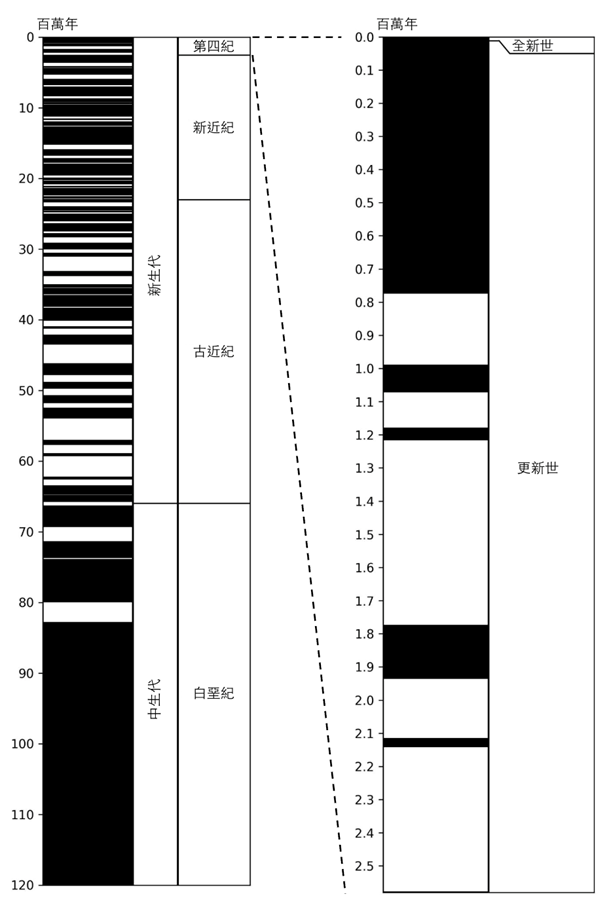
Eight hundred thousand years ago, the needle of a compass would have pointed to the South: back then the true and magnetic souths shared the same orientation. Of course, nobody was holding the compass back then. But the magnetic field was recorded in volcanic and sedimentary rocks that formed at that time . By measuring the magnetization of these rocks, a specialized branch of science called paleomagnetism, it is possible to reconstruct the history of the Earth’s magnetic field. The main message delivered by paleomagnetism is that this field has considerably varied in the past, both in direction and in amplitude. At some point, the direction of the magnetic field was even reversed: the north became south and vice versa, a period called reversed polarity chron. The events of magnetic polarity reversal were brief, typically less than a few thousands of years, and happened irregularly, that is to say they do not repeat periodically. According to the Geomagnetic polarity time scale 2020 [1], the reversal frequency is about 5 per Myr recently and drops to zero during mid-Cretaceous (i.e., 121 to 84 Ma; see Figure 1). For almost 40 Myr, the polarity remained the same. This period is called the Cretaceous normal superchron (CNS). The exact reason why CNS happens is not yet clear. But several studies suggest that geographical and temporal variations in the heat flux at the core-mantle boundary (CMB), which measures the heat that can be extracted from the core to the mantle, play a key role in controlling the long-term variations of the magnetic field.
The outer core and the geodynamo
The Earth’s magnetic field finds its source in the outer core of our planet, a region located below the rocky mantle (20-2890 km depth), at depths ranging from 2890 to 5150 km. The outer core is essentially composed of liquid iron and nickel. Due to the high prevailing temperature (around 6000 K), the metallic atoms release their outermost (valence) electrons, which are then free to move, playing the role of electric charge carrier. The outer core is further animated by large scale movements (or flow), and because, as we have just mentioned, electrons are free to move, these movements trigger large scale electric currents. This, in turn, generate a magnetic field through a process called geodynamo. Without entering into the details, several forces are acting on the core flow, including viscous forces that tend to weaken the flow, the Lorentz force, acting on electric currents, and the Coriolis force, which entrain magnetic field lines in the North/South direction and resulting the Earth’s magnetic field predominantly dipolar character. The competition between these forces and is responsible for short- and long-term variations in the field. the Earth’s magnetic field.
Note: These events are recorded in the core from the western Philippine Sea and studied by IES researcher Chorng-Shern Horng. See also his article <從古地磁學的研究看地球磁場長期的變化> published with Science Monthly in 2022.11.
Extracting heat from the core: the role of mantle convection
Being protected by a magnetic field has a cost. The molten iron flow in the outer core, from which the geodynamo is generated, requires energy to function well. Today, in Earth, this energy is provided by the release of latent heat associated the crystallization of the core. This, in turn, requires the mantle to extract enough heat from the core, such that the core can cool down. In other words, there is a minimum heat flux below which the geodynamo cannot operate. But there is more. Heat flux variations in time and space are influencing details of the flow at the top of the core. For instance, regions with low heat flux may cause local stratification of the fluid [2], or strengthen specific currents. Recent studies suggested that such mechanisms can block polarity reversals [3].
The exact value of heat flux at the core-mantle boundary (the amount of heat that can be extracted from the mantle) and the its spatial and temporal variations are therefore crucial for a better understanding of our magnetic field and its evolution. Determining these variations with accuracy requires, in turn, a good description of what happens in the abyssal Earth’s mantle, from depths of about 2000 to 2890 km. The Earth’s mantle is animated by large scale movements of convection, and because these movements are much slower than those in the outer core, they are controlling heat flux at the core-mantle boundary. Crucial to our story, the efficiency of convection to transport heat and the lateral changes in heat flux at the core-mantle boundary can themselves be affected by several mantle properties, for instance its viscosity and its thermal conductivity. Also crucial, the abyssal Earth’s mantle hosts structures that may affect the heat flux regionally. This include the so-called large low shear-wave velocity provinces (LLSVPs). Within these continental-scale regions, which are located at the base of the mantle beneath Africa and beneath the Pacific, seismic shear-wave velocity decreases by a few per cent compared to the rest of the mantle. Following the dominant hypothesis, this drop in seismic velocity denotes an increase in temperature combined with change in composition, most likely an enrichment in iron.
Estimating core-mantle boundary heat flux patterns
Within the last few years, research carried out at the Institute of Earth Sciences of Academia Sinica (IES) aimed to better understand these effects. In a recent study based on numerical simulations of mantle convection, we showed that heat flux at the core-mantle boundary strongly decreases in LLSVPs. More specifically, our simulations show that throughout these regions heat flux is lower than the heat flux on the core side. Locally heat flux may even be negative, i.e., heat flows from the mantle to the core, and not the other way around. In these conditions, the core cannot cool down beneath LLSVPs. Our calculations further show that both spatial and temporal variations in heat flux have strong amplitudes, reaching 3 to 4 times the average heat flux. If correct, the heat flux pattern observed in our simulations would strongly impact core dynamics and the geodynamo. Low heat flux beneath LLSVPs is expected to trigger thermal stratification at the top of the core beneath LLSVPs. Combined with strong heat flux variations, this stratification could play a role in starting or ending geomagnetic superchrons.
Another ongoing study at the IES aims at mapping the heat flux pattern at the core-mantle boundary using seismic tomography images (the same images that are mapping regions with low shear-wave velocity). Based on results obtained from simulations of convection, we developed a technique that can distinguish the seismic signature of different types of materials in seismic tomography images. In other words, given a tomographic image, we can predict which type of material is present at one specific geographical location at the bottom of the mantle. This distribution is closely linked to spatial changes in temperature and as such, it strongly impacts the spatial variations in core-mantle boundary heat flux. We are now working on a method that can estimate this heat flux directly from seismic tomography maps. Such maps are important because, when incorporated in simulations of core dynamics, they may help us to better understand the evolution of geodynamo and of the Earth magnetic field.