




 Home
Date: 2026-11-26
Why can respiratory syncytial virus (RSV) infection worsen asthma symptoms and trigger persistent coughing? A research team led by Dr. Ya-Jen Chang at the Institute of Biomedical Sciences, Academia Sinica, has discovered that RSV infection activates group 2 innate lymphoid cells (ILC2s) in the lungs, stimulating them to release the neurotransmitter serotonin. ILC2-derived serotonin not only promotes airway inflammation and airway hyperreactivity, but also activates pulmonary vagal sensory neurons1 , triggering cough responses.
The study reveals how serotonin released by immune cells influences neural activity in the lungs, exacerbating asthma-related symptoms. These findings expand our understanding of neuroimmune interactions and provide new insights into potential therapeutic strategies for airway inflammation and cough. The research has been published in Immunity, a leading international journal in immunology.
Immune Cells Release Serotonin to Activate Neural Circuits and Trigger Cough
Previous studies on cough and asthma exacerbations following viral infections have largely focused on airway inflammation, mucosal swelling, and airway obstruction. However, how immune cells trigger coughing through neural mechanisms has remained poorly understood. By integrating immunology and neuroscience, Dr. Chang’s team combined experimental mouse models with analyses of clinical samples to establish a mechanistic link between immune cell activation, peripheral neural circuit activation, and respiratory symptoms. The study uncovers a previously unrecognized role for serotonin in peripheral tissues and its relevance to asthma.
The researchers further demonstrated that genetically suppressing serotonin production or pharmacologically blocking serotonin signaling to sensory neurons could reduce RSV infection-induced airway inflammation and coughing in experimental models. These findings demonstrate that immune cells not only participate in the body’s defense against infection but also regulate neural activity through the release of serotonin, thereby influencing respiratory symptoms.
RSV Threatens Not Only Infants and Young Children but Also Older Adults and People with Chronic Diseases
RSV is a common respiratory pathogen that poses a particular health risk to infants, young children, older adults, and individuals with chronic respiratory diseases. According to data released by medical societies in Taiwan in 2025, approximately 2,000–3,000 infants and young children are hospitalized with RSV infection in Taiwan each year, more than 90% of whom are under two years of age.
However, RSV infection is not limited to young children. Studies have reported that 66.8% of patients hospitalized with RSV infection are aged 60 years or older, with nearly 40% of this group aged 75 years or older. Individuals with asthma, chronic obstructive pulmonary disease (COPD), or cardiovascular disease may also face an increased risk of severe illness following an RSV infection.
Respiratory viral infections are major triggers of acute asthma exacerbations and persistent cough, adversely affecting patients’ quality of life and increasing the burden on healthcare systems. By uncovering a neuroimmune mechanism underlying RSV-induced respiratory symptoms, this study provides a scientific foundation for exploring novel therapeutic strategies to alleviate asthma-related symptoms.
The first author of the study is Chia-Hui Luo, a PhD student. The research was led by Dr. Ya-Jen Chang at the Institute of Biomedical Sciences, Academia Sinica, in collaboration with Assistant Professor Chuan-Ying Lai of the Department of Microbiology and Immunology, Taipei Medical University; Dr. Wei-Chang Huang, of the Department of Chest Medicine, Taichung Veterans General Hospital; Associate Professor Wei-Yu Chen of the Department of Biochemistry and Molecular Biology, National Cheng Kung University; Distinguished Research Fellow Dr. Chih-Cheng Chen of the Institute of Biomedical Sciences, Academia Sinica; and Professor Nicholas W. Lukacs of the Department of Pathology, University of Michigan, USA.
This research was jointly supported by Academia Sinica and the National Science and Technology Council (NSTC), Taiwan.
- Pulmonary vagal sensory neurons are afferent neurons of the vagus nerve (the tenth cranial nerve) that relay sensory information from the lungs and airways to the brainstem. They play essential roles in respiratory regulation, the cough reflex, and neuroimmune communication in the lungs.
-
Pei-Ling Chen, Institute of Biomedical Sciences, Academia Sinica
(02) 2789-9002,lydia@ibms.sinica.edu.tw
-
Yi-Hsin Hung, Secretariat, Academia Sinica
(02) 2789-9875,yshung@as.edu.tw
-
Ms. Yi-ling Lee, Media & Public Affairs, Secretariat, Academia Sinica
(02) 2789-8820,cvcc54@as.edu.tw
-
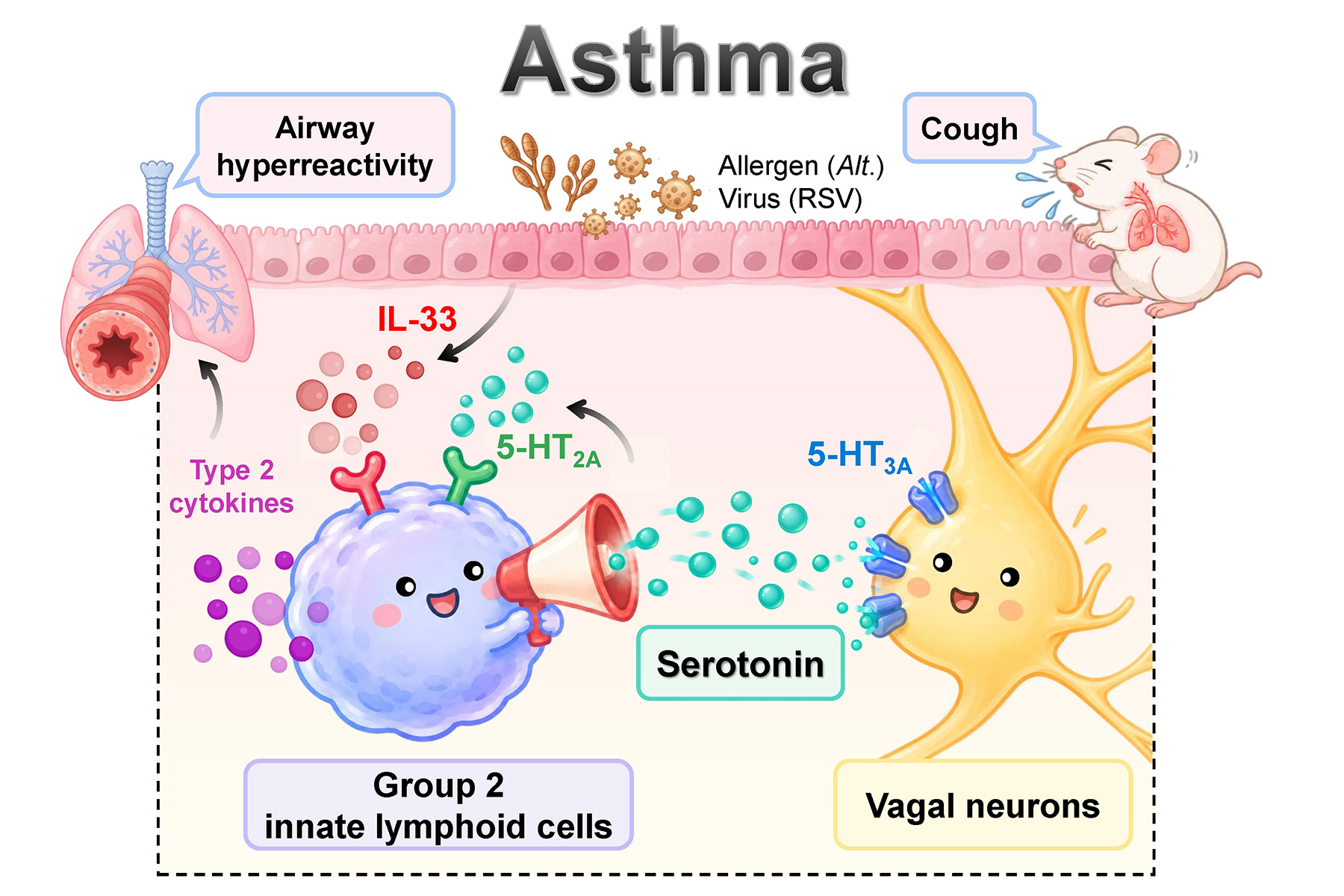 During RSV infection, ILC2-derived serotonin amplifies the ILC2 response and type 2 lung inflammation via 5-HT2A signaling, exacerbating AHR and eosinophilia. It also activates VSNs through 5-HT3A receptor signaling, promoting neuronal sensitization and cough hypersensitivity. Photo credit: Academia Sinica.

-
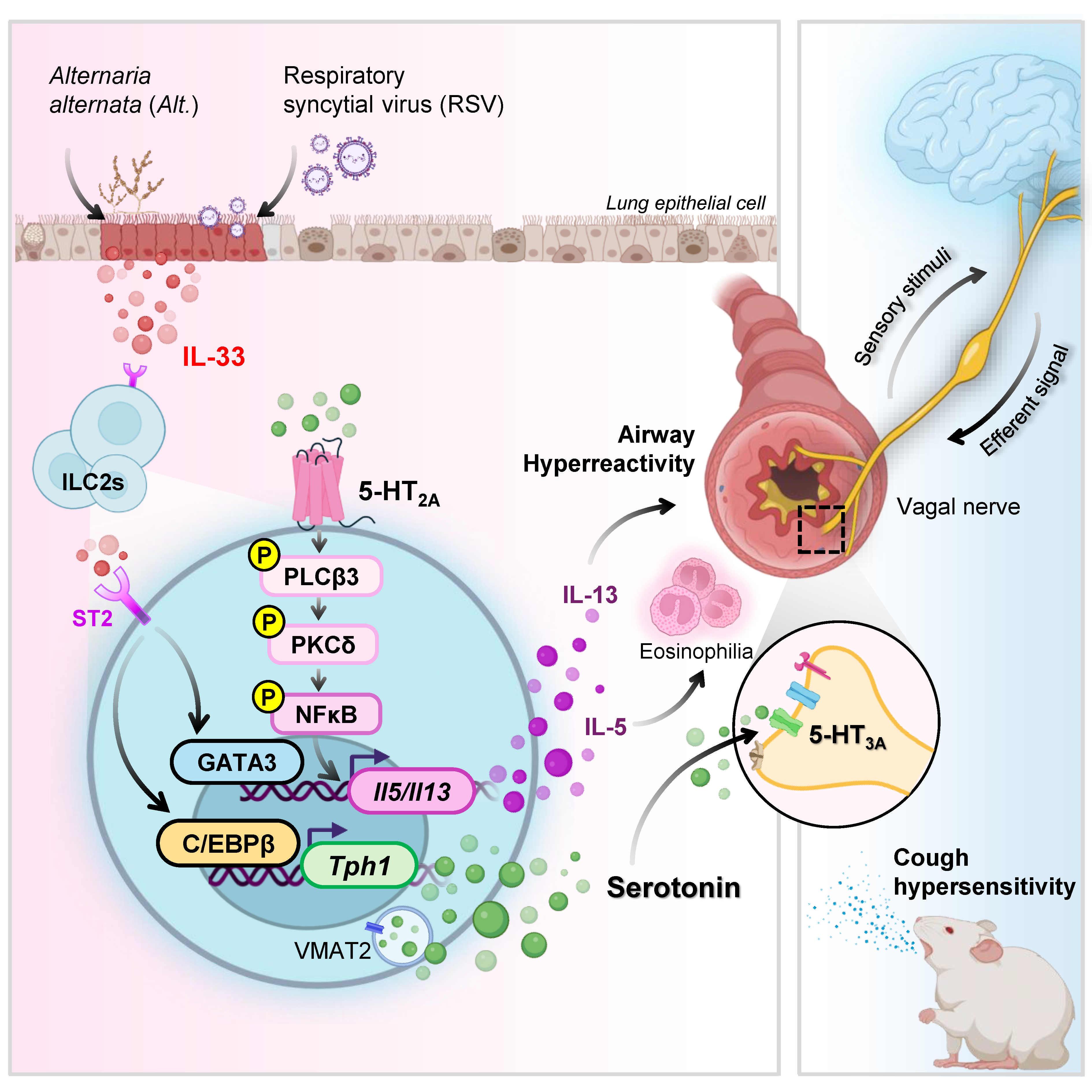 During RSV infection, ILC2-derived serotonin amplifies the ILC2 response and type 2 lung inflammation via 5-HT2A signaling, exacerbating AHR and eosinophilia. It also activates VSNs through 5-HT3A receptor signaling, promoting neuronal sensitization and cough hypersensitivity. Photo credit: Academia Sinica.