




 Home
Date: 2026-11-11
Stomata are microscopic structures on leaves that allow plants to take up carbon dioxide for photosynthesis while regulating water loss. Their abundance and distribution directly affect gas exchange and water-use efficiency. But what determines how many stomata a leaf produces? The answer may lie within the nuclei of its cells. A research team led by Associate Research Fellow Chin-Min Kimmy Ho in the Institute of Plant and Microbial Biology, Academia Sinica, has identified a key protein, HOMEODOMAIN-LIKE (HDL), that helps organize chromatin in the nucleus and influences the balance between cell proliferation and differentiation, ultimately affecting the numbers of stomata and trichomes (tiny hair-like structures on the leaf surface).
The study reveals how chromatin organization within the nucleus influences the development of leaf epidermal cells and opens new avenues for investigating how plants adapt to their environments. The findings were published in Nature Communications.
Divide or differentiate? The answer is inside the nucleus
The leaf epidermis contains a group of precursor cells. These cells are highly flexible in their developmental potential: they can continue dividing to produce stomatal precursor cells or stop dividing and differentiate into trichomes or pavement cells (puzzle-shaped cells that cover much of the leaf surface). How plants decide which way to go has long been an important question in developmental biology. “We initially wanted to understand how leaf epidermal cells decide whether to keep dividing or begin differentiating,” said Ho. “As we followed the question further, we discovered that the answer is closely tied to how chromatin is organized inside the nucleus.”
By comparing wild-type plants with mutants lacking HDL, the team found that loss of HDL alters chromatin organization and gene activity in the nucleus. Without HDL, fewer cells continue dividing to produce stomata, while more cells enter differentiation, resulting in fewer stomata and more trichomes on the leaf surface. Further investigation revealed that HDL is associated with the boundary between active and repressive chromatin regions, where genes are more or less accessible for expression. By helping maintain the organization of these regions, HDL may influence which genes are activated or repressed, thereby affecting whether leaf epidermal cells continue dividing or differentiate.
Cross-disciplinary collaboration links chromatin architecture, cell fate, and leaf development
To understand how HDL influences leaf epidermis development at the nuclear level, the researchers brought together expertise in plant developmental biology, cell biology, epigenetics, and genomics. By examining the spatial organization of chromosomes within the nucleus and analyzing genome-wide changes in chromatin organization, the team found that HDL does more than regulate individual developmental genes. Instead, HDL helps coordinate chromatin organization and gene activity at the boundary between active and repressive chromatin states, influencing the balance between cell proliferation and differentiation and thereby shaping stomatal and trichome formation.
Together, these findings establish a link between chromatin architecture, cell fate decisions, and leaf development. The identification of HDL provides new insights into the longstanding question of how precursor cells balance continued division with differentiation. The study also opens new avenues for exploring plant development through the organization of chromatin inside the nucleus.
The first author in this study, Ansar Ali, was a Ph.D. student in the Molecular and Biological Agricultural Sciences (MBAS) program of the Taiwan International Graduate Program (TIGP) at Academia Sinica. The research was supported by Academia Sinica, National Science and Technology Council, and National Taiwan University.
-
Pei-Ling Wu, Institute of Plant and Microbial Biology, Academia Sinica
(02) 2787-1001,lilian541@gate.sinica.edu.tw
-
Yi-Hsin Hung, Secretariat, Academia Sinica
(02) 2789-9875,yshung@as.edu.tw
-
Ms. Yi-ling Lee, Media & Public Affairs, Secretariat, Academia Sinica
(02) 2789-8820,cvcc54@as.edu.tw
-
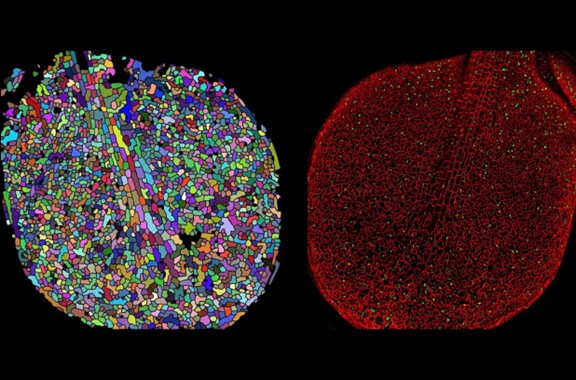 Fluorescence microscopy (right) and cell segmentation (left) reveal the diverse shapes and arrangements of leaf epidermal cells, highlighting the complex cellular organization of the leaf surface. Photo credit: Academia Sinica.

-
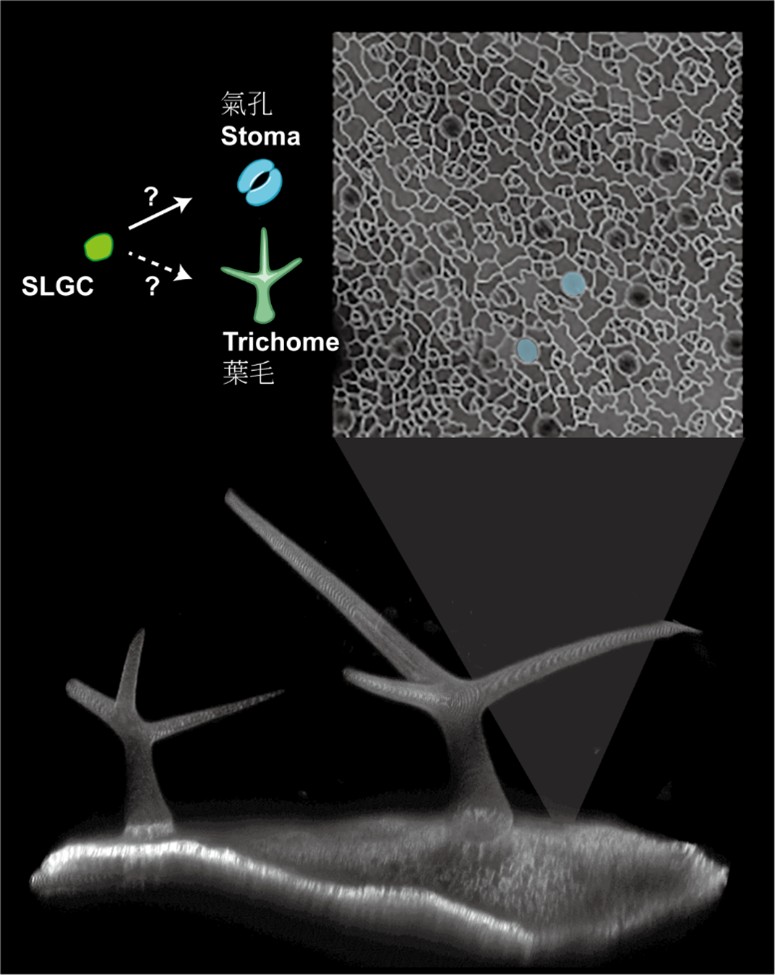 Leaf epidermal cell fate. SLGCs can continue dividing to form stomata or differentiate into other epidermal cell types, shaping the leaf surface. Photo credit: Academia Sinica.
-
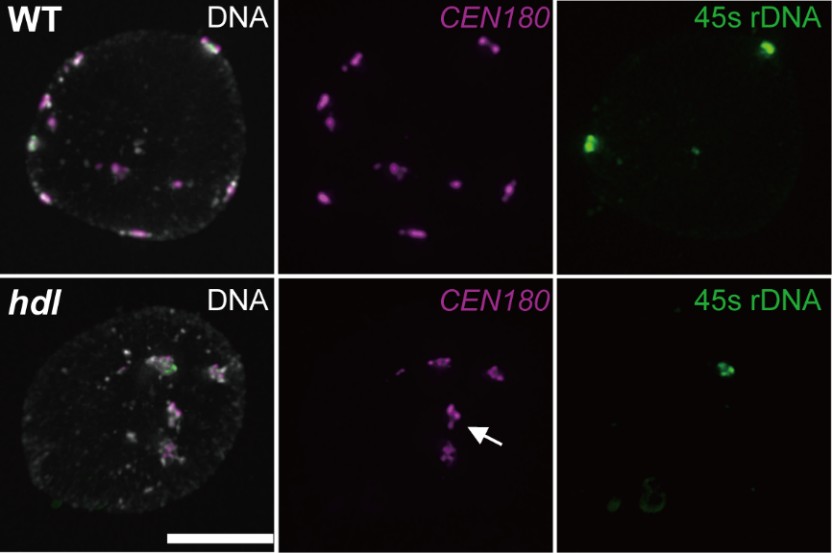 HDL maintains chromatin organization. DNA FISH shows altered CEN180 clustering in hdl mutants, indicating disrupted chromocenter organization. Photo credit: Academia Sinica,