


 Home
HomeDate: 2025-12-02
On December 1, Academia Sinica hosted the second TAIWAN BRIDGES series lecture, featuring Ms. Nadia Murad, recipient of the 2018 Nobel Peace Prize. In her lecture “Who Can Influence the End of Conflict-Related Sexual Violence (CRSV) Worldwide? – The Power of Personal Stories and the Role of Activism,” Ms. Murad discussed her personal journey and her longstanding advocacy of global human rights.
President James C. Liao noted that Ms. Murad has spent years advancing international human rights, pushing for judicial remedies and systemic reform. She was awarded the 2018 Nobel Peace Prize for her efforts to end the use of sexual violence as a weapon of war. Her advocacy has become a powerful global symbol of human rights, reflecting humanity’s shared values.
Ms. Murad is a member of the Yazidis, a minority group from the Middle East. In 2014, her hometown of Kocho was invaded by armed militants. After escaping the atrocities she endured, she stepped onto the world stage, raising awareness at the United Nations and across the international community about the urgent need to confront CRSV.
The lecture was organized by the Institute of Sociology, Academia Sinica. Institute Director Prof. Chih-Jou Jay Chen noted that Ms. Murad’s visit encourages the academic community to engage more deeply with global issues of gender, violence, war and justice. Assistant Research Fellow Dr. Jung Chen added that hearing directly from someone with first-hand experience allows researchers and students to better understand the importance of institutional reform and international advocacy—making this event a rare and meaningful dialogue between academia and human rights practice.
During the lecture, Ms. Murad conversed with Prof. Mei-Hua Chen, Distinguished Professor and Dean of the College of Social Sciences at National Sun Yat-sen University. Speaking with calm yet unwavering conviction, Ms. Murad recounted her experiences and paths to recovery. More than two hundred attendees listened intently, many moved by her courage in transforming trauma into advocacy.
Ms. Murad underscored the fact that conflict-related sexual violence is not merely an individual tragedy; it is intertwined with international law, political dynamics, ethnic identity, and social and cultural structures. To end such atrocities, she stressed that governments and international organizations must strengthen legal frameworks and prosecution mechanisms to ensure accountability for perpetrators. At the same time, non-governmental organizations and local communities play indispensable frontline roles in supporting survivors’ recovery. She called on the international community to amplify survivors’ voices and ensure they are included in policy discussions and cross-border collaboration—so that no one endures such pain again.
Ms. Murad also spoke about the advocacy initiatives she is currently leading. She recalled that, as a child, she once dreamed of opening a small beauty salon where the women in her village could gather, talk, and make friends—because in the environment where she grew up, women had almost no public space of their own. Today, that dream has taken shape in a far more powerful form: she has established the New Women’s Center in Sinjar, a safe space where local women can learn, share their experiences, receive psychological support, and discuss issues such as community rebuilding, education, and livelihoods. Ms. Murad noted that seeing more and more women enter the center to attend classes and activities reassures her that, no matter how difficult the path of advocacy may be, it is all worthwhile.
After the talk, many attendees brought copies of The Last Girl, her memoir based on her own experiences, and took the opportunity to interact with her in person. Ms. Murad engaged warmly with readers, generously sharing her thoughts and contributing to a warm and lively atmosphere.
The TAIWAN BRIDGES program is jointly organized by Academia Sinica, National Taiwan University, and ten other academic institutions in Taiwan, in collaboration with the International Peace Foundation. The initiative aims to foster deep exchanges between Taiwan and leading global scholars. From November 2025 through April 2026, ten Nobel Laureates in the fields of biomedicine, chemistry, peace, and physics will visit Academia Sinica. Through interdisciplinary and international dialogue, the program seeks to cultivate a broad and dynamic global platform for intellectual exchange.
The next TAIWAN BRIDGES lecture will be held on January 16, 2026, featuring Dr. Serge Haroche, laureate of the 2012 Nobel Prize in Physics, who will speak on “New Developments and Applications in Laser Science and Quantum Optics, Electronics and Computing.”
Registration link: https://forms.gle/znjx9iQyxbxVkTCU9
-
Ellen Lu, Section Chief,Department of International Affairs, Academia Sinica
(02) 2787-2688,phlu@as.edu.tw
-
Stanley Lin,Acting Senior Executive Officer, Department of International Affairs, Central Administrative Office, Academia Sinica
(02) 2789-9446,lsd@gate.sinica.edu.tw
-
Ms. Yi-ling Lee, Media & Public Affairs, Secretariat, Academia Sinica
(02) 2787-2717,cvcc54@as.edu.tw
-
Ms. Steffi Tung Lin, Media & Public Affairs, Secretariat, Academia Sinica
(02) 2789-8820,tunglin@as.edu.tw
-
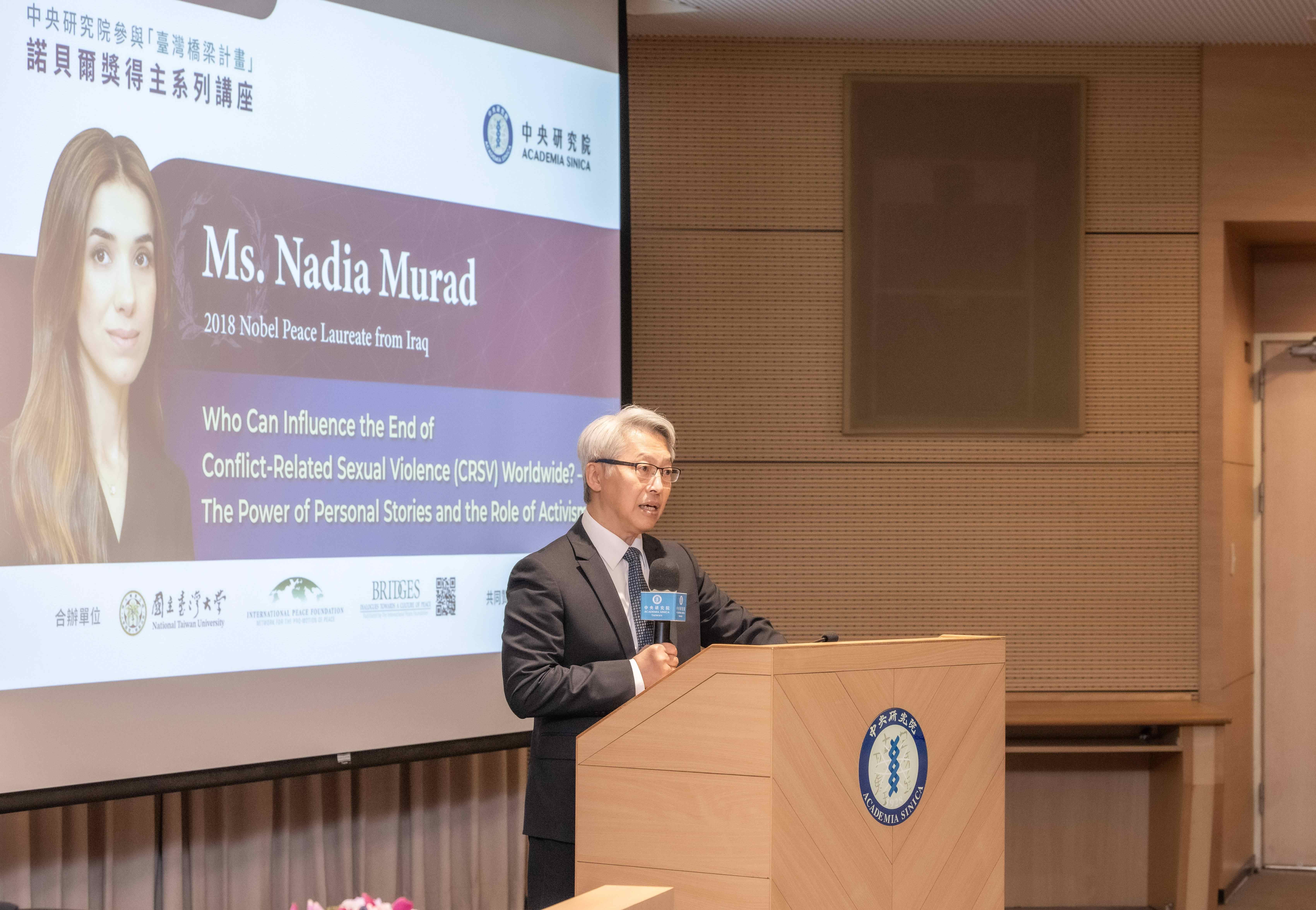 Remarks by Academia Sinica President James C. Liao. Photo credit: Academia Sinica.

-
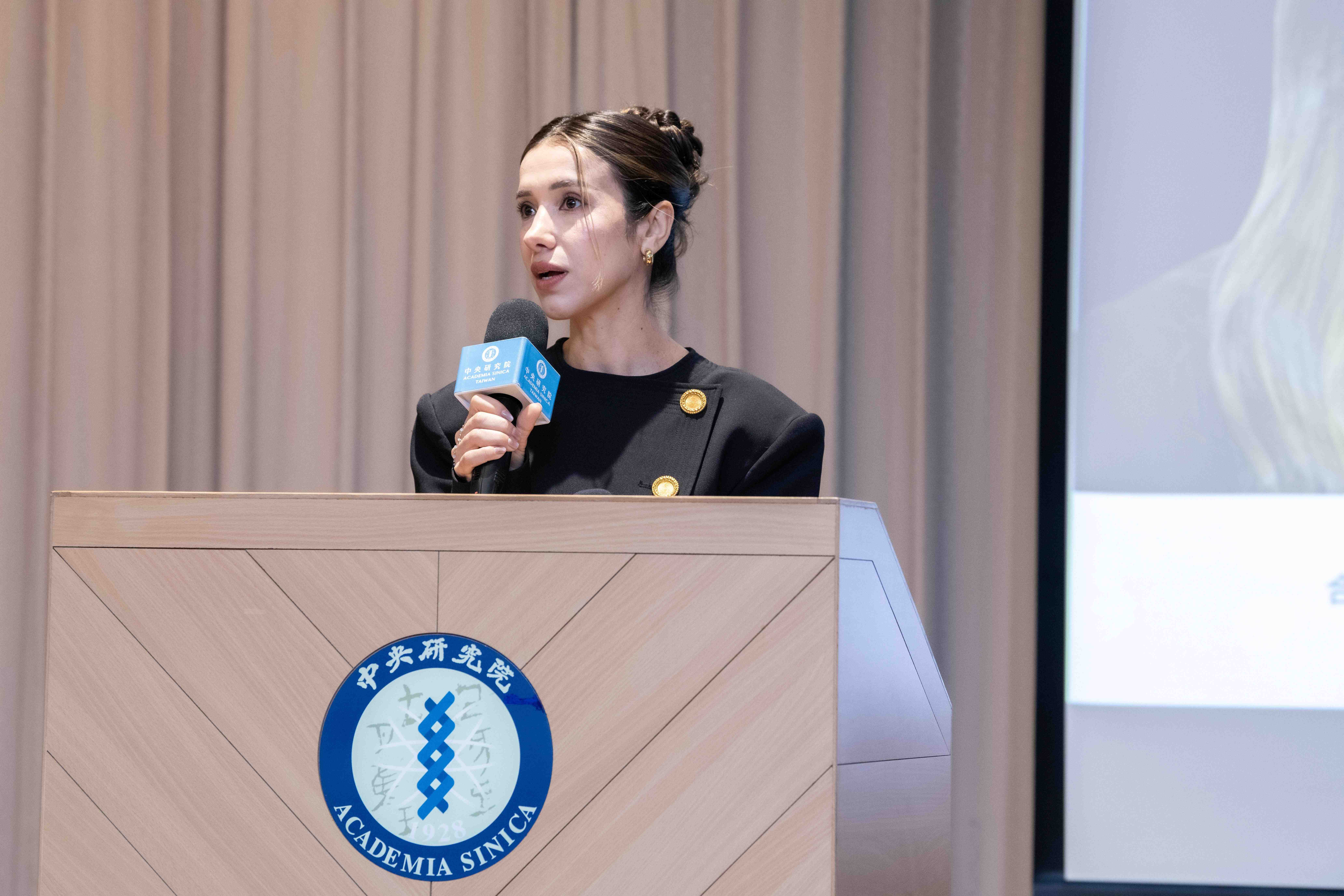 Ms. Nadia Murad delivers remarks. Photo credit: Academia Sinica.
-
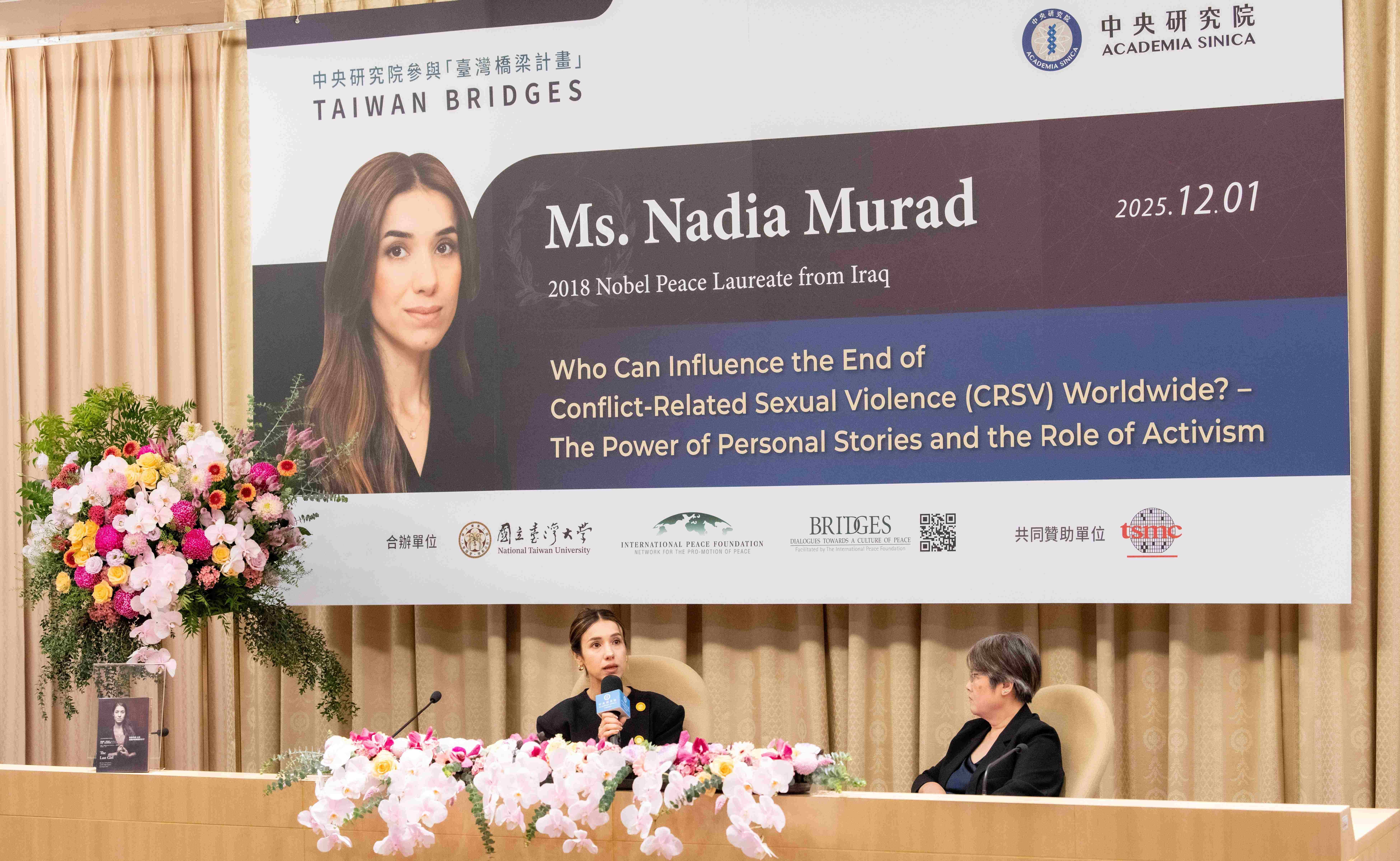 Ms. Nadia Murad in conversation with Distinguished Professor Mei-Hua Chen of the College of Social Sciences, National Sun Yat-sen University. Photo credit: Academia Sinica.
-
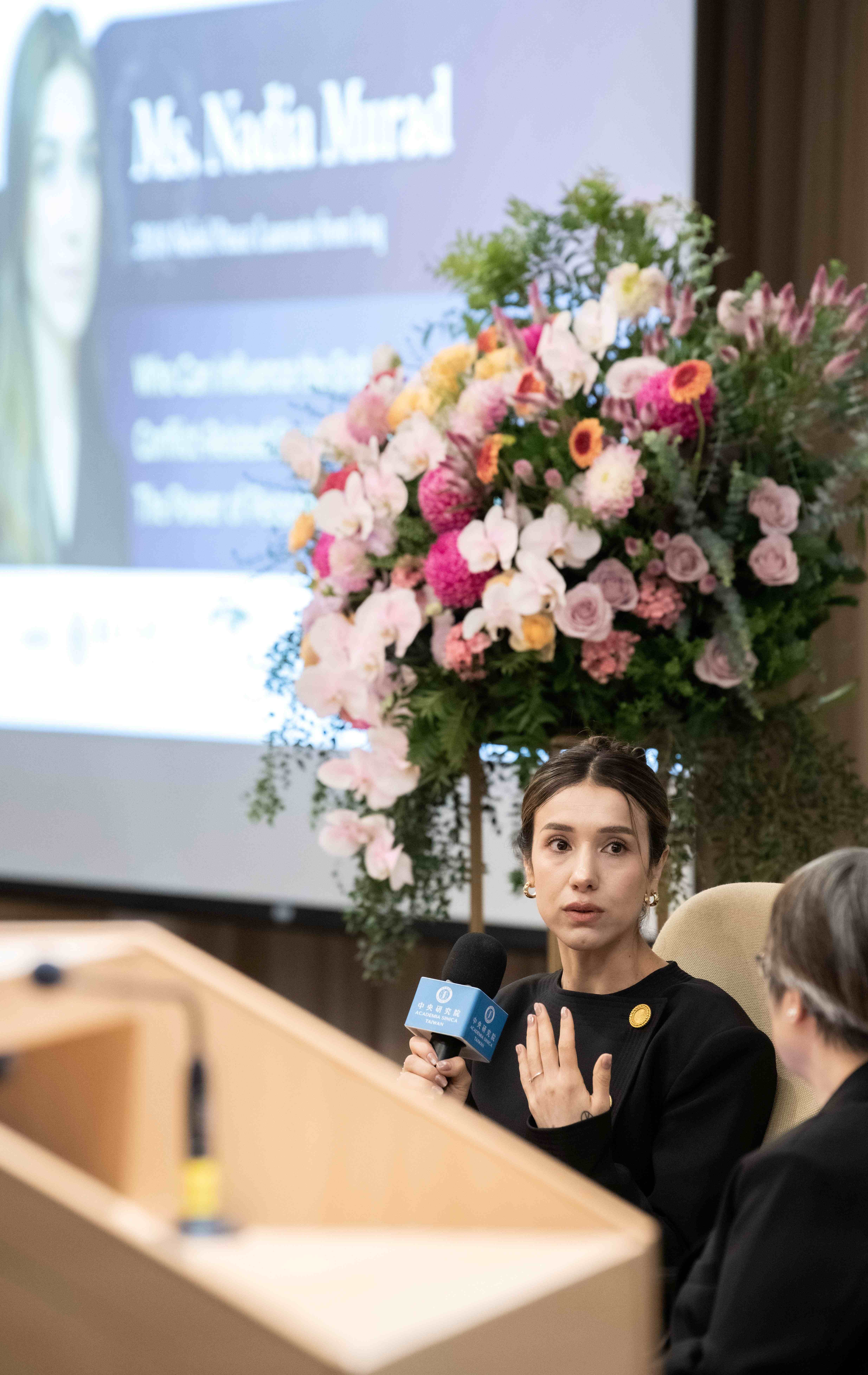 Ms. Nadia Murad in conversation with Distinguished Professor Mei-Hua Chen of the College of Social Sciences, National Sun Yat-sen University. Photo credit: Academia Sinica.
-
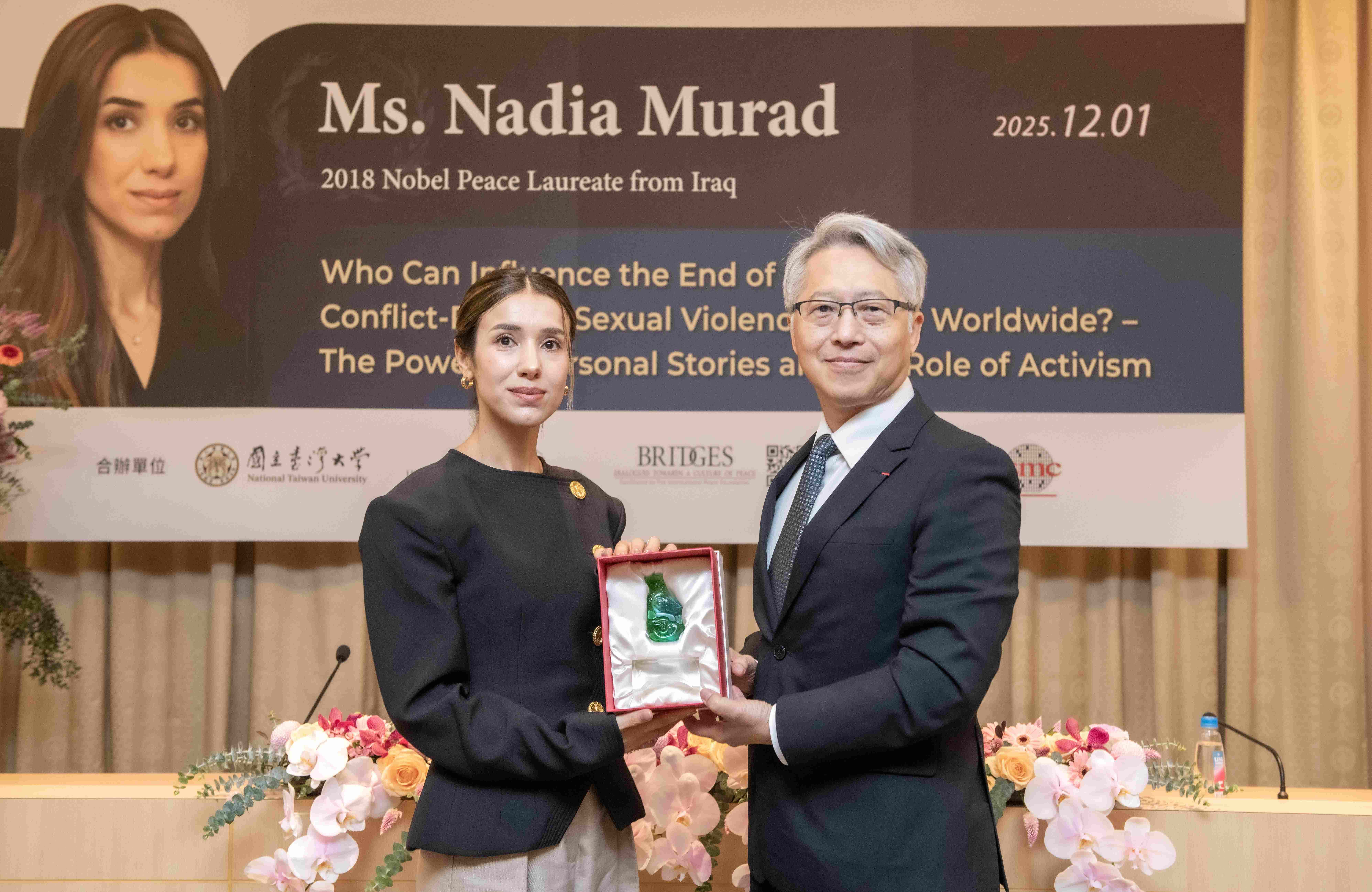 Academia Sinica President James C. Liao and Ms. Nadia Murad. Photo credit: Academia Sinica.
-
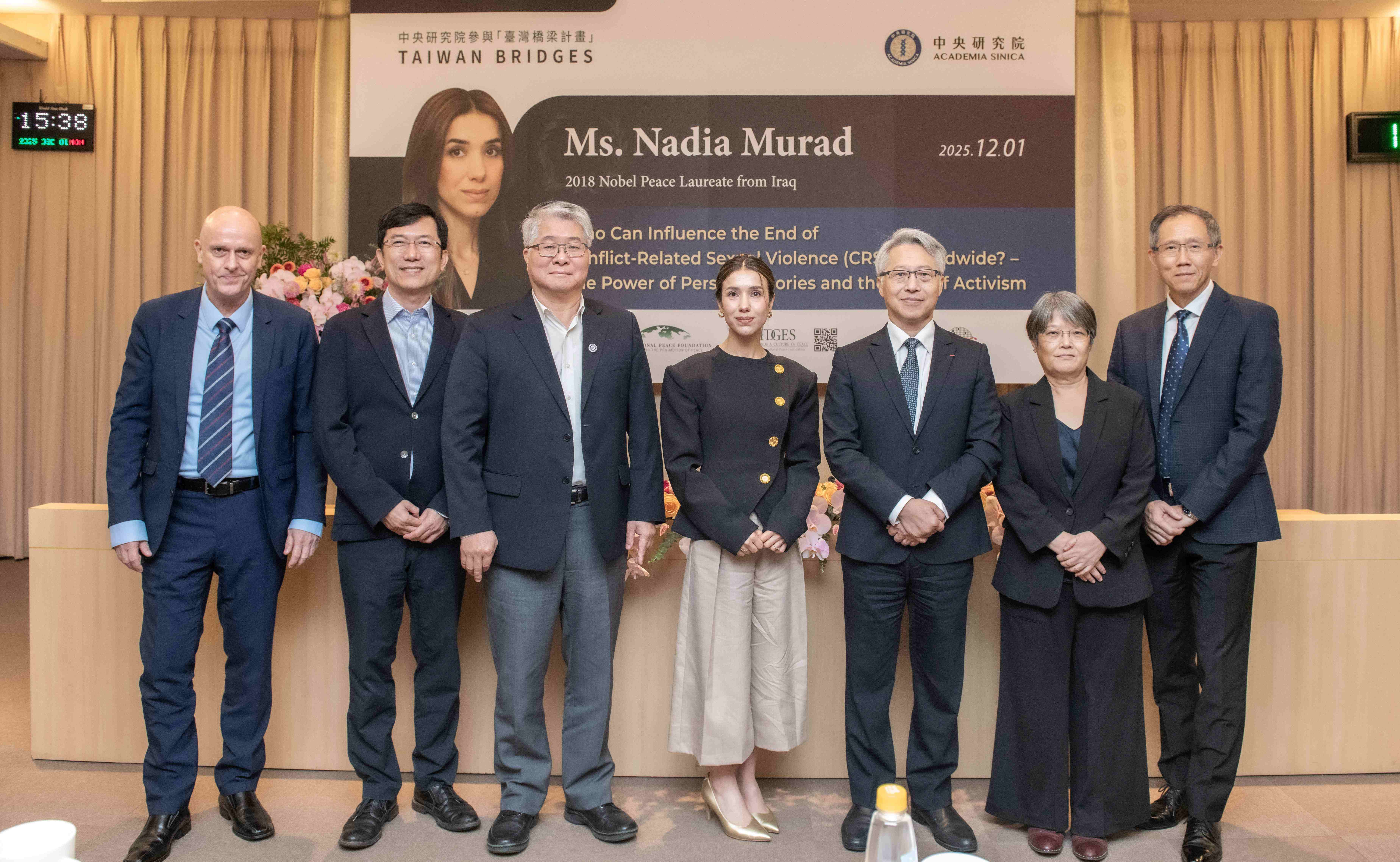 From left to right: Uwe Morawetz, Chairman of the International Peace Foundation; Chih-jou Chen, Director of the Institute of Sociology, Academia Sinica; Shin-Kun Peng, Vice President of Academia Sinica; Ms. Nadia Murad; James C. Liao, President of Academia Sinica; Professor Mei-Hua Chen; Tzu-Ching Meng, Director of the Department of International Affairs, Academia Sinica. Photo credit: Academia Sinica.