




 Home
HomeDate: 2026-10-08
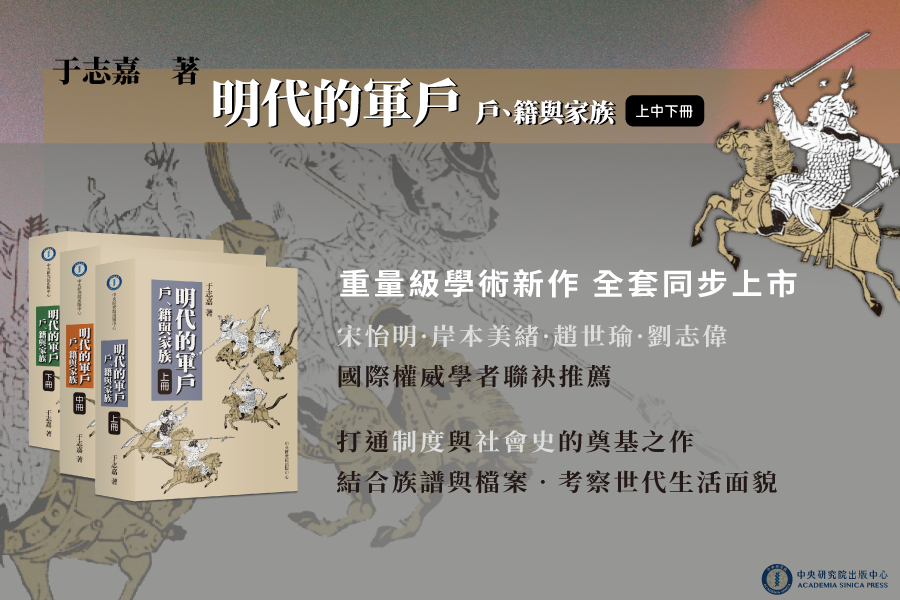
In September 2026, Academia Sinica Press published Military Households in Ming China: Registration, Status, and Lineage by Chih-chia Yue, a retired Research Fellow at Academia Sinica’s Institute of History and Philology. The collection comprises 21 articles organized into seven thematic sections, bringing together more than four decades of research on Ming military households and the garrison system (weisuo, 衛所). Drawing extensively on genealogical sources, Yue connects institutional and social history to examine how state institutions operated within local society.
Military Household Categories, Taxation, and Service Obligations
Under the Ming garrison system, military households bore hereditary service obligations. Their members accounted for approximately one-fifth of the empire’s population. Maintaining a supply of servicemen and ties between households in their places of origin and those at the garrisons involved household registration, the allocation of taxes and service obligations, and arrangements within families.
Yue distinguishes three categories: military households in the garrisons, military households in their places of origin, and military households with attached registration. The last category has received comparatively little scholarly attention. Using sources ranging from official records and local gazetteers to genealogies, she investigates the registration status and service obligations of these households, as well as their relationship to the lijia (里甲) system. In the context of tax and service reforms, she examines how the division of military households and the establishment of juntu (軍圖) affected lijia organization. She also examines changes in military farmland, registration, and tax collection as garrisons were abolished or merged during the Qing dynasty.
Military Service and Lineage Organization
Drawing on genealogies and guard appointment registers spanning several centuries, Yue examines how military households arranged to meet their service obligations under institutional constraints. To cope with onerous service obligations and preserve lineage continuity, many households arranged for dependents (jiaren, 家人) or adopted sons (yinan, 義男) to serve as substitutes. In some cases, military service continued under the original registered household name even when the actual serviceman had been replaced. Thus, the continuity of a registered household name could coexist with changes in the individuals who served and in their kinship relationships.
Relatives in home localities contributed to service expenses, while some families allocated land whose rental income financed military equipment and travel. Yet concerns about military obligations could also lead to the omission or obscuring of lineage branches with military status in genealogies. Once the relevant garrisons no longer existed and concerns about service obligations had subsided, later generations sought out relatives and organized their genealogical records. Moving from household categories and their operation to substitution arrangements and the estrangement and reunion of distant kin, the collection brings together research on household registration, fiscal and service obligations, and lineages to show how state institutions operated within local society and shaped lives across generations.
Scholarly Endorsements for a Foundational Work Bridging Institutional and Social History
Harvard University Professor Michael Szonyi praises Yue’s exceptional contributions to the study of Ming military households and the garrison system. Mio Kishimoto, a Research Fellow at Toyo Bunko, commends the collection’s vivid account of military families and their little-known lives. Peking University Professor Shiyu Zhao highlights the interweaving of state institutions, social practices, and individual experiences, while Professor Zhiwei Liu of Sun Yat-sen University regards the book as a model for connecting institutional and social history.
Combining institutional analysis with locally preserved sources, the collection offers detailed evidence and case studies for research on Ming and Qing household registration, fiscal and service obligations, and lineage history. It also deepens understanding of the relationship between the garrison system and local society.
Book Information: https://reurl.cc/qa28Aq、https://reurl.cc/AXa8rK
Academia Sinica Press Facebook Page: https://www.facebook.com/share/p/14qYeQoMcFV/