


 Home
HomeDate: 2026-02-26
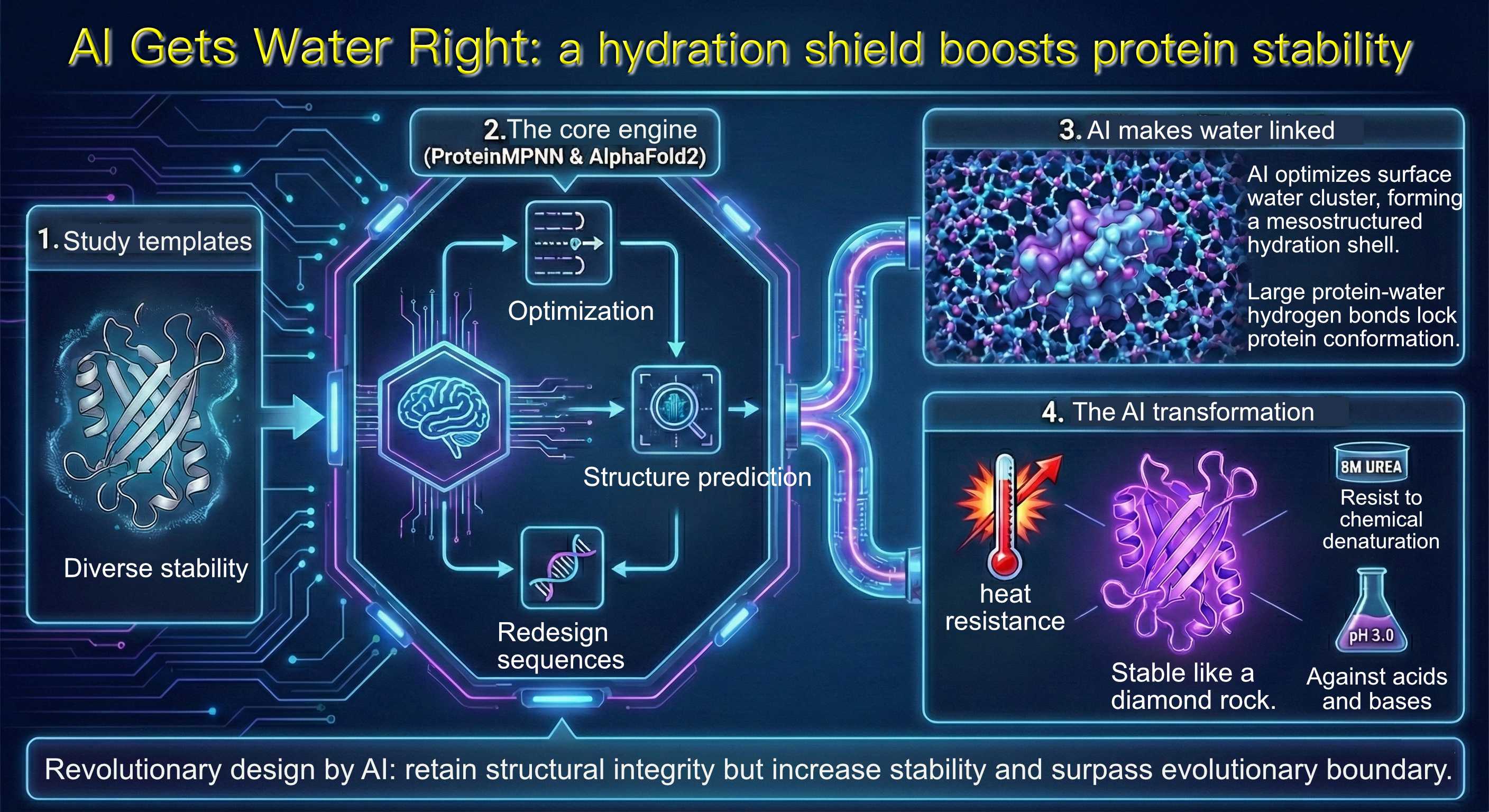
Protein stability under harsh conditions is a central challenge in bioengineering, directly impacting the manufacturing, storage, and practical use of therapeutic proteins and industrial enzymes. Traditionally, strategies to enhance protein stability have focused on strengthening the tight packing of the hydrophobic core. However, a multinational research team led by Dr. Kuen-Phon Wu, Associate Research Fellow at the Institute of Biological Chemistry, Academia Sinica, has discovered that artificial intelligence (AI) can enhance protein stability in an unexpected way — not only by redesigning the protein itself, but also by “designing” the surrounding water molecules.
Using the AI-based tool ProteinMPNN, the team redesigned ubiquitin and structurally related ubiquitin-fold proteins such as ISG15. The resulting variants (R4, R10, and ICVs) demonstrated remarkable resilience to extreme conditions. Even under temperatures exceeding 120 °C and strongly denaturing environments (pH 3 and 8 M urea), the proteins retained their native folded structures.
Through advanced nuclear magnetic resonance (NMR) spectroscopy and molecular dynamics simulations, the researchers found that AI reorganizes and clusters surface charges on the protein. This redistribution promotes the formation of an ordered, structured hydration shell around the protein surface. This protective water layer effectively buffers thermal and chemical stress, suppressing unfolding pathways. The findings reveal that hydration structure is a sequence-encoded and engineerable stability mechanism.
This study establishes a new design principle for durable biologics and biocatalysts: in addition to reinforcing the “dry” hydrophobic core, protein engineers must also control the “wet” outer water environment that surrounds the protein.
The first author of the study is doctoral student Lu-Yi Chen from the Institute of Biochemical Sciences at National Taiwan University. Collaborating institutions include the University of California, Riverside, and Osaka University. The research was supported by Academia Sinica and National Science and Technology Council, with additional assistance from Academia Sinica’s core facilities in biophysics, high-field NMR, and big data analysis. The study was published on February 5, 2026, in the Journal of the American Chemical Society (JACS).
-
Link