


 Home
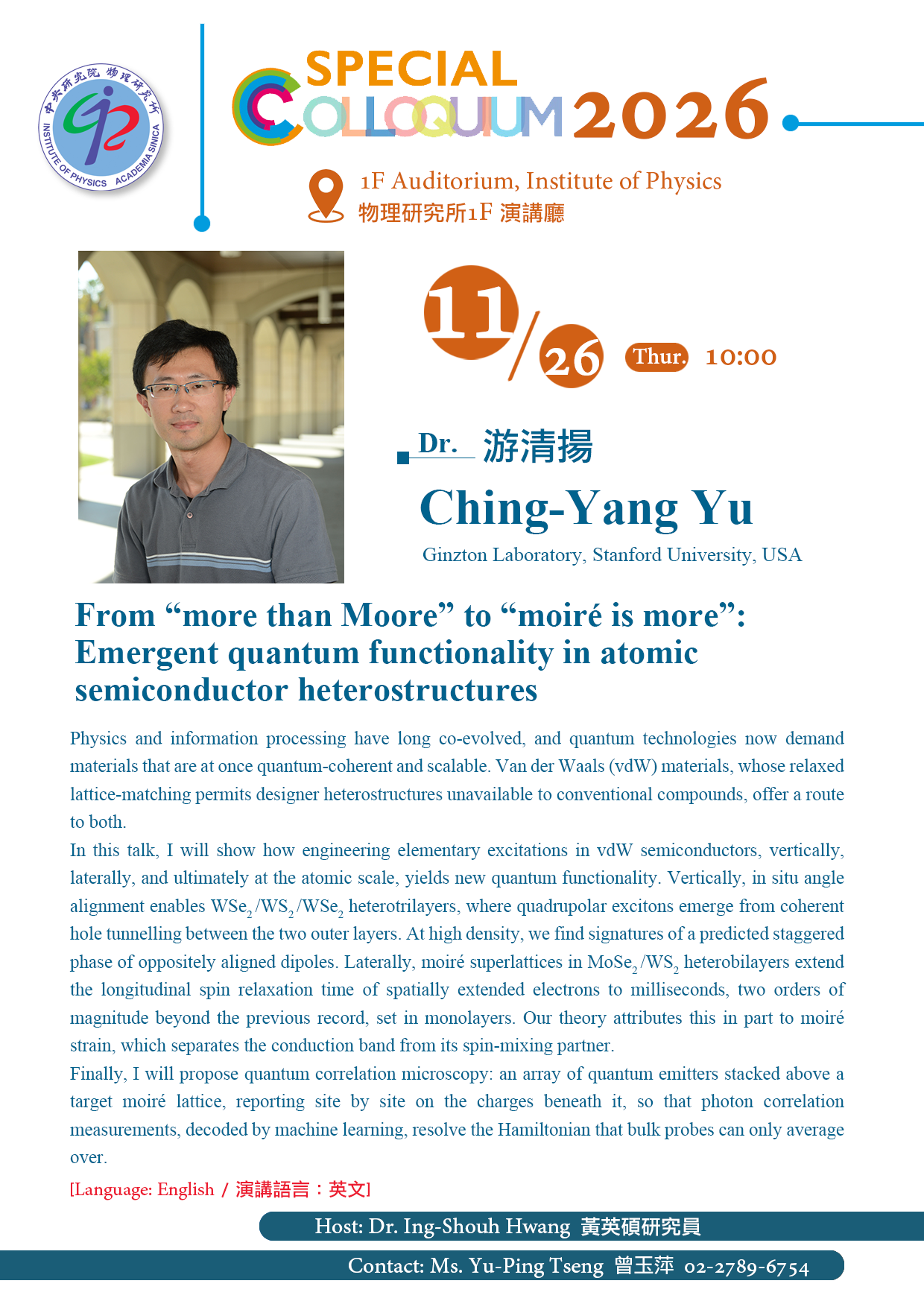
- Lectures
- Institute of Physics
- Location
1F, Auditorium, Institute of Physics
- Speaker Name
Dr. Ching-Yang Yu (Ginzton Laboratory, Stanford University)
- State
Definitive
- Url
https://www.phys.sinica.edu.tw/lecture_detail.php?id=3281&eng=T
2026-11-26 10:00 - 12:00

Physics and information processing have long co-evolved, and quantum technologies now demand materials that are at once quantum-coherent and scalable. Van der Waals (vdW) materials, whose relaxed lattice-matching permits designer heterostructures unavailable to conventional compounds, offer a route to both. In this talk, I will show how engineering elementary excitations in vdW semiconductors, vertically, laterally, and ultimately at the atomic scale, yields new quantum functionality. Vertically, in situ angle alignment enables WSe₂/WS₂/WSe₂ heterotrilayers, where quadrupolar excitons emerge from coherent hole tunnelling between the two outer layers. At high density, we find signatures of a predicted staggered phase of oppositely aligned dipoles. Laterally, moiré superlattices in MoSe₂/WS₂ heterobilayers extend the longitudinal spin relaxation time of spatially extended electrons to milliseconds, two orders of magnitude beyond the previous record, set in monolayers. Our theory attributes this in part to moiré strain, which separates the conduction band from its spin-mixing partner. Finally, I will propose quantum correlation microscopy: an array of quantum emitters stacked above a target moiré lattice, reporting site by site on the charges beneath it, so that photon correlation measurements, decoded by machine learning, resolve the Hamiltonian that bulk probes can only average over.