

 Home
Home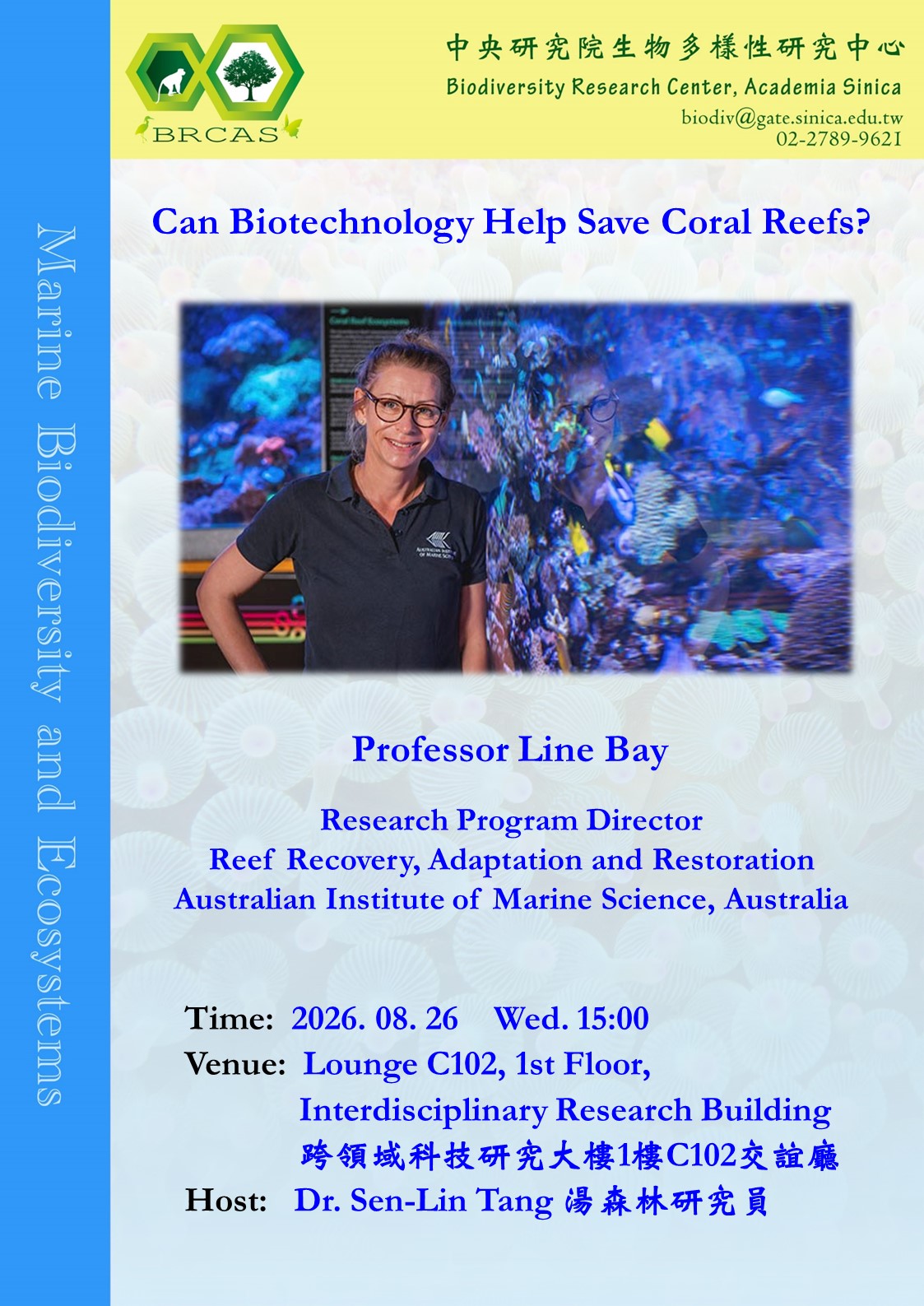
- Lectures
- Biodiversity Research Center
- Location
Lounge C102, 1st Floor, Interdisciplinary Research Building
- Speaker Name
Professor Line Bay (Australian Institute of Marine Science, Australia)
- State
Definitive
- Url
2026-08-26 15:00 - 15:40

Cancelled
Due to the approaching typhoon, the speakers have rescheduled their travel plans and cancelled their seminars at our center. We apologize for any inconvenience caused.
Abstract
Coral reef restoration has been practiced for decades to mitigate damage from local pressures but accelerating climate threats have rendered traditional approaches limited in scale and vulnerable to large disturbances such as global mass bleaching events. New restoration approaches are urgently needed that simultaneously upscale the technology for coral production and seeding while accelerating the pace at which scientific knowledge around coral adaptation is generated and applied. This presentation will outline how advances in biotechnology are playing an important role in addressing key knowledge gaps and bottlenecks that are currently limiting scale and efficacy of coral reef restoration on the Great Barrier Reef. Gene editing using CRISPR-Cas can be used to understand gene function, potentially enhance trait expression and introduce inert DNA tags to track seeded corals. Multi-omics approaches combined with robotics can be used to unlock our understanding of the biological basis of surviving corals and to support the efficient identification of brood stock for breeding purposes. Building on these advances, a location-based hub concept is presented to identify and breed corals that can better survive current and future conditions. With science at its core, local restoration hubs are multi-purpose reef locations used to turbo-charge knowledge of coral heat tolerance, health and fitness, develop brood stock for restoration, and act as living biobanks for critical biodiversity. The hub activities will include interdisciplinary collaboration and engagement amongst interest groups, including scientists and engineers, rights-holders and stakeholders, decision makers and funders. They will also include training and capacity building for practitioners necessary for long-term success. The coral reef restoration challenge remains immense, requiring a moonshot of innovation and collaboration. The potential benefits delivered through a successful hub concept to sustain reef functions for the billions who depend on them are equally profound.
~Welcome your participation~