







 Home
Home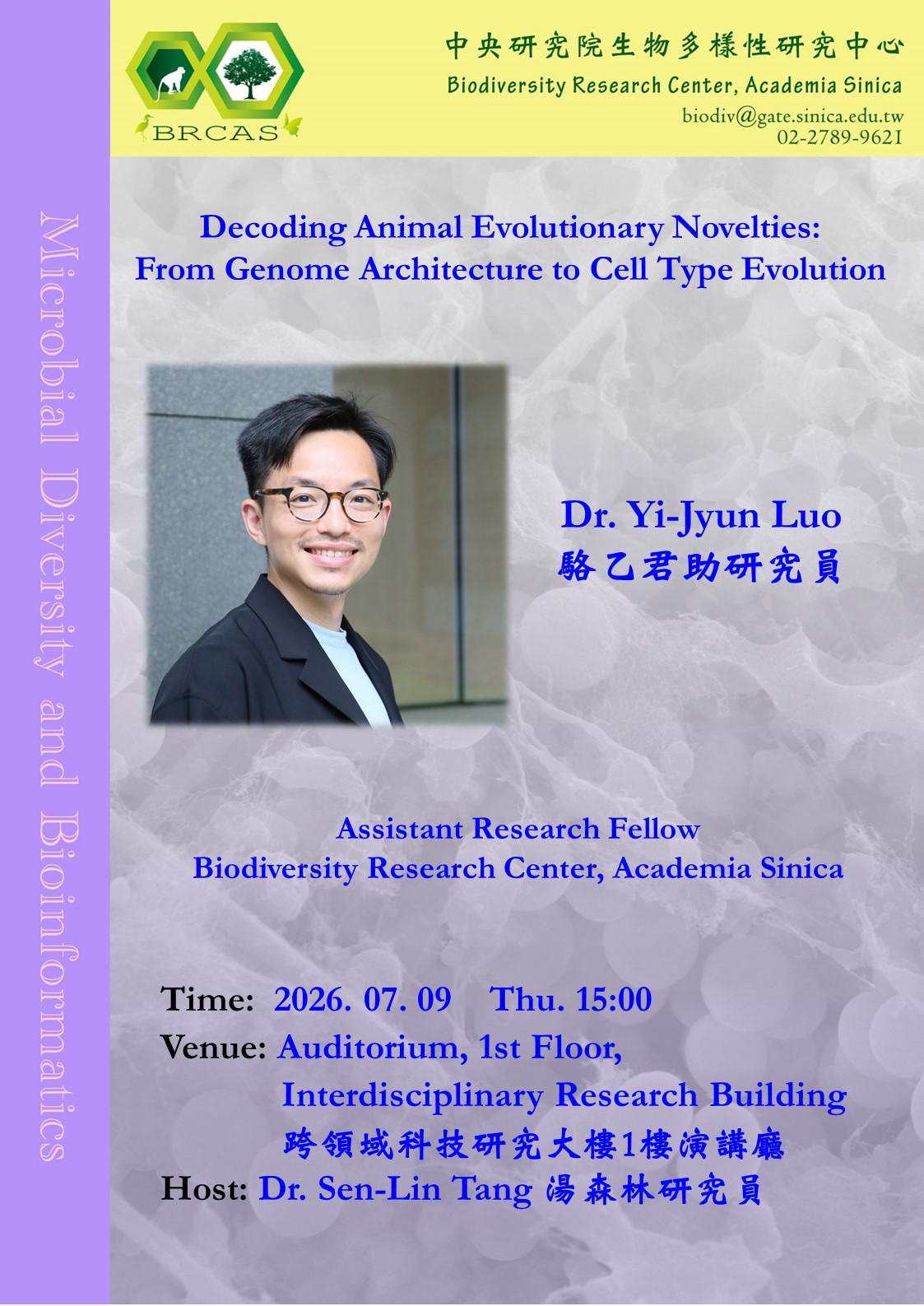
- Lectures
- Biodiversity Research Center
- Location
Auditorium, 1st Floor, Interdisciplinary Research Building
- Speaker Name
Dr. Yi-Jyun Luo (Biodiversity Research Center, Academia Sinica)
- State
Definitive
- Url
2026-07-09 15:00 - 16:30

Abstract
How do evolutionary novelties arise during animal evolution? Our laboratory addresses this question by integrating comparative genomics, functional genomics, and single-cell transcriptomics to investigate the genomic and cellular basis of evolutionary novelty. In this talk, we present three complementary research directions that illustrate this approach. First, we show how chromosome-scale genome comparisons provide evolutionary insights beyond sequence-level analyses. Rare chromosomal rearrangements, such as chromosome fusions, serve as phylogenetically informative markers that help resolve deep animal relationships and provide an evolutionary context for the emergence of biological innovations. Second, we explore the evolution of coral calcification by integrating chromosome-scale comparative genomics with single-cell transcriptomics. Comparative genomic analyses establish a phylogenetic framework for inferring ancestral and derived states, enabling reconstruction of the evolutionary history of coral calcification. Within this framework, comparative single-cell analyses identify calicoblasts as a specialized cell type unique to reef-building corals, suggesting that coral calcification emerged through the coordinated evolution of chromosome structure, biomineralization genes, and a novel skeleton-forming cell state. Finally, we investigate the evolution of animal–algal photosymbiosis using symbiotic acoel worms as a model system. By integrating single-cell transcriptomics with experimental perturbations, we identify an ancestral endodermal program that has been repeatedly co-opted for photosymbiosis across distantly related animal lineages. Our analyses suggest that the metabolic functions and transcriptional plasticity of digestive endoderm may have facilitated the repeated evolution of animal–algal photosymbiosis. Together, these studies illustrate how comparative genomics and single-cell transcriptomics can be integrated to investigate how genome architecture and cell type evolution contribute to the emergence of animal evolutionary novelties.
~Welcome your participation~