







 Home
HomeDate: 2026-01-07
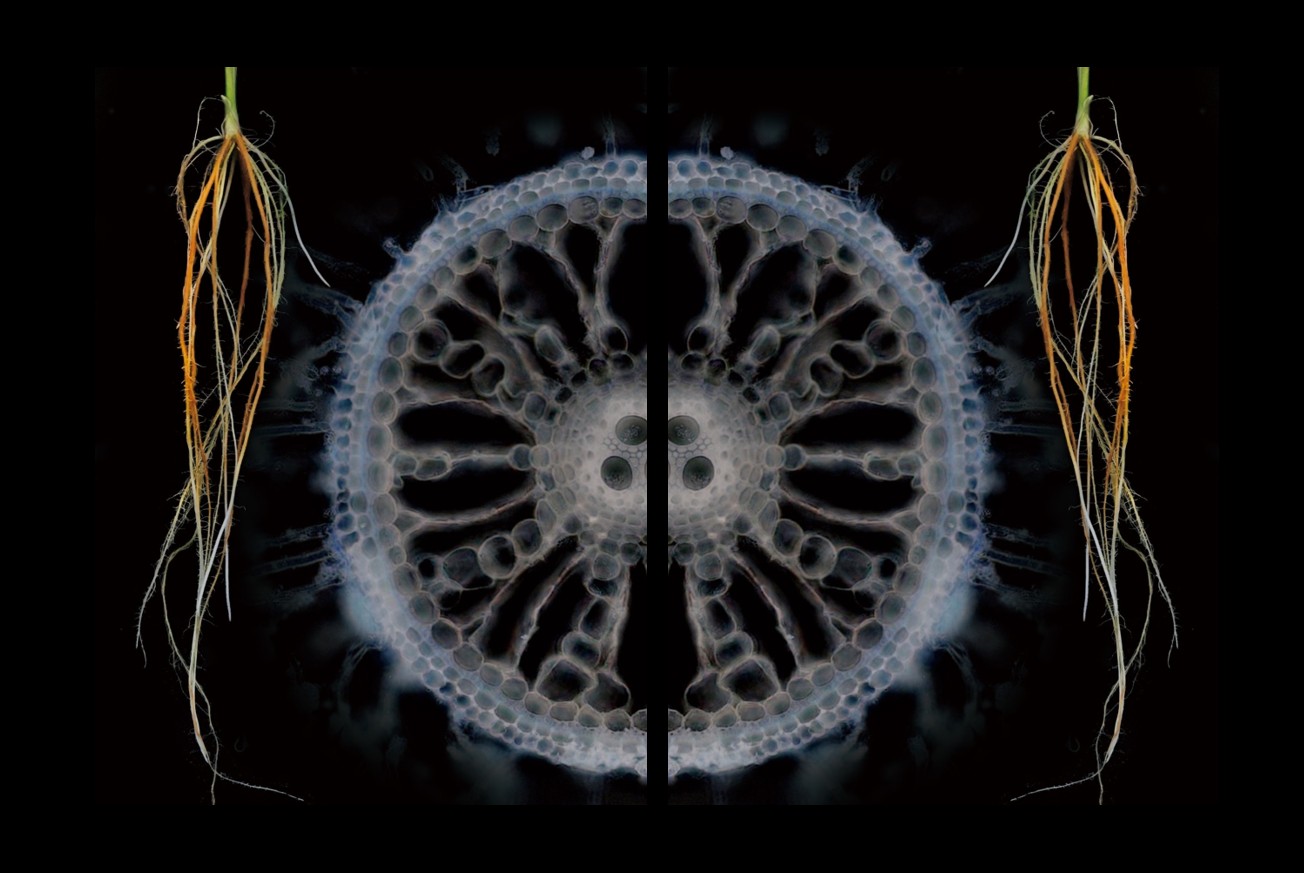
In the oxygen-poor and excess iron conditions of flooded paddy fields, rice relies on two essential protective strategies to survive: the formation of the aerenchyma inside the root and the reddish-brown iron plaque on the root surface. Aerenchyma acts like an internal ventilation system, channeling oxygen from the shoot to the submerged root to oxidize toxic ferrous iron to ferric iron that precipitates and forms iron plaque on the root surface. For decades, these two traits were assumed to be inseparable and arose from a single regulatory pathway. Yet this widely accepted idea was rooted more in superficial observation and assumption than in direct experimental evidence.
Motivated by a long-standing curiosity about iron plaque, a research team led by Distinguished Research Fellow Kuo-Chen Yeh at Academia Sinica’s Agricultural Biotechnology Research Center began, more than ten years ago, to investigate the genetic basis of iron plaque formation. Screening a large collection of chemically mutagenized rice lines collected by Prof. Chang-Sheng Wang at National Chung Hsing University, the team discovered mutants defective in aerenchyma and/or iron plaque formation. A TIGP graduate student, Jeevan Kumar Shrestha, identified mutants defective only in iron plaque but not aerenchyma formation, revealing for the first time that the presence of aerenchyma does not warrant iron plaque formation.
Gene mapping of a mutant named AZ1302, lacking both iron plaque and aerenchyma, revealed the mutation of OsPSY2, a key enzyme in carotenoid biosynthesis. Through collaboration with a KAUST team, the team discovered that the mutant has greatly reduced levels of two carotenoid-derived hormones: strigolactones (SLs) and abscisic acid (ABA). Rescue experiments showed that SL restores only aerenchyma, whereas ABA restores only iron plaque, proving that these adaptation strategies are controlled by two independent hormonal pathways.
This discovery overturns a long-standing biological assumption and offers new strategies for breeding rice varieties better adapted to flooded and excess iron environments. The work is published in Nature Plants 2026, DOI: 10.1038/s41477-025-02170-y.
-
Link