





 Home
Home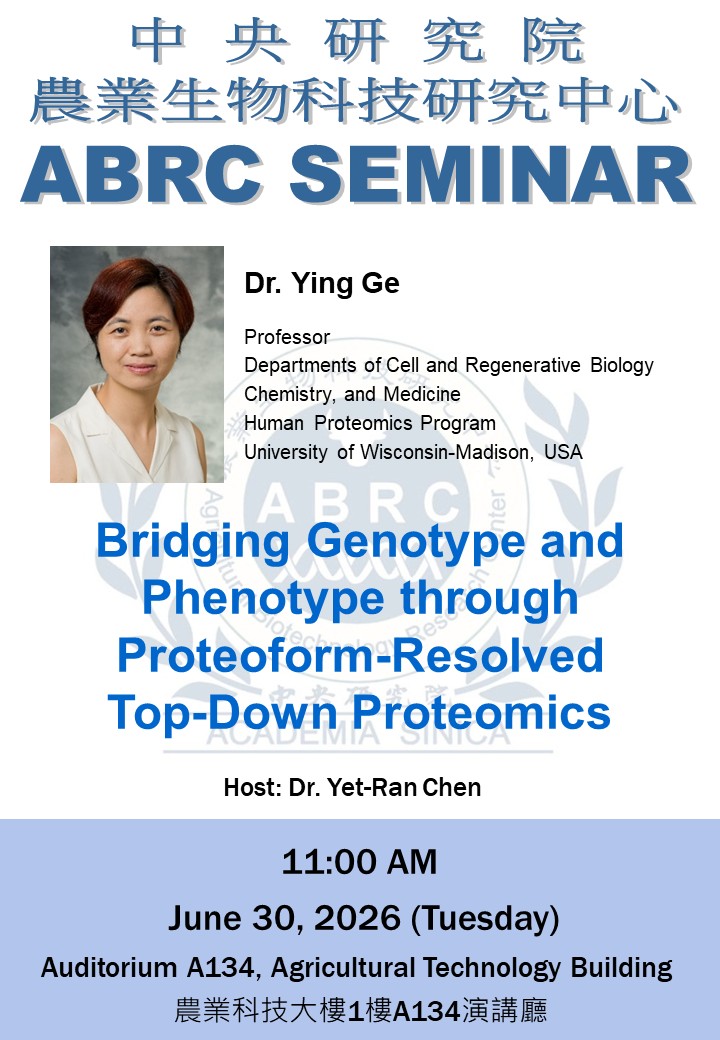
- Lectures
- Agricultural Biotechnology Research Center
- Location
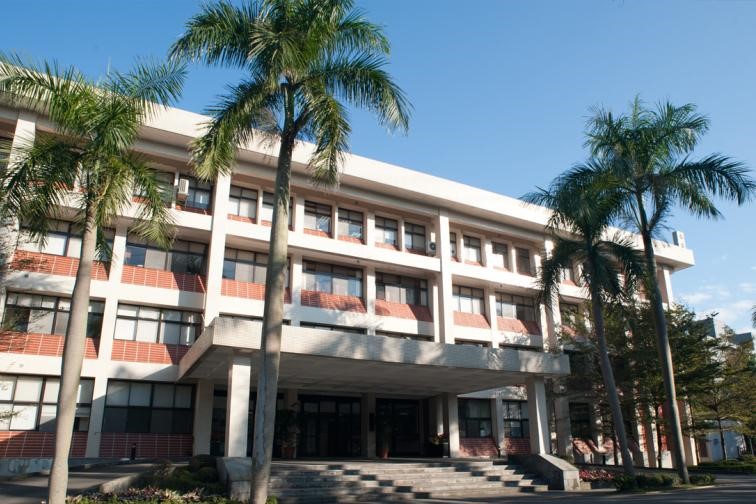
Auditorium A134, Agricultural Technology Building
- Speaker Name
Dr. Ying Ge (Professor, Departments of Cell and Regenerative Biology, Chemistry, and Medicine, Human Proteomics Program, University of Wisconsin-Madison, USA)
- State
Definitive
- Url
2026-06-30 11:00 - 13:00

Proteoforms, the diverse protein products arising from genetic variation, alternative splicing, and post-translational modifications, are the major functional molecules that connect genotype to phenotype. Defining proteoform complexity is therefore essential for understanding biological processes and disease mechanisms. Top-down proteomics directly analyzes intact proteoforms and provides unique insights into protein isoforms, sequence variants, and combinatorial modifications that are often obscured by conventional bottom-up approaches.
In this presentation, I will discuss recent advances from our laboratory in developing high-sensitivity top-down proteomics workflows for comprehensive characterization of proteoforms from limited biological and clinical samples. These advances include new MS-compatible surfactants for protein solubilization, novel multidimensional separation strategies for enhanced proteome coverage, and enabling technologies for more sensitive analysis of low-abundance proteoforms. I will also highlight progress in native top-down proteomics and native nanoproteomics for characterizing endogenous protein complexes directly from human tissues.
Applications to cardiovascular research will be presented to illustrate the biological power of these approaches. In particular, studies of hypertrophic cardiomyopathy, dilated cardiomyopathy, and heart failure have revealed disease-associated alterations in cardiac proteoforms involved in contractile regulation, signaling, and structural remodeling. By directly characterizing intact proteoforms and protein complexes, top-down proteomics provides new opportunities to connect molecular variation with biological function and disease phenotype.Together, these studies demonstrate how proteoform-resolved mass spectrometry can bridge technological innovation with mechanistic biology and help advance precision medicine.