




 Home
Home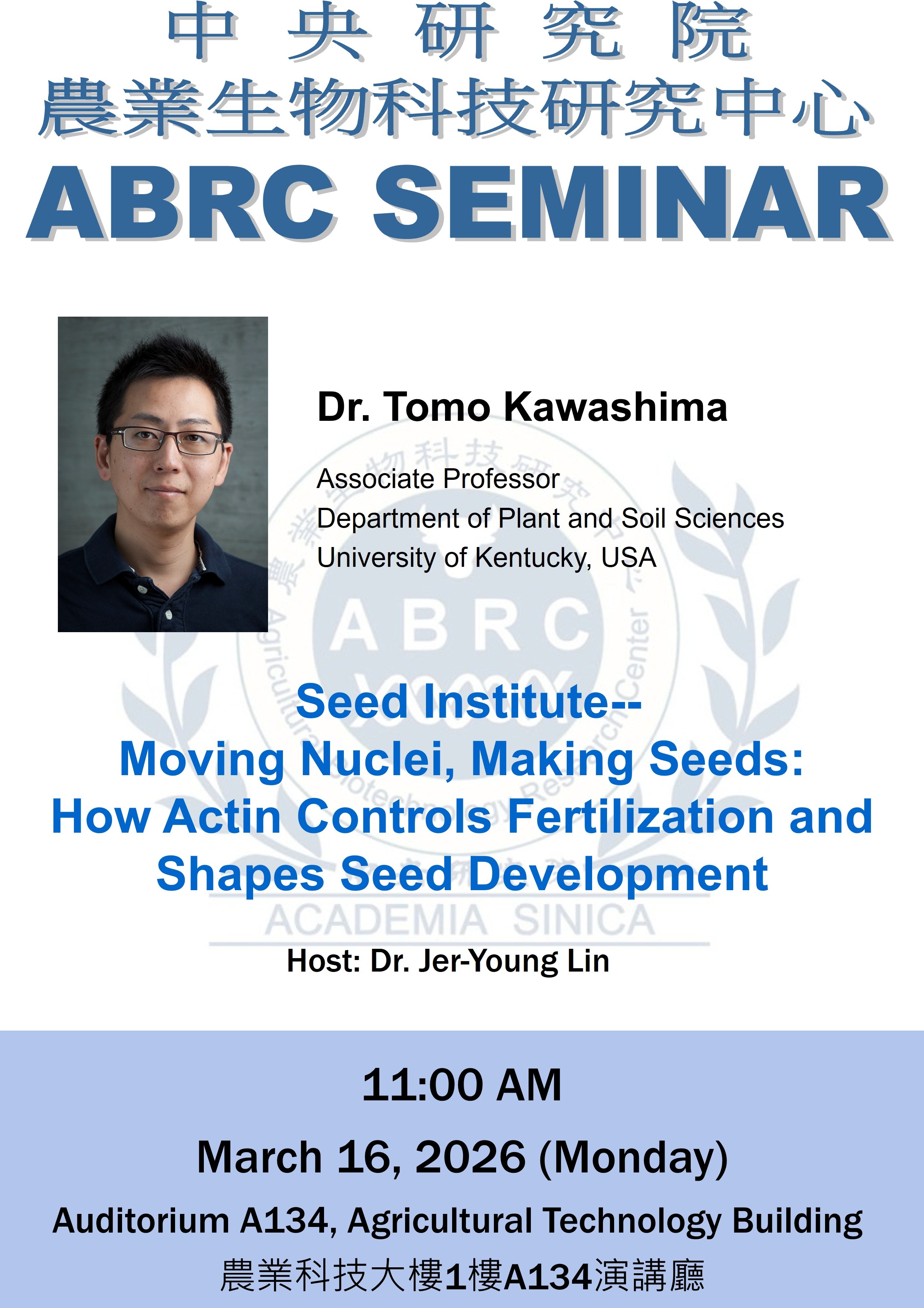
- Lectures
- Agricultural Biotechnology Research Center
- Location
Auditorium A134, Agricultural Technology Building
- Speaker Name
Dr. Tomo Kawashima (Associate Professor, Department of Plant and Soil Sciences, University of Kentucky, USA)
- State
Definitive
- Url
2026-03-16 11:00 - 13:00

Flowering plants perform a unique process of double fertilization, in which one sperm cell fertilizes the egg cell to form the embryo, while the second sperm cell fuses with the central cell to initiate endosperm development. Unlike animals, where microtubules primarily drive pronuclear migration, fertilization in flowering plants relies on dynamic remodeling of actin filaments (F-actin). In the central cell, a continuous inward movement of F-actin toward the nucleus transports the sperm nucleus to enable karyogamy. However, the molecular mechanisms governing this highly specialized cytoskeletal dynamics remain poorly understood.
Using live-cell confocal time-lapse imaging in Arabidopsis thaliana, we demonstrate that sperm nuclear migration is driven by a unique F-actin system regulated independently of the canonical ARP2/3 complex through a plant-specific WAVE/SCAR signaling pathway. We further identify a non-canonical function of the class XI myosin XIG, revealing that XIG actively generates force to drive F-actin movement, rather than serving solely as a cargo transporter.
Following fertilization, the primary endosperm nucleus undergoes rapid synchronous divisions without cytokinesis, forming a large multinuclear coenocyte. Our live-cell imaging reveals that F-actin organizes into dynamic aster-like structures surrounding each nucleus, maintaining their equidistant positioning and coordinating nuclear movement during endosperm expansion. Perturbation of F-actin dynamics disrupts nuclear distribution, endosperm growth, and ultimately seed size, demonstrating a central role for the actin cytoskeleton in early seed development.
Together, these findings establish a unified framework for understanding how plant-specific cytoskeletal mechanisms drive fertilization and early endosperm development. This work provides foundational insight into coenocytic development and identifies new molecular targets for improving fertilization robustness and seed yield, which are critical for sustaining crop productivity under increasing climate instability.