





 Home
Home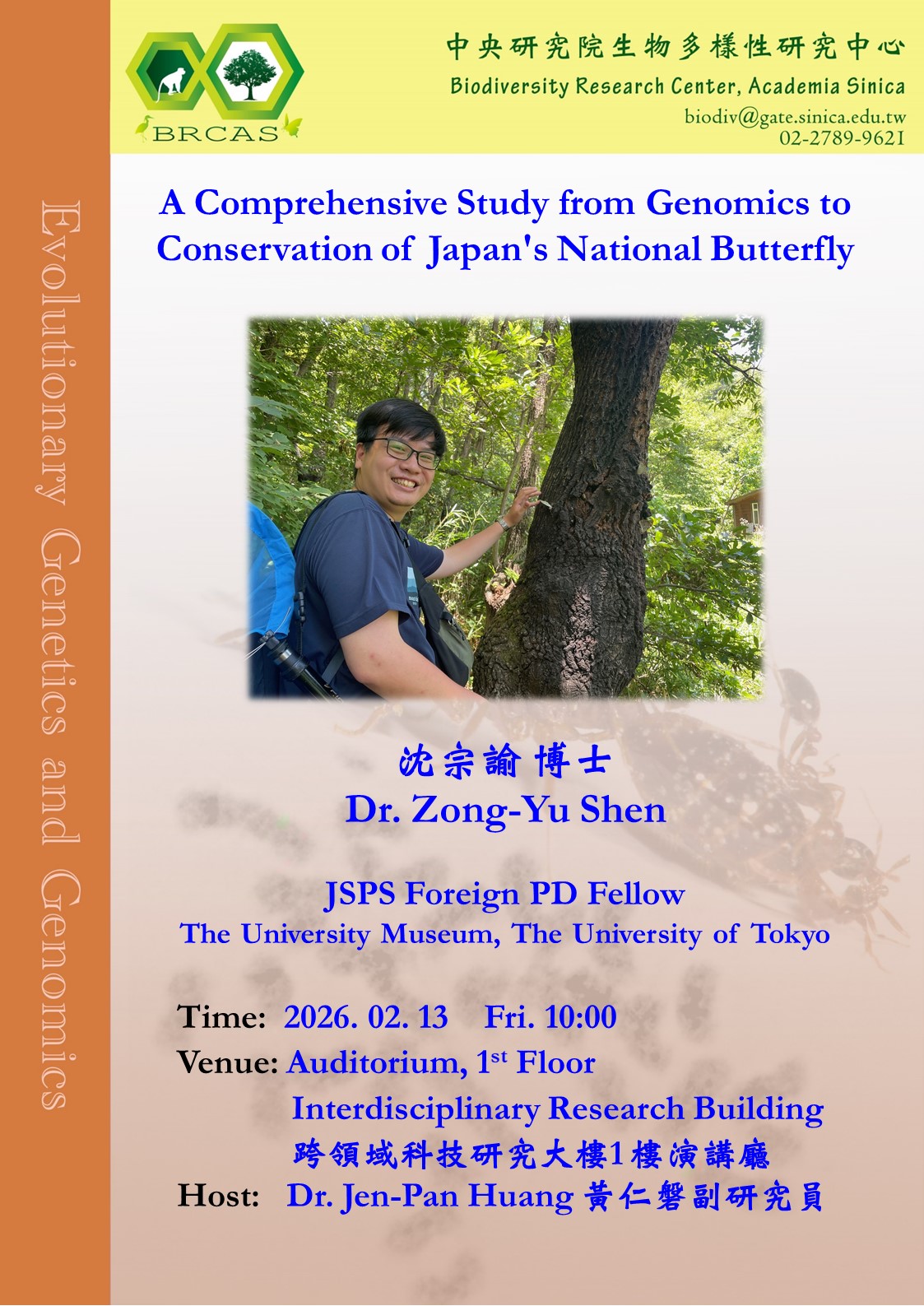
- Lectures
- Biodiversity Research Center
- Location
Auditorium, 1st Floor, Interdisciplinary Research Building
- Speaker Name
Dr. Zong-Yu Shen(The University of Tokyo)
- State
Definitive
- Url
2026-02-13 10:00 - 11:30

Abstract
Species that persist across continental and island systems often experience climatic oscillations, geographic isolation, and ecological transitions. These processes produce complex evolutionary histories that shape present population structure and future persistence. However, divergence, environmental differentiation, and demographic history are often evaluated in isolation. This fragmented approach can leave conservationists without a comprehensive view of how deep-time history and future environmental mismatch interact to influence lineage resilience. Thus, an integrative framework is crucial for defining biologically meaningful CUs and pinpointing the most vulnerable lineages, helping allocate limited conservation resources to where they will have the greatest impact.
Sasakia charonda (Hewitson, [1863]), the national butterfly of Japan, is not only culturally significant but also an iconic umbrella species of the Satoyama landscape. It provides an exceptional single-species system for applying this approach. Four subspecies have been described, including island lineages in Japan and Taiwan and continental lineages across East Asia. Despite this prominence, the evolutionary divergence, demographic history, and environmental differentiation among these lineages remain unresolved. Resolving these dimensions together would establish a robust foundation for CU delineation, as well as for assessing the current genetic state and future vulnerability in the face of ongoing environmental change. We leverage the most comprehensive range-wide sampling to date and the first chromosome-level reference genome. We reconstructed evolutionary divergence and demographic history to explain current phylogeographic patterns, delimiting five biological and evolutionary meaningful CUs with limited contemporary gene flow. Then, we assessed CU-specific genetic health using classical conservation genetic indices and demographic inferences across timescales and evaluated climate-associated vulnerability via genotype–environment association analyses. Our results reveal significant differences in risk among CUs. Populations from Taiwan, southwestern China, and northern Vietnam appear to be the most vulnerable and require urgent management. These findings not only provide a genomic foundation for evidence-based conservation of this culturally and ecologically important butterfly. At the same time, these results also highlight the importance of considering past divergence, current genetic health, and future environmental factors together to ensure conservation-relevant resilience.
~Welcome your participation~