


 Home
Home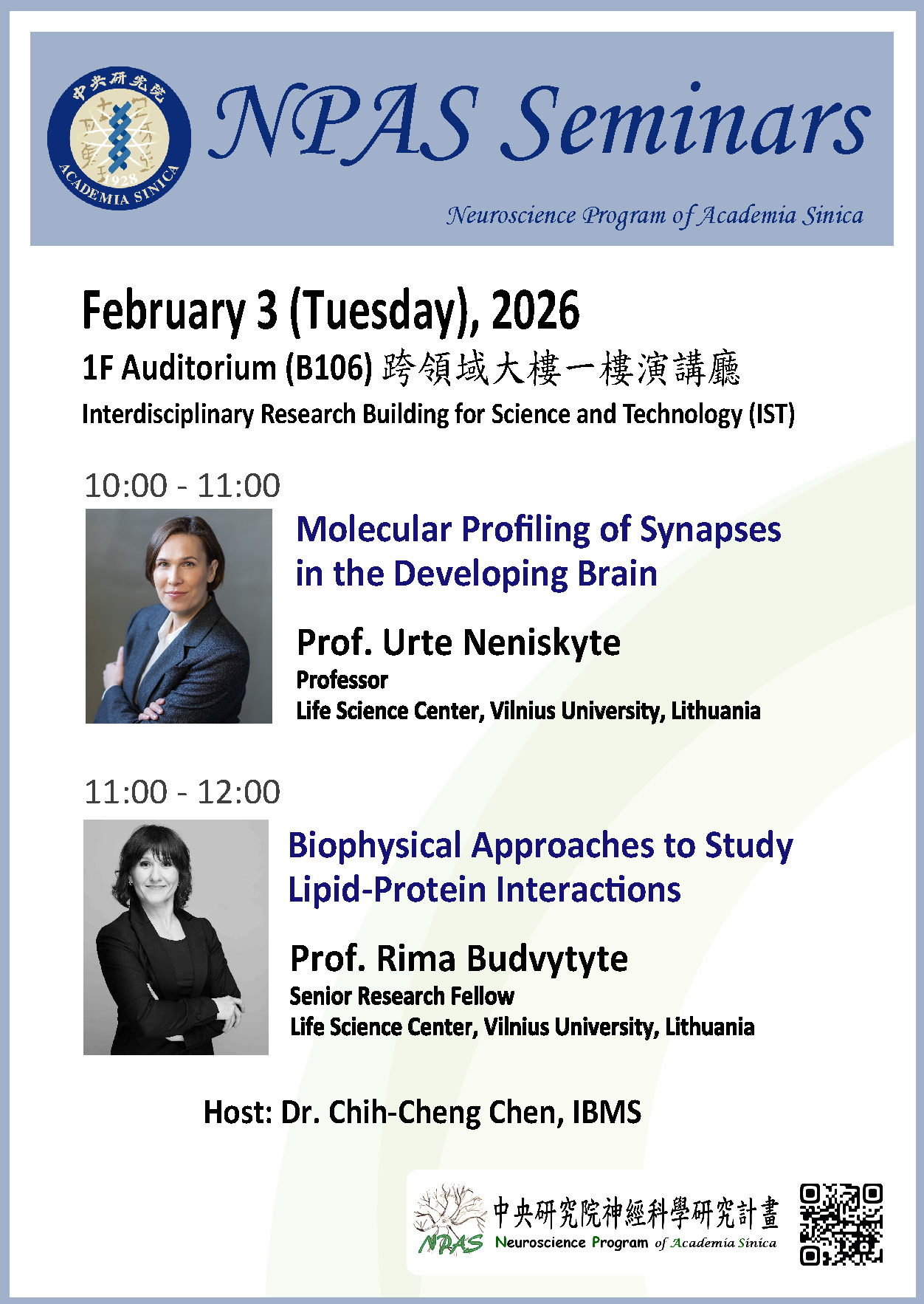
- Lectures
- Institute of Biomedical Sciences
- Location
1F Auditorium (B106), IST
- Speaker Name
Please see the content for more information
- State
Definitive
- Url
2026-02-03 10:00 - 12:00

Schedule:
10:00-11:00 Prof. Urte Neniskyte / Molecular Profiling of Synapses in the Developing Brain
Abstract
Brain development relies heavily on critical periods characterised by heightened synaptic plasticity, facilitating structural and functional alterations in response to sensory stimuli. Once the critical period closes, synaptic plasticity significantly declines. Recent investigations underscore the pivotal role of local protein synthesis at synaptic terminals for critical period plasticity. Neurons, with their complex and polarised structures, require local protein synthesis at presynaptic and postsynaptic sites to update the synaptic proteome, supporting rapid changes in synaptic function. However, the local synaptic biochemical processes initiating synapse elimination remain elusive. To study the local transcriptome changes during a critical period, synaptosomes – isolated synaptic terminals – can be utilised, which can be further enriched by fluorescence-activated synaptosome sorting (FASS). Transcriptomic analysis of local synaptic coding mRNAs and regulatory miRNAs revealed that most synaptic transcripts are involved in cellular transport, synaptic transmission regulation, and local protein synthesis. Comparison of the local transcriptome in immature, peak plasticity, and consolidated visual cortex defined plasticity-, stability, and maturity-associated clusters of synaptic transcripts and their targeting miRNAs, uncovering local mechanisms of regulation in the developing pre-synapse. These findings highlight the intricate molecular adaptations that occur to support synaptic stability and function during neural network maturation.
11:00-12:00 Prof. Rima Budvytyte / Biophysical Approaches to Study Lipid-Protein Interactions
Abstract
Membrane-protein interactions. Biological membrane-related processes such as protein– membrane interactions and cell–cell signalling are highly complex phenomena. Their investigation of whole cells is often very difficult or even impossible. As a cell membrane model, tethered bilayer lipid membranes (tBLM) have been engineered on an Au-monolayer-coated glass slide, providing a long-term stable and universal experimental platform. The tBLM technology enables the assembly of membranes with different lipid compositions and the functional reconstitution of peptides and membrane proteins, allowing for a detailed analysis of protein-membrane interactions and facilitating biosensing applications by sensitive techniques, including the electrochemical impedance spectroscopy (EIS), surface plasmon resonance (SPR), vibrational spectroscopies, and atomic force microscopy (AFM).
Lipid–based nanoparticles for gene delivery via membrane fusion. Lipid-based nanoparticles (LNPs) have been utilized for drug delivery for multiple decades, and the components of LNPs have also been systematically optimized for efficient CRISPR/Cas9 delivery. Our research group is developing and formulating LNPs with improved cellular uptake. Furthermore, we demonstrated that the selected LNPs enable efficient and functional delivery of CRISPR–Cas ribonucleoprotein complexes to mammalian cells. Together, these findings underscore the potential of rationally engineered LNPs as versatile, safe, and effective non-viral delivery platforms for advanced genome-editing applications.