






 Home
Home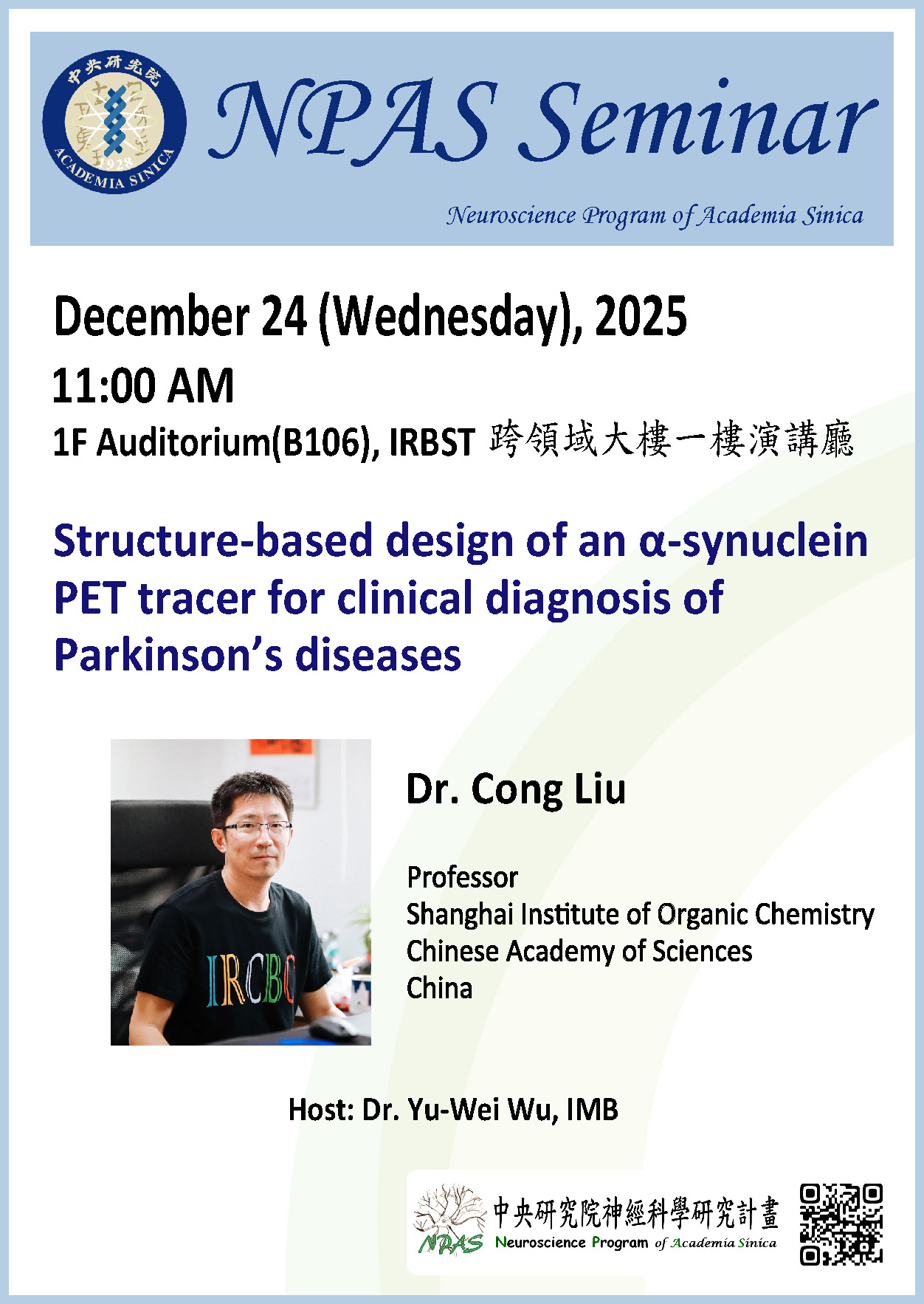
- Lectures
- Institute of Biomedical Sciences
- Location
1F Auditorium (B106), IST
- Speaker Name
Dr. Cong Liu (Chinese Academy of Sciences, China)
- State
Definitive
- Url
2025-12-24 11:00 - 12:00

Biosketch:
The research of Dr. Cong Liu focuses on protein phase separation and pathological aggregation of amyloid proteins in neurodegenerative diseases (NDs) with systematical achievements during his independent research career since 2013. In brief, by combining cutting-edge chemical and biological approaches, Dr. Liu revealed the structural basis of protein pathological aggregation in NDs; demonstrated the regulation mechanism of protein aggregation by disease-related chemical modification; explained at the atomic level how small molecules bind to pathological amyloid fibril; developed new strategies of small molecules modulating protein phase separation for therapeutic application. Dr. Liu published over 100 SCI papers, the majority of which focus on ɑ-synuclein. As the corresponding or co-corresponding author, he published over 70 papers, including Cell, Science, PNAS (10), Nat Struct & Mol Biol (3), Nat Chem Biol (3), JACS (2), Cell Research (6), Nat Commun (10), Angew, Mol Cell, Dev Cell, and Sci Adv.
Abstract:
In various neurodegenerative diseases, the accumulation of protein fibrillar aggregates—such as tau and Abeta in Alzheimer's disease, TDP-43 in frontotemporal dementia, and α-synuclein in Parkinson’s disease (PD)—is a central pathological feature and a diagnostic biomarker. Targeting these amyloid fibrils is crucial for both diagnosing and treating these diseases. In this presentation, I will share our latest discoveries on how ligands interact with amyloid fibrils, a process distinctly different from traditional ligand-protein interactions. Understanding these interactions at the molecular level has enabled the rational design of a novel PET imaging tracer. This PET tracer uniquely binds to pathological α-synuclein fibrils in various contexts, including in vitro, cellular environments, and in animal models of PD such as mice, rats, and marmosets. Our development of this PET tracer marks a significant step forward in enabling early and accurate diagnosis of Parkinson’s disease.