


 首頁
首頁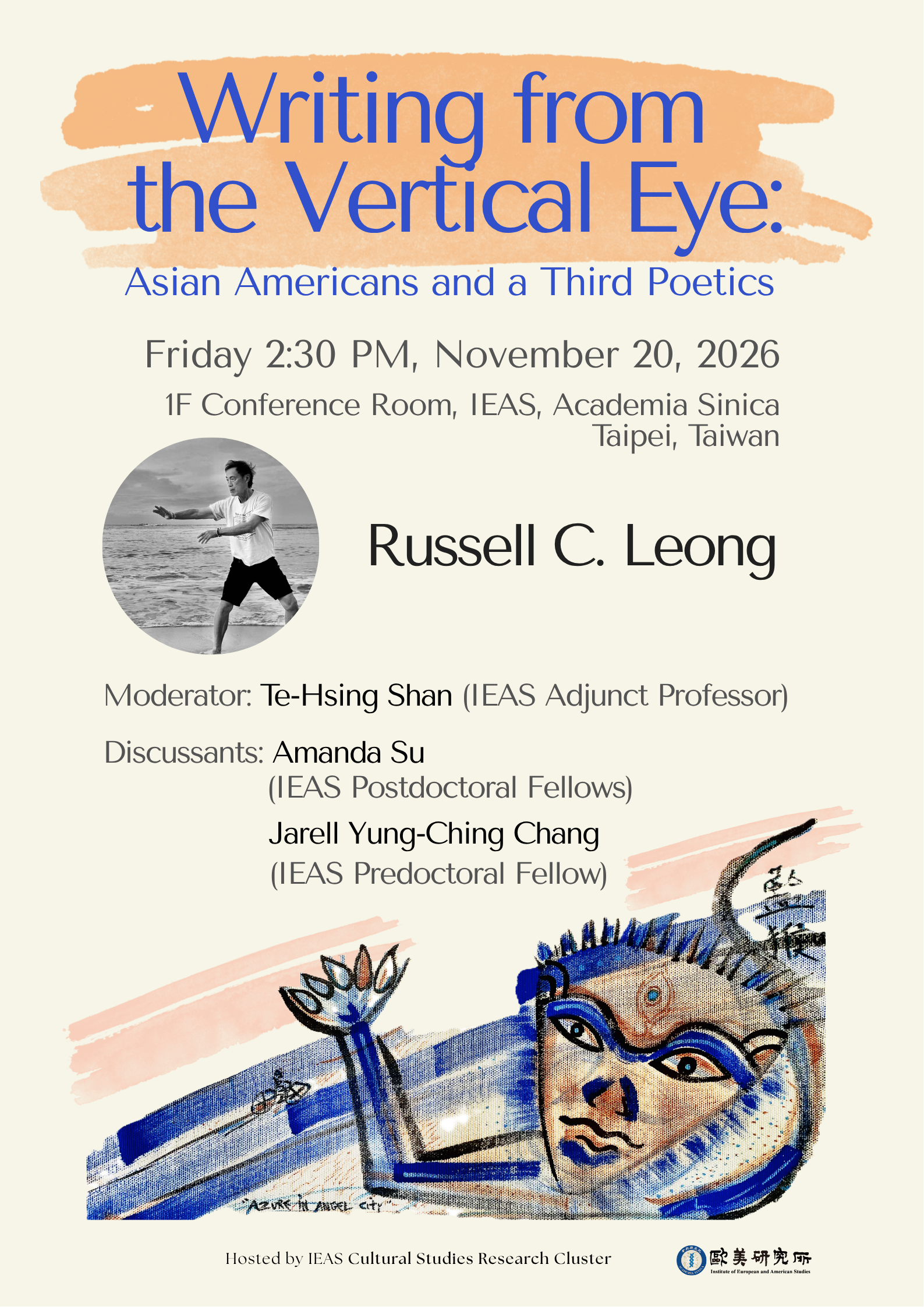
- 演講或講座
- 歐美研究所
- 地點
中央研究院歐美研究所一樓會議室
- 演講人姓名
Russell C. Leong教授(Editor for Creative Projects /Foundations & Futures, UCLA Asian American Studies Center, and Founding Editor, CUNY FORUM: Asian American/ Asian Studies, CUNY Asian American /Asian Research Institute)
- 活動狀態
確定
- 活動網址
https://www.ea.sinica.edu.tw/Content_List_Page.aspx?pid=0&uid=237&cid=65572
2026-11-20 14:30 - 17:00

演講大綱:
How did the convergence of Asian American Studies, the Vietnam War, and anti-colonial movements create the context for a transcultural “third poetics” among some activist Asian American writers?
Some Asian American writers of the 1960s, 70s and 80s, took their ideological cues and literary practices from such diverse sources as:
- the Bandung Conference and Orientalism
- the Women’s Movement and the LGBTQ movement; AIDS and marginalization;
-Aiiiieeeee! The early Asian American anthology that critiqued American racialization, and such diverse literary movements as May 4th movement (1919), Harlem Renaissance Writers (1930s) Taiwan’s Xiangtu Native Literature Movement (1970s), and Latin American, North African, and literatures.
For Chinese Americans there was the “push” of U.S. race, class, gender, and identity politics, while, at the same time, they were subject to the “pull” of global post-cold war recruitment for their “hearts and minds” by both Taiwan and mainland China. Here, Leong argues that Asian American writers, attempted to create a “third poetics” not linked to U.S./Sino relations. Such a poetics was rooted in history and experience yet imaginatively rendered with a third sense of “vertical vision.”. (The “third” has its roots in “Third World” in terms of literature and cinema; the “vertical” in the symbolic third eye of intuitive wisdom of Lord Shiva and other Asian deities; and Third World Liberation (movement for ethnic studies in the 1960s and 70s of which Leong was a part).
Leong utilizes his recent narrative poem as one example of a “third poetics": “Azure in Angel City” (Veritas Review, Cambridge) that follows the life of an allegorical blue monkey born under a blue tarp in the industrial Los Angeles river. His companions are a Chinese martial artist who overstayed his tourist visa, an unemployed Khmer baker, and an indigenous Latino/Tongva man—all denizens of a polluted river once home to native Tonga peoples. In the modern tale (part one), Leong alludes to elements of Journey to the West, Megaduta, and Ramayana, together with a multi-cultural environmental post-industrial, post-covid approach to his themes.