






 首頁
首頁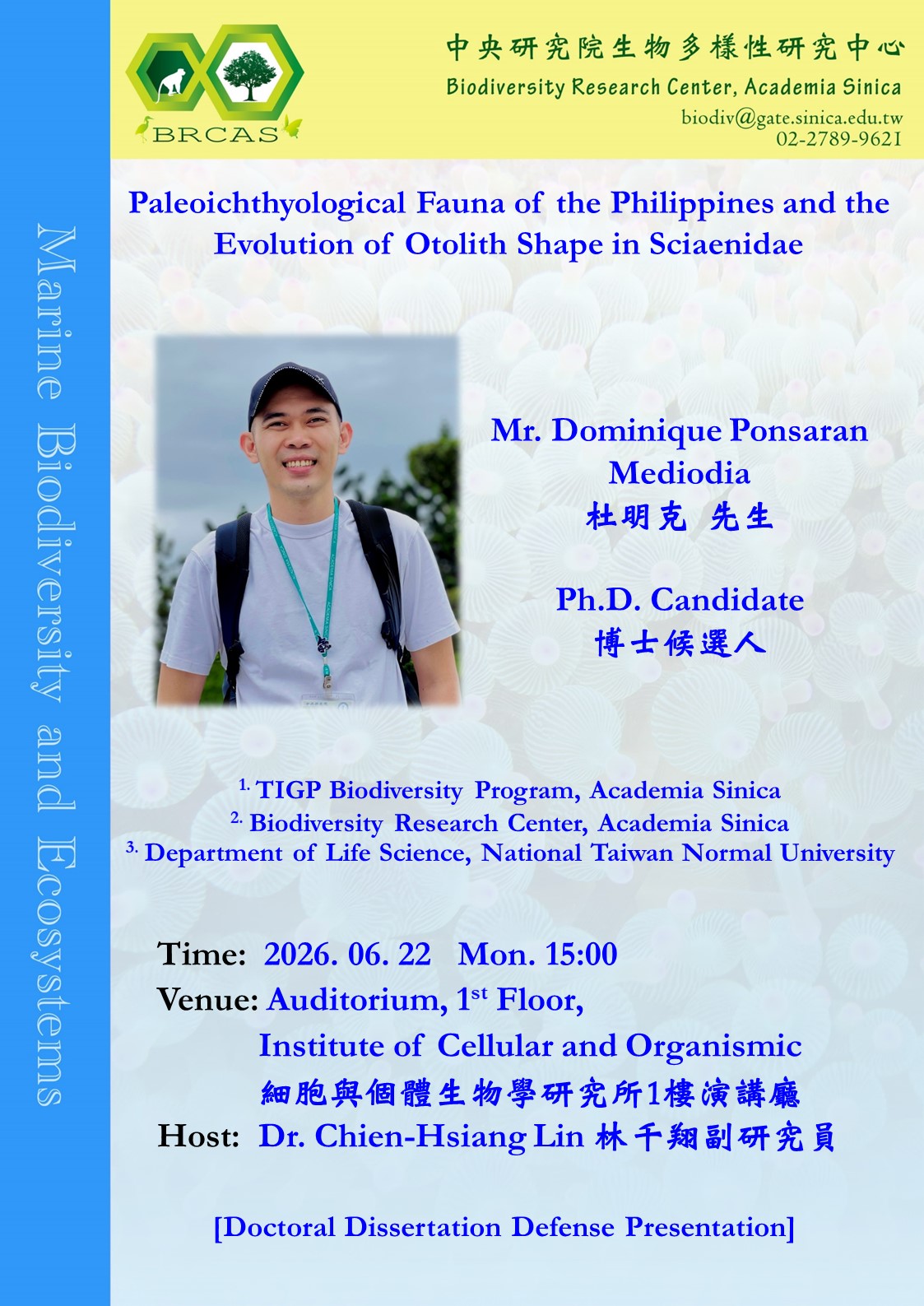
- 演講或講座
- 生物多樣性研究中心
- 地點
細胞與個體生物學研究所1樓演講廳
- 演講人姓名
杜明克 先生 (TIGP, Academia Sinica)
- 活動狀態
確定
- 活動網址
2026-06-22 15:00 - 16:00

Abstract
Fish otoliths are calcified inner-ear structures used for hearing and balance. These structures show high morphological diversity and are often well preserved in the fossil record. Despite this, the use of otoliths for reconstructing past environments, particularly in the West Pacific, remains largely underexplored. At the same time, the evolutionary mechanisms underlying otolith morphological diversification remain poorly understood. In this dissertation, I address these gaps by investigating the paleoichthyological record of the Philippines and by tracing the evolutionary history of otolith shape in the family Sciaenidae, commonly known as croakers.
First, I highlight that fossil fish records in the Philippines remain limited and unevenly distributed. These records have been reported only from three major sedimentary basins and range in age from the Late Oligocene to the Pleistocene. This review also allowed me to identify the major challenges and future directions for paleoichthyological research in the Philippines.
I then expanded the known fossil fish record of the Philippines by describing the paleoichthyological fauna of early Pliocene Cabarruyan Island, Pangasinan. From this locality, 1,225 otoliths were recovered, representing at least 69 taxa from 28 families. These include two new myctophid species, Benthosema rarang and Myctophum luzonicum, as well as 48 new fossil otolith records. The composition of the fish assemblage suggests that the sediments were deposited in an open-marine outer-shelf to upper-slope environment.
Finally, I determined factors that may have influenced otolith shape diversification using high-density three-dimensional geometric morphometrics of extant sciaenid otoliths from 46 genera. My results suggest that the overall sagittal shape retains a weak but more detectable phylogenetic signal than the sulcus. In contrast, sulcus morphology appears to be more labile and may be more responsive to ecological and functional factors that influence shape variation.
Overall, my work highlights otoliths as reliable tools for documenting fish paleodiversity and as informative structures for understanding how morphology and sensory function have evolved in fishes.
Keywords:
Fish otoliths; Philippine paleoichthyology; Sciaenidae; geometric morphometrics; macroevolution.
~歡迎踴躍參加~