

 首頁
首頁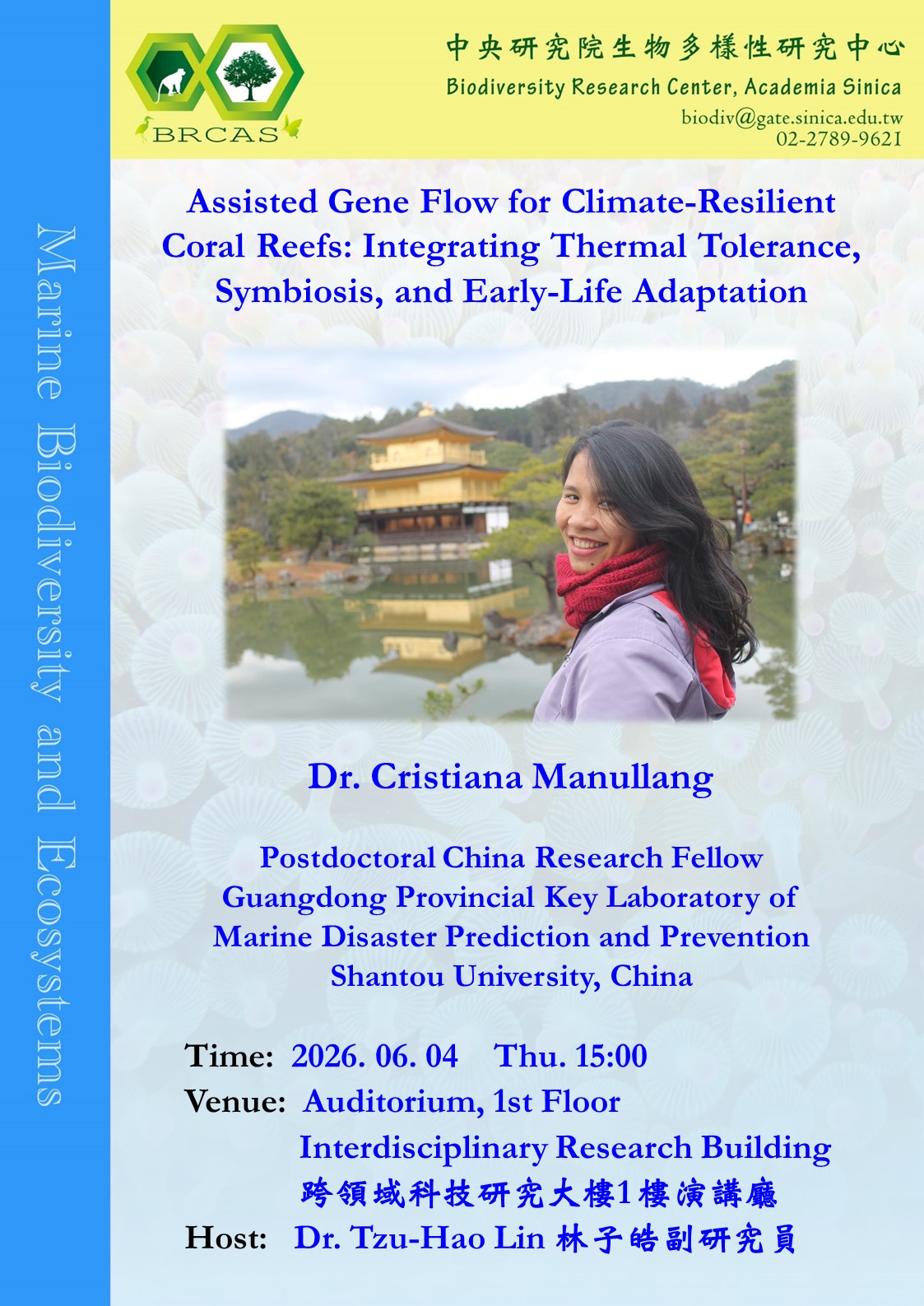
- 演講或講座
- 生物多樣性研究中心
- 地點
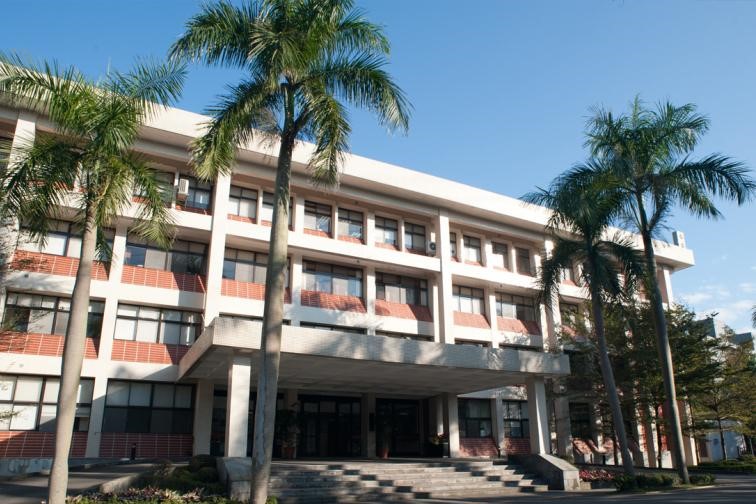
跨領域科技研究大樓1 樓演講廳
- 演講人姓名
Dr. Cristiana Manullang (Shantou University, China)
- 活動狀態
確定
- 活動網址
2026-06-04 15:00 - 16:30

Abstract
Coral reefs are rapidly declining under climate change, with increasing frequency of marine heatwaves driving mass bleaching and ecosystem degradation. Understanding the mechanisms underlying coral thermal tolerance, and translating this knowledge into actionable conservation strategies, is critical for reef survival. However, key uncertainties remain regarding how heat resilience is distributed among coral populations, how it is transmitted across life stages, and whether it can be enhanced through managed interventions. My research focuses on the mechanisms of coral resilience to environmental stress, integrating coral–symbiont interactions, physiological plasticity, and molecular regulation under climate change. Using Acropora coral, I combine field ecology, controlled breeding experiments, physiological assays, and multi-omics approaches to investigate how host genetics, symbiont composition, and stress-response pathways jointly shape coral performance under thermal stress. My previous work has demonstrated strong intraspecific variation in thermal tolerance and early-life-stage stress sensitivity in corals, and has contributed to understanding how environmental factors such as nutrient ocean acidification, ocean warming, and plastic pollution influence coral–symbiont metabolic regulation. These studies provide a foundation for linking molecular mechanisms with ecological outcomes in reef systems. Building on this framework, my future research will establish an experimental platform for testing Assisted Gene Flow (AGF) as a climate adaptation strategy for coral reefs, using Green Island, Taiwan as a natural model system. This program will (1) identify thermally resilient donor populations using physiological and genomic screening, (2) test inheritance of thermal tolerance through controlled crosses under experimental heat stress, (3) evaluate persistence of resilience across juvenile development and symbiont stabilization, and (4) assess ecological feasibility through field transplantation trials. By integrating experimental reproduction, multi-level phenotyping, and field validation, this research will establish a mechanistic and translational framework for coral climate resilience. Ultimately, it aims to bridge fundamental understanding of stress biology with applied conservation strategies, providing evidence-based guidance for reef restoration and climate adaptation in tropical marine ecosystems.