







 首頁
首頁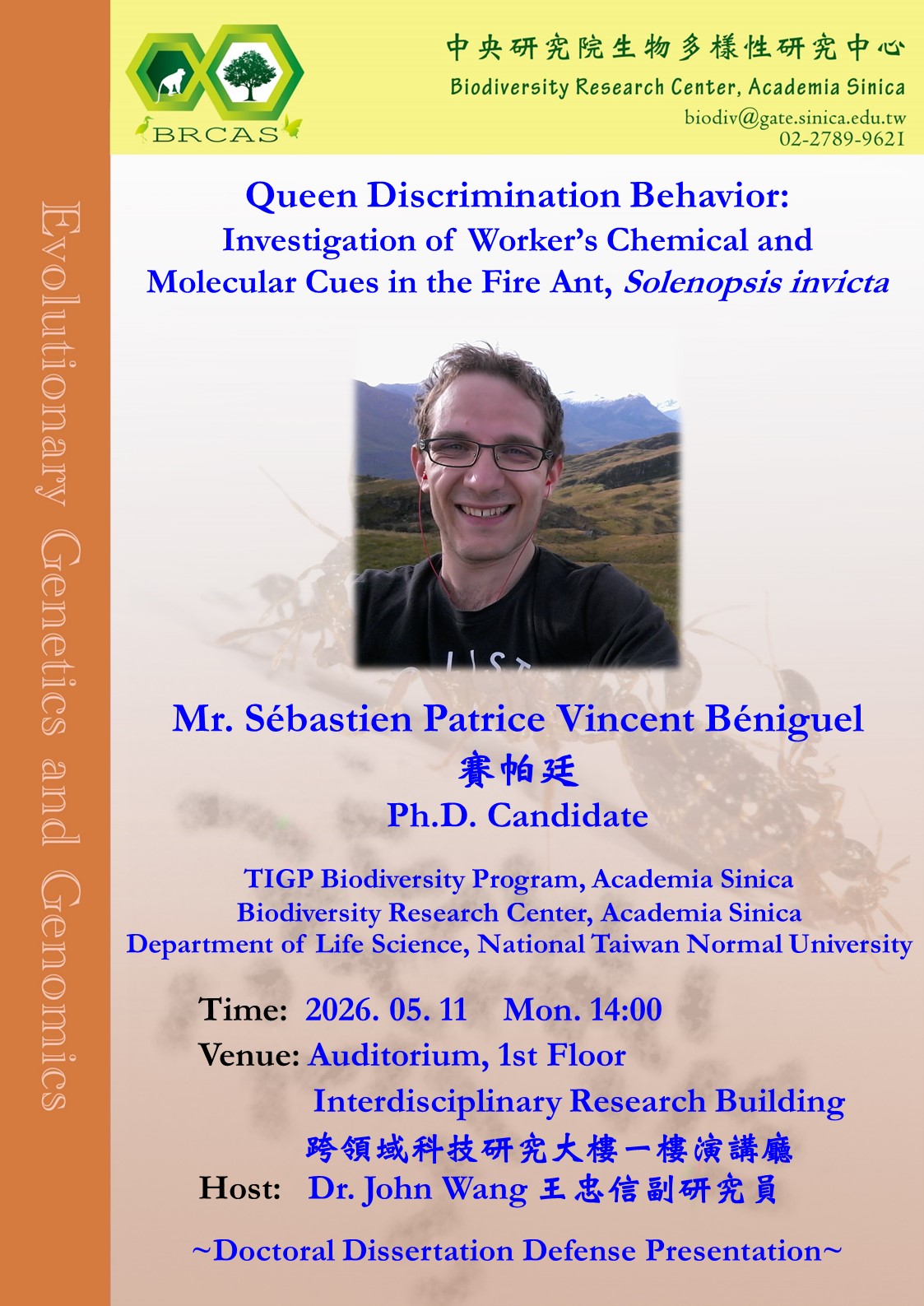
- 演講或講座
- 生物多樣性研究中心
- 地點
跨領域科技研究大樓1樓演講廳
- 演講人姓名
賽帕廷先生(TIGP博士候選人)
- 活動狀態
確定
- 活動網址
2026-05-11 14:00 - 15:00

[Doctoral Dissertation Defense Presentation]
Abstract
Social polymorphism is an intriguing area of research in social insects, but the mechanisms that stabilize alternative social organizations are not fully understood. In the red imported fire ant, Solenopsis invicta, we observe a social polymorphism with monogyne (single queen) and polygyne (multiple queens) colonies, which is associated with variation in a supergene. This thesis aims to identify and validate the molecular and chemical mechanisms underlying queen discrimination from the workers' perspective.
First, I developed and validated a new supergene genotyping method based on polymorphic insertion-deletion (indels) markers within the social supergene. These assays offer a reliable and adaptable alternative for determining colony social structure and facilitate future functional molecular experiments on candidate genes to explain queen discrimination behavior.
Second, I characterized the developmental change in the worker surface chemical profile during the first month of adulthood. While cuticular hydrocarbons (CHCs) showed complex developmental changes, piperidines (venom alkaloids) increased significantly over time and also displayed a social form difference in the proportion of saturated to unsaturated piperidine. Importantly, analyses of individual workers and venom sacs indicated that the saturated-to-unsaturated piperidines were influenced by social environment rather than by worker supergene genotype.
Finally, I explored the feasibility of functional genetic manipulation in S. invicta through CRISPR-Cas9 mutagenesis and piggyBac-mediated transgenesis. We showed that knocking out Gp-9 was not lethal during development, did not cause worker discrimination from wild-type, nor alter the surface chemical profile. PiggyBac-mediated transgenesis results demonstrated that this method is feasible in fire ants but also challenging.
Together, these results demonstrated that the social supergene plays a crucial role in maintaining social polymorphism in S. invicta while enabling phenotypic plasticity at the individual level. Therefore, chemical analysis and molecular tools used to study gene function, as presented in this thesis, added another important step in understanding queen discrimination behavior in fire ants.
~歡迎踴躍參加~