




 首頁
首頁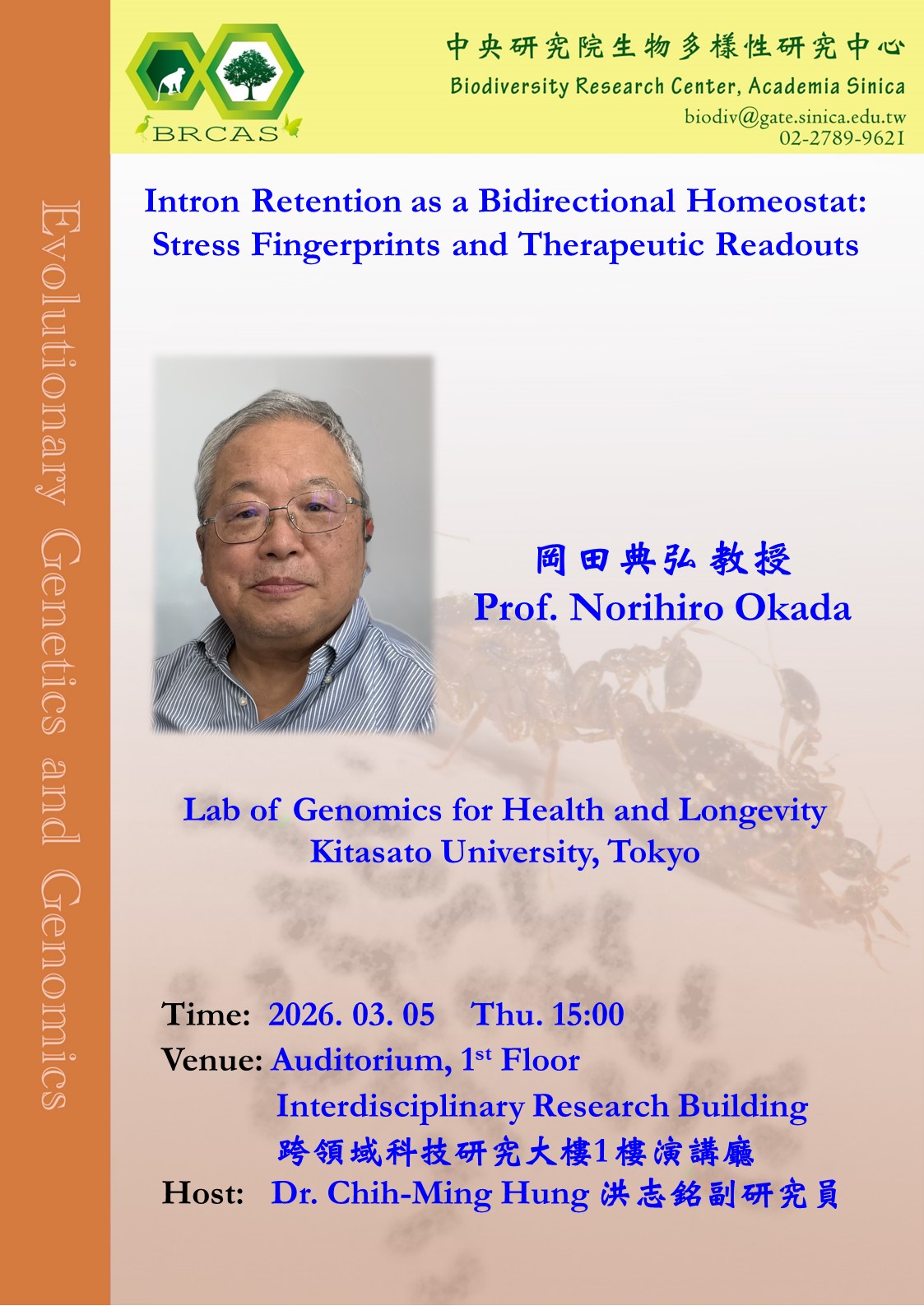
- 演講或講座
- 生物多樣性研究中心
- 地點
跨領域科技研究大樓1樓演講廳
- 演講人姓名
岡田典弘 教授 (Kitasato University, Tokyo)
- 活動狀態
確定
- 活動網址
2026-03-05 15:00 - 16:30

Abstract
Several years ago, we discovered that in an aging mouse model, specific introns from dozens of genes reproducibly accumulate compared with wild-type controls. Strikingly, this “IR load” (intron retention, IR) is not irreversible: it reverts toward a healthy pattern when metabolic status is improved by Japanese herbal medicine. Subsequent work revealed that this is not an aging-specific curiosity but a general response to a broad spectrum of stresses. Importantly, stress elicits a bidirectional IR program—some introns accumulate (IncIR), while others are actively reduced (DecIR). The genes exhibiting these intron changes (IRGs) are stressor-specific, meaning that IRG profiles can serve as molecular fingerprints to identify the type of stressor. Clinical studies further indicate that IR dynamics in patients’ blood can quantify recovery trajectories and even report the efficacy of medications themselves. Together, these observations suggest a unifying model in which stress-induced deviations in protein concentrations are counterbalanced by IR: IncIR dampens protein output, whereas DecIR restores it, thereby functioning as a tunable “IR-Homeostat” that stabilizes the proteome under fluctuating demands. In this presentation, I will introduce the experimental evidence leading to this hypothesis, highlight its testable predictions, and discuss how IR-based readouts could enable stress typing and response-guided medicine. Finally, I will discuss mechanistic routes by which IR may couple RNA processing to proteostasis and how this framework can be validated experimentally.
~歡迎踴躍參加~