

 首頁
首頁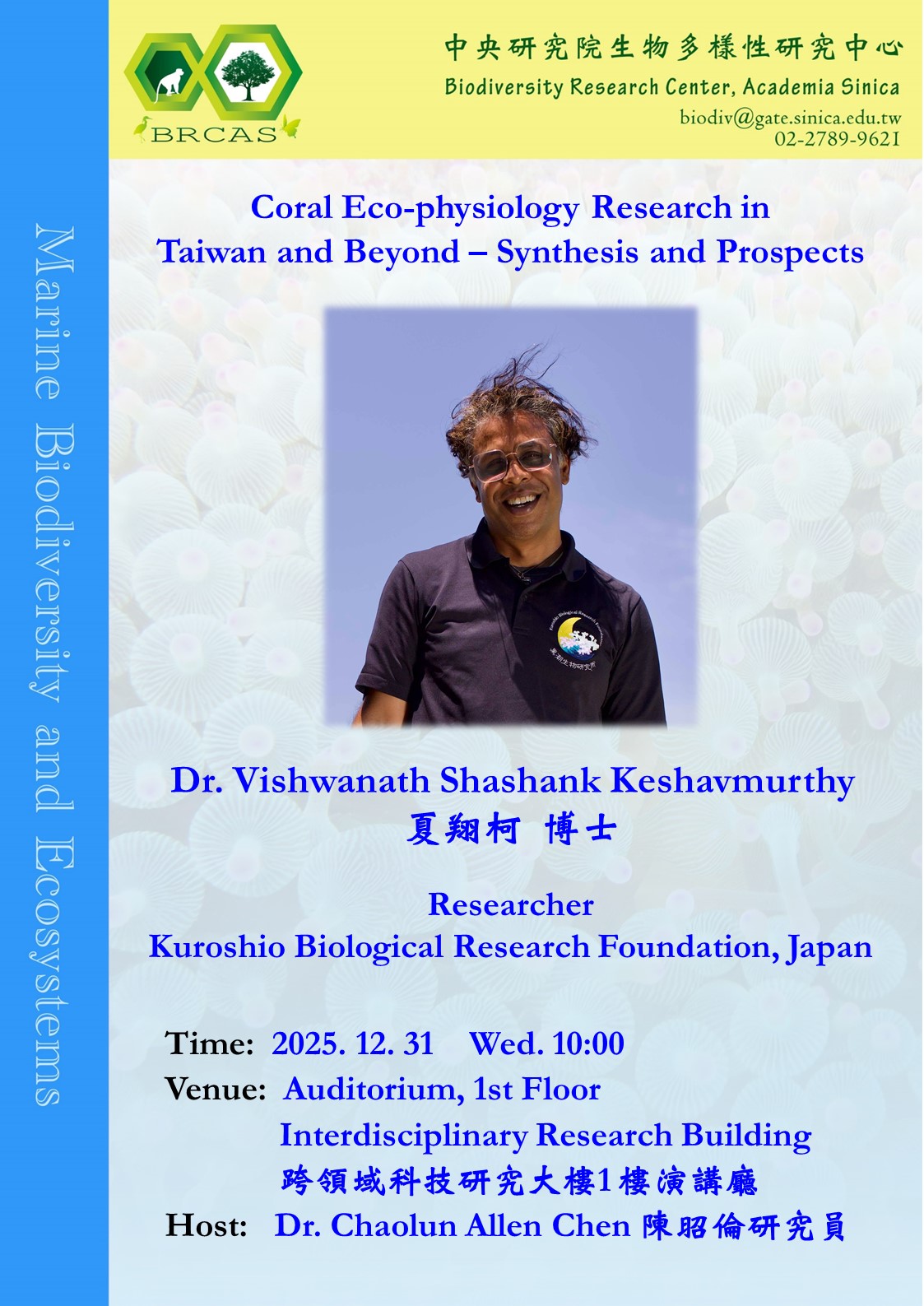
- 演講或講座
- 生物多樣性研究中心
- 地點
跨領域科技研究大樓1樓演講廳
- 演講人姓名
夏翔柯博士(Kuroshio Biological Research Foundation, Japan)
- 活動狀態
確定
- 活動網址
2025-12-31 10:00 - 11:00

Abstract
Taiwan sits at the northern margin of the Coral Triangle influence and along the path of the Kuroshio Current, creating sharp environmental gradients. Taiwan’s reefs, as biogeographic and environmental “crossroads,” offer a powerful natural laboratory, especially areas influenced by the 3rd Nuclear Power Plant in Kenting, for testing hypotheses about acclimatization, adaptation, and assisted resilience. Building on over a decade of work, this synthesis integrates research on coral ecophysiology, with respect to temperature stress physiology from Taiwan, Korea and Japan. including insights into marginal reefs, coral–Symbiodiniaceae flexibility, and mechanistic thresholds for bleaching. Drawing on studies from subtropical and tropical reefs around Taiwan, including sites influenced by the Kuroshio Current and upwelling systems, I show how corals respond to temperature stress at micro- and macro-geographic scales. I highlight findings on thermal tolerance, bleaching susceptibility, and trade-offs in growth, reproduction, and metabolic performance, as well as emerging insights into host–symbiont interactions that underpin resilience. Comparisons with neighbouring regions (e.g. Japan, Korea) reveal both shared constraints and region-specific adaptive strategies shaped by coral species, local environmental variability and disturbance regimes. I discuss how advancing coral eco-physiology in Taiwan and beyond can better inform conservation planning, restoration design, and policy decisions aimed at sustaining reef ecosystem function in a rapidly changing ocean. Key knowledge gaps include limited long-term, integrative datasets; in terms of coral species, and early life-history stages; and insufficient coupling of experimental and field studies. Hence, the future research priorities for coral and coral communities in Taiwan and beyond are, (i) coordinated long-term eco-physiological observing networks; (ii) mechanistic, multi-stressor experiments reflecting realistic environmental variability; and (iii) cross-scale integration of physiological, genomic, and microbiome data. Collectively, these directions can leverage Taiwan’s unique seascape to advance predictive coral eco-physiology and inform management of coral reefs in a rapidly changing ocean.